
FGD and DeNOx
NEWSLETTER
November 2019
No. 499
Table
of Contents
MARKETS
FGD Market offers Billions of Dollars of Profits
INDUSTRY NEWS
CCR/ELG
Compliance Webinar
Balkan Coal
Plants failing to Meet European Union Stand
Most Indian Coal
Units Won’t Comply with Pollution Standards by 2022
KEK to Get €76 Million Grant to
Cut Pollution from Kosovo B Power Plant
Thermax Q2 Order Booking Up 28%,
Revenue Higher By 12.5%
Carper and
Alexander defend Mercury Rule
ADES Profits from Refined Coal
Fuel Tech
Awarded Air Pollution Control Orders Totaling $2.1 Million
B&W Generated
Consolidated Adjusted EBITDA of $10.1 Million in the Third Quarter
Hamon displayed a Range of
Equipment and Services
CECO displayed NOx Control Systems, Precipitator
Controls and Dampers
Improving
Limestone Scrubber Efficiency
Libra provides
Ceramic Pumps and Impellers
Duechting
Ceramic Pumps demonstrate Lowest Cost of Ownership in U.S. Cement Plant
Sunbo Supplies
FGD Pumps and Parts from Chinese Factory
Hanhe is a
Chinese FGD Pump and Parts Supplier with exports to India
CONTINUING OF IMPORTANT TOPICS AT POWER-GEN
KSB is a Service Partner for the entire Product Life Cycle
Benefits of Advanced Rubber Joint Arrangements
MARKETS
FGD
Market offers Billions of Dollars of Profits
More
than $50 billion per year will be spent on the systems, parts, consumables and
services by power companies to build and maintain flue gas desulfurization (FGD)
systems. If these systems are not meeting SO2 emission limits the
power plant must cease operations. All the elements of severe service are
present: corrosion, temperature, and abrasion. As a result, power companies are
focused on buying products with the lowest true cost. This translates into
billions of dollars of potential profits for suppliers.
These
profits are achievable by identifying the potential for each customer, providing
evidence of the lowest true cost and then convincing the customer (validating
the claims).
A
cost-effective program is available. FGD Most Profitable Market Program costs
less than $10,000 per year. It includes customized forecasts for each country
and each purchaser for any one of the following.
|
Chemicals |
Ball Mills |
Instrumentation |
|
Compressors |
Lime |
Scrubbers - Wet |
|
CEMS |
Valves |
Pumps |
|
Filters |
Mist Eliminators |
Scrubbers - Dry |
|
Filter Belts |
Nozzles |
Stainless Alloys |
|
Fans |
Limestone |
Remote Monitoring |
|
Filter Bags |
Controls |
Pneumatic Conveying |
This
is an extension of
http://home.mcilvainecompany.com/index.php/markets/air/n027-fgd-market-and-strategies.
Identification of each purchaser and weekly project tracking is included in
http://home.mcilvainecompany.com/index.php/databases/42ei-utility-tracking-system.
The
validation process with customers is accomplished through
http://home.mcilvainecompany.com/index.php/silobusters/44i-coal-fired-power-plant-decisions.
This
service allows the purchasers to conclude which products have the lowest true
cost. Here is a link to one of the recent webinars
https://youtu.be/1GSbwSiTZrE.
The
broader Most Profitable Market Program is detailed at
www.mcilvainecompany.com.
Bob
McIlvaine can answer your questions at
rmcilvaine@mcilvainecompany.com;
direct 847-784-0013 and cell 847=226=2391.
INDUSTRY NEWS
CCR/ELG Compliance
Webinar
A
free live webinar on the proposed CCR/ELG rules was undertaken December 3. by
Burns & McDonnell‘s professionals who have hands-on experience with these
projects. The three presenters, who together have executed CCR/ELG projects
and/or studies for 126,000 megawatts across 300 units in the fleet, delved into
what exactly has changed, outline your next steps for compliance and discussed
real-world scenarios of how the new regulations would be applied to various
facility types and retirement dates. The presenters were Jason Eichenberger, PE,
CCR Disposal Specialist, Tisha Scroggin-Wicker, PE, Wastewater Treatment
Specialist and Mike Roush, PE, CCR Handling Specialist.
Balkan Coal Plants Failing to Meet European Union Standards
The
Energy Community (EC) has warned that all member countries that have coal plants
in their energy mix do not comply with standards for at least one of nitrogen
oxides, sulfur dioxide and dust emissions. Kosovo breached all three emission
limits while Bosnia and Herzegovina and North Macedonia did not comply with
sulfur dioxide and dust standards. Moldova did not report its annual emissions
for 2018. The EC is an organization between the European Union and nine
Southeast European countries seeking to establish a pan-European energy market.
The EC’s Deputy Director, Dirk Buschle, warned that the there was a need to
reform the EC treaty to improve its enforcement mechanism so that, for example,
Bosnia and Herzegovina’s lack of compliance with the state aid rules in relation
to the Tuzla 7 coal-fired power plant could be addressed.
Most
Indian Coal Units Won’t Comply with Pollution Standards by 2022
An
analysis of Central Electricity Authority (CEA) data reveals that over half of
India’s 440 coal units will not comply with new pollution standards by early
2022, even though the Association of Power Producers (APP) argued that it would
take between 27 and 30 months for flue gas desulfurization (FGD) units to be
installed. FGD units dramatically reduce sulfur dioxide emissions. The Indian
Government’s original deadline was for all coal plants to comply with the new
pollution standards by December 2017 but, following lobbying by the APP, which
represents companies including Adani Power, the deadline was extended until
December 2022 with a staggered timetable for compliance. The CEA data indicates
that 267 units, which have a combined capacity of 103,400 MW, are scheduled to
comply with the standards by February 2022. However, the owners of 224 units,
which have a capacity of 84,800 MW, have not yet ordered FGD units.
KEK to Get €76 Million Grant to Cut Pollution from Kosovo B Power Plant
Kosovo Energy Corp.
(KEK) has announced Kosovo will receive a €76 million grant from the EU’s
Instrument for Pre-accession Assistance
(IPA) for a project to reduce air pollution from the Kosovo B coal-fired power
plant.
The
implementation of the project, which involves the replacement of the Kosovo B
power plant’s electrostatic precipitator, is expected to start within six
months.
After
the completion of the project, the Kosovo B power plant will operate in line
with EU standards by 2021, KEK said, adding that the EU office in Kosovo is in
the final phase of project preparation. KEK also recalled that it has invested
around €60 million in environmental protection projects in the past ten years.
As
much as 98 percent of electricity generated in Kosovo comes from two old,
inefficient and highly-polluting lignite-fired power plants, Kosovo A and Kosovo
B. According to a World Bank report on
Kosovo’s energy sector, citizens suffer power shortages due to insufficient
output, aging grids, and electricity thefts, the media recalled.
The European
Commission has also warned that Kosovo continues to
rely on the highly-polluting lignite, even though some progress has been seen on
renewables. In a report, the European Commission recommended, among others, that
Kosovo should prepare for the decommissioning of the Kosovo A power plant and
the environmental upgrade of Kosovo B.
According to earlier reports, the Kosovo government plans to build a new
coal-fired power plant, in a project that is expected to cost more than €1
billion. The planned Kosova e Re power plant would have an installed capacity of
500 MW.
Thermax Q2 Order Booking Up 28%, Revenue Higher By 12.5%
For
the 2nd quarter of Fiscal Year 2019-20, Thermax posted consolidated
operating revenue of Rs. 1606 crore, up 12.5 percent as compared to Rs. 1428
crore in the corresponding quarter, last year.
Profit after tax (PAT) stood at Rs. 26 crore as compared to Rs. 75 crore
(includes company's share of profit/loss in joint venture) in 2nd
quarter.
As on
September 30, 2019, Thermax Group had an order balance of Rs. 5334 crore (Rs.
6411 crore) down 16.8 percent. Order booking for the quarter, at the
consolidated level, was at Rs. 1723 crore (Rs. 1344 crore), up 28.2 percent. The
Environment segment of the company has bagged Rs. 471 crore Flue Gas
Desulfurization (FGD) order during the quarter.
On a
standalone basis, from continuing operations, Thermax posted an operating
revenue of Rs. 838 crore for the quarter, compared to Rs.758 crore in the
corresponding quarter of the previous year. PAT for the quarter remained the
same as last year's Rs. 39 crore.
Carper
and
Alexander Defend Mercury Rule
U.S. Senators Tom Carper (D-DE), top Democrat on the Environment and Public
Works Committee and Lamar Alexander (R-TN), chairman of the Energy and Water
Development Appropriations Subcommittee, penned an op-ed published in
USA Today defending the Mercury and
Air Toxics Standards (MATS), protections that have cost-effectively reduced
toxic air emissions from power plants since 2012. In the op-ed, Senators Carper
and Alexander urge the Environmental Protection Agency (EPA) to reverse
course on their December 2018 proposal undoing the mercury rule, writing that it
has improved public health and supported economic growth in Delaware, Tennessee
and throughout the country.
“The mercury rule, which limits mercury emissions from coal- and oil-fired power
plants, has resulted in 90% less mercury in the air than a decade ago. But now,
the Environmental Protection Agency is moving forward with a proposal that
asserts it is no longer ‘appropriate and necessary’ to protect the public from
our country’s largest sources of mercury and air toxic emissions,” the senators
wrote.
The senators continued, “Changing the rule after billions of dollars have
already been spent means that utilities will have less certainty about federal
regulations, and it will be more difficult to maintain steady electricity prices
for American families in the future. The gains we have made over the past decade
to protect children and families from dangerous mercury pollution should not be
lost.”
ADES Profits from Refined Coal
L.
Heath Sampson, President and CEO of
ADES commented, "During the 3rd quarter Tinuum was able to
identify and secure tax-equity investors for two additional refined coal
facilities. The incremental tonnage contracted by these two transactions brings
our year-to-date total to roughly 15 million tons, comfortably exceeding our
previous guidance of 12 million. We've been very pleased with this progress;
however, coal-dispatch pressure and utility closures have impacted our total
expected RC cash flows. We have updated these RC cash flows and they will
continue to support our capital allocation priorities and our organic investment
in our activated carbon growth channels. Additionally, we are now more
optimistic related to Tinuum's ability to obtain incremental cash flows through
additional RC facility closures."
Highlights
Recognized consolidated revenues of $19.1 million compared to $5.1 million in the 3rd quarter of 2018.
Fuel Tech Awarded Air Pollution Control Orders Totaling $2.1 Million
Fuel Tech, Inc.
announced the receipt of multiple air pollution control (APC) contracts from
customers in the US and Europe. These awards have an aggregate value of
approximately $2.1 million.
An
order was received for a Selective Catalytic Reduction (SCR) system for an
industrial process unit firing natural gas located in the United States. The
scope includes Fuel Tech’s SCR and UDI™ Urea Direct Injection technologies,
along with ancillary systems to reduce nitrogen oxide (NOx) emissions
from a metal processing line. Fuel Tech’s UDI process, similar to their ULTRA®
technology, provides the safe use of urea reagent where SCR is used to reduce NOx,
eliminating the hazards associated with the transport, storage and handling of
anhydrous or aqueous ammonia. Equipment deliveries are expected to be completed
in the third quarter of 2020.
A
contract was received for an ULTRA® system that will be installed on
a natural gas-fired steam boiler in the western United States retrofitted with
SCR technology. This ULTRA system is a permanent system on a unit where a
temporary ULTRA rental unit replaced a competing technology. Equipment delivery
will be in the first quarter of 2020.
In
Europe, several change orders to three existing contracts for SCR related
systems were also received. Work will be completed in the fourth quarter of
2019.
B&W
Generated Consolidated Adjusted EBITDA of $10.1 Million in the Third Quarter
Babcock & Wilcox Enterprises, Inc.
("B&W Enterprises") announced 3rd quarter 2019 GAAP loss from
continuing operations improved by $47.2 million to a loss of $57.0 million
compared to a loss of $104.1 million in 3rd quarter 2018. Adjusted
EBITDA also improved by $36.8 million to a positive $10.1 million compared to
negative $26.7 million in the prior year period, resulting in the company's
second consecutive quarter of profitability in 2019 on an adjusted EBITDA basis.
"Our
performance in the 3rd quarter of 2019 builds on last quarter's
improvements following our improved operational performance and cost-saving
efforts. Our consolidated business continued to show increasing operating
margins and for the second consecutive quarter the company was profitable on an
adjusted EBITDA basis. Our Babcock & Wilcox segment continued its solid
performance and across the company we are showing steady progress on our
strategy to improve profitability by focusing on our core strengths and reducing
unnecessary G&A," said Kenneth Young, B&W Enterprises Chief Executive Officer.
"With our equitization transactions completed in July, we are working to
re-finance our existing credit facility to support our growth. As 2019 draws to
a close, we are demonstrating the underlying core value of our businesses to our
customers and shareholders and laying the foundation to leverage new
opportunities on a worldwide basis."
"We're continuing to implement our cost-savings initiatives, for $119 million in
annualized savings," said Lou Salamone, B&W Enterprises Chief Financial Officer.
"Approximately $106 million of these initiatives have now been implemented and
we are aggressively looking for further ways to streamline our operations while
maintaining our focus on our customers and quality. As we turn toward 2020, we
expect to see improvement each quarter as our cost-savings measures continue to
translate to bottom-line results. We are also seeing our new opportunity
pipeline increase for our core technologies across the Babcock & Wilcox, Vølund
and SPIG segments globally.
The
company's focus on core technologies and profitability, as well as completion of
the EPC loss contracts, were the primary drivers, as expected, of a decline in
revenue compared to the 3rd quarter of 2018. Consolidated revenues in
3rd quarter 2019 were $198.6 million, down 33 percent compared to 3rd
quarter 2018. The sales of Palm Beach Resource Recovery Corp. ("PBRRC") in the 3rd
quarter of 2018 and Loibl, a materials handling business in Germany in the 2nd
quarter of 2019; and a lower level of activity on SPIG legacy loss contracts and
lower volume of new build cooling system services in the SPIG segment following
a change in strategy to improve profitability, also drove the decline in
revenue.
Babcock & Wilcox segment revenues decreased 15.3 percent to $161.8 million in
the 3rd quarter of 2019 compared to $191.1 million in the prior-year
period, primarily attributable to lower volume related to the periodic nature of
large construction new build projects.
SPIG
segment revenues decreased 70.4 percent as expected to $10.3 million in the 3rd
quarter of 2019 compared to $34.8 million in 3rd quarter 2018, mainly
due to a lower volume of new build cooling system projects as anticipated
following the change in strategy to more selectively bid and focus on core
geographies and products to improve profitability.
Vølund & Other Renewable segment revenues were $32.4 million for the 3rd
quarter of 2019, compared to $76.5 million in 3rd quarter 2018. As
expected, 3rd quarter revenues were lower compared to the prior year
quarter due to the completion of the EPC loss contracts; the sales of PBRRC and
Loibl, which had previously generated annual revenues of approximately $60
million and $30 million, respectively; and a shift to a core technology business
model, partially offset by the startup of two operations and maintenance
contracts in the U.K.
Hamon Displayed a Range of Equipment and Services at Power-Gen
Hamon provides a full range of aftermarket services for existing particulate
control, emission control, cooling systems, heat recovery systems, and chimneys.
It specializes in developing cost-effective solutions to the operational
challenges of installed equipment regardless of original manufacturer
Hamon is a major supplier of both wet and dry cooling towers. Hamon has been
awarded the order for the natural draft cooling tower for the Nizhnekamsk power
plant. The Nizhnekamsk project is a new combined cycle power plant of 495 MW
located in Tatarstan, Russia.
Hamon launched a new Standardized and Modularized Fabric Filters concept:
Plug & Play Fabric Filters have been developed and tested to meet the
needs of the industry, worldwide and at a very competitive price. The following
people will be at the Hamon stand and can be contacted in advance to arrange
meetings.
Hamon Custodis & R-C Cooling – John Boone, President
–
john.boone@hamon.com
908-333-2026.
Hamon Deltak – Ron Meyer
–
rmeyer@hamon.com
–
763-557-7457.
Hamon Research-Cottrell – Neil Dahlberg -
neil.dahlberg@hamn.com
617-510-1274
and Buzz Reynolds
buzz.reynolds@hamon.com
908-578-0693.
CECO Displayed NOx Control Systems, Precipitator Controls and Dampers
at Power-Gen
The company was an exhibitor at Power-Gen. It has a Record Backlog of
$237.8 million, compared with
$182.1 million as of
December 31, 2018 and says that the energy sector has been strong.
CECO's Chief Executive Officer Dennis Sadlowski
commented, "I am very pleased with our team's execution during the quarter which
generated triple digit bookings, strong profitability and a record backlog for
the company. Our investments are continuing to pay off as we realized sequential
quarterly growth in all our key financial metrics. Our strong third quarter
bookings, led by our Energy Segment, and our record backlog are the best
predictors of the future, signaling improving revenue going forward."
The company supplies SNCR and SCR systems and a range of diverter, guillotine
and diverter dampers for both coal and gas applications.
To arrange a meeting at the stand on dampers you can contact
Jeff Korth
|
Vice President of Sales
Effox-Flextor
C: +1.513.295.5493|
JKorth@OneCECO.com
.
Improving Limestone Scrubber Efficiency
U.S.
and Indian FGD operators both are interested in higher SO2 removal
efficiency. In the case of U.S. operators faced with operating higher cost old
plants, the potential to cut pump-connected horsepower is appealing. For Indian
operators there is the potential to reduce capital as well as operating costs.
Three options involve scrubber design. scrubber chemicals, and optimization
systems.
Relative to scrubber design there are the following choices:
Another alternative is to use dibasic acid or another chemical to enhance
scrubber efficiency. Some plants in
Europe add lime during periods when higher efficiency is needed.
India
is moving forward with approximately 100,000 MW of FGD systems. This will
require 15-20 million of tons of
limestone per year. SHI-FW has conducted a study which shows that because of the
poor limestone a CFB scrubber is the best choice for many plants.
This
analysis is based on a 300-MW plant
with 0.6 percent sulfur. Limestone cost is 7 rs Crore /yr. ($989,000) based on 5
tons per hour and a cost of limestone at
1750 rs./ton ($ 24.50/ton) vs EPA cost estimates based on $30/ton. The
tons/MW = 134.7.
Scrubber additives can improve the economics when using a poor-quality
limestone. One answer is that if treatment chemicals can be justified for a 0.6%
sulfur coal, they will be even more attractive for higher sulfur coals.
Here
is the CEA specification for Indian Limestone.
Brad
Buecker of Chemtreat has reviewed this analysis and concludes, “With regard to
the analysis, the CaO range equates to a calcium carbonate (CaCO3)
range of 82 to 91 percent. A quick thought suggests that this might be an
excellent application for ChemTreat’s DBA replacement product. A general
rule-of-thumb that I always followed is that limestones with 94 percent or
greater CaCO3 concentration are usually quite reactive (if ground
properly). My gut feeling says that the stones outlined in the analysis could be
significantly enhanced in reactivity using our FGD1105 product.”
Brad
wrote an article in Power Engineering
earlier this month where he provided further details:
“Many
plants do not have access to such high-purity limestones. The stone may contain
a significant concentration of dolomite (MgCO3∙CaCO3) or
inert materials that inhibit reactivity. Thus, supplemental methods are needed
to boost the reactions. A common method that has been used for years is addition
of dibasic acid (DBA) to scrubber process streams, but new technology is
improving upon this chemistry. Dibasic acid is a generic name for a blend of
relatively short-chain dicarboxylic acids (two COOH functional groups), which
add hydrogen ions (H+) to help in the dissociation of limestone, and
then circulates through the process to continue assisting with SO2-absorption
chemistry. However, the availability, cost, and even efficiency of DBA has
placed limits on the chemical’s effectiveness. An alternative is available that
is much more promising for wet FGD reactivity enhancement.”
Personnel at the Longview Power Plant in Maidsville, WV had faced constant
problems with handling and feeding DBA to the wet-limestone scrubber of their
770-MW supercritical steam generator. For example, the product must be kept warm
to prevent solidification. Exacerbating the issues were DBA delivery
constraints, both from a distance perspective and that the tank volume had to be
lowered to less than 10 percent before introduction of a fresh load. Combined,
these factors affected scrubbing efficiency and SO2 removal, the
latter of which is a critical aspect of scrubber operation. Violation of
discharge permits can result in load restrictions or forced shutdowns.
Accordingly, the plant staff began full-scale testing and then subsequent
application of an alternative, specially-formulated organic acid blend with the
product name of FGD1105 (patent pending). Almost immediately upon chemical
addition, SO2 emissions dropped by approximately 35 percent to 40
percent, such that even at full load one of the scrubber’s five recycle pumps
could be, and was, removed from service. Stack SO2 emissions only
slightly increased from 120 lb/hr to 200 lb/hr following the pump reduction.
This action alone reduced auxiliary power consumption by 3 MW, at a projected
annual benefit of approximately $700,000. As a test, the plant staff removed a
second recycle pump from service and found that SO2 removal was still
more efficient than in the period prior to the FGD1105 addition. According to
Chad Hufnagel, Longview’s Plant Manager, the ability to operate with 3 recycle
pumps instead of 4 or 5 has provided additionally flexibility for recycle pump
maintenance strategy, as well as offering additional net revenue opportunity
with improved unit efficiency.
Therefore, the cost saving is more than $700,000/yr. less the cost of the
additive. There are other questions to pursue such as changes to wastewater
treatment costs. This analysis is based on a spray tower. If a tray tower or rod
deck scrubber is used, then the saving would have to be in fan rather than pump
horsepower. Another question to be answered is the parasitic cost of power for
the average Indian plant versus that in the U.S.
The
McIlvaine Coal Fired Power Plant
Decisions has a number of relevant papers. They include
INVISTA DBA Dibasic Acid - The McIlvaine Company.
www.mcilvainecompany.com/Decision_Tree/subscriber/Tree/DescriptionTextLinks/Richard...
There are a number of suppliers of DBA around the world. They include:
FGD
Scrubber Monitoring and Control:
The
use of the right chemicals is only part of the true cost reduction. Monitoring
and control of parameters is equally important. The CEMS system should be used
for process monitoring. In the case above the system could operate with 3, 4 or
5 pumps depending on the reactivity of the limestone. However varying sulfur
levels in the incoming coal provide another variable. If SO2 is
measured prior to the scrubber as well as at the stack the right balance between
efficiency and energy consumption can be determined.
The
measurement of liquids is also important. Brad Buecker addressed this subject in
an older Power Engineering article.
He pointed out that it is important to constantly measure the alkalinity in the
scrubber module or modules, as too much alkalinity will waste reagent while lean
alkalinity will impair SO2 removal. The technique universally
employed in wet scrubbers is pH monitoring. These measurements must be
continuous, with control of reagent feed rates based upon the readings. For the
lab staff, grab-sample pH analyses are very important to make sure that the
in-line probes/monitors are accurate.
The
slurry circulating pumps can only handle so much mass before electrical
requirements are exceeded. Like pH, scrubbers are equipped with continuous
density monitors, typically utilizing radioactive detectors. Again, the lab
staff needs to monitor density on a grab sample basis to ensure the accuracy of
the continuous instruments.
Control of solids chemistry offers interesting challenges and is extremely
critical to operation. Experience has shown that operation in either a
completely oxidized state (no calcium sulfite-sulfate hemihydrate in the
scrubbing slurry) or a completely un-oxidized state (no gypsum in the slurry)
minimizes scaling in the scrubber. Scale buildups can be extremely problematic,
as deposit formation on scrubber internals and subsequent gas flow restrictions
may cause unit de-rates and even forced outages if gas flow is severely
restricted.
The
technique that has proven itself very well for scrubber solids analysis is
thermogravimetry. A thermogravimetric analyzer (TGA) is a quantitative not a
qualitative instrument, so the operator needs to have a good idea of the primary
constituents in the sample before analysis. If the sample compounds decompose at
distinct and separate temperatures, it becomes easy to calculate the
concentration of the original materials. Wet-limestone scrubber byproducts lend
themselves well to this technique.
https://www.power-eng.com/2008/07/01/properly-monitor-your-scrubber-chemistry/
The
plant can vary the number of pumps in operation. An optimization system enables
the plant to use the minimum number of pumps required to keep the outlet SO2
lower than limits. This also reduces the amount of limestone slurry required,
but the major contributor to cost savings is cutting energy use by removing one
or more recirculation pumps from service based on the input SO2
value. One optimization system available was described by Toshihiko Fujii of
Yokogawa Electric Corp.
in a recent Power Magazine article.
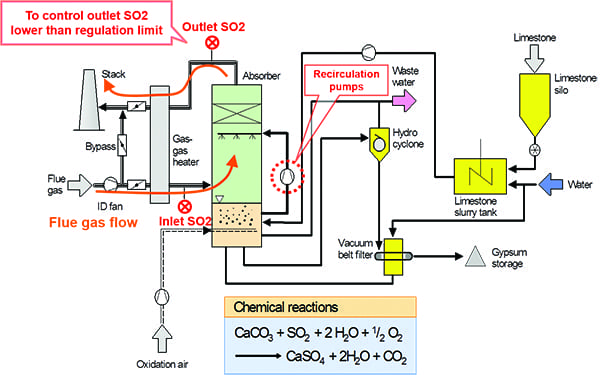
FGD
control is normally implemented by the distributed control system through the
regulation of limestone slurry flow. The limestone slurry flow is controlled
based on the pH value as measured by an analyzer installed in the absorber.
Typically, the pH value must be controlled to ensure proper performance of the
desulfurization process in the absorber, therefore the limestone slurry flow is
controlled to maintain the proper pH value. For this control scheme, other
indices such as the FGD inlet and outlet SO2 are not used, and all
recirculation pumps are operated regardless of the inlet SO2 value,
with slurry flow regulated by the control valve.
The
optimization system typically consists of three functions: enhanced regulatory
control, model-based prediction, and process value prediction. The system uses
these three functions to continuously determine the minimum required number of
recirculation pumps in operation, and to calculate the setpoint for the
limestone slurry flow PID (proportional-integral-derivative) control loop.
A
700-MW coal-fired power plant in Japan implemented the optimization system. This
plant runs about 300 days per year at baseload and is not in operation for the
other 65 days of the year. The energy savings realized by running only the
required number of recirculation pumps was 12.4 percent of the unit’s total
house load, equating to about $900,000 in energy savings per year based on
market conditions in Japan. Another benefit was reduced pump run times, which
resulted in lower pump maintenance costs and extended pump life. A third benefit
was less limestone usage.
https://www.powermag.com/advanced-process-control-for-optimizing-flue-gas-desulfurization/?pagenum=1
Libra
Provides Ceramic Pumps and Impellers
Libra Fluid Equipment Co., Ltd.
was founded in 1999 and provides pumps and parts
for various industries, such as mining, metallurgy, coal, power,
petroleum, chemical, municipal, environmental, etc.
As a China-based slurry pump impeller manufacturer, Libra provides a broad range
of impellers, including froth pump impeller, medium/light duty pump impeller,
sump pump impeller, sand pump impeller and FGD (flue gas desulfurization) pump
impeller or customized impellers. It produces its own pump impellers, and also
can provide impellers for competitor pumps Libra Fluid does not represent or is
not in any way affiliated with original pump manufacturers. As for the slurry
pumps, Libra endeavors to “only supply parts to the aftermarket where components
were originally designed and developed over twenty years ago (which other OEM’s
have well and truly enjoyed returns to justify the initial product development –
the reason patents expire after 20 years!).
Our aim is to provide end users an alternative supplier and so bring competition
back into the pump aftermarket resulting in end users paying fair prices,
obtaining realistic lead times, having better product support, and encouraging
future product improvements by all OEM’s. All companies and end users benefit
from competition.”
Duechting Ceramic Pumps demonstrate Lowest Cost of Ownership in U.S. Cement
Plant
Due to its significant corrosive and abrasive characteristics, gypsum slurry is
a very difficult medium to handle. An American cement plant with a yearly
capacity of about 2 million metric tons has found a good solution for that issue
when it installed the first of two scrubber systems in 1998. This application
has similar wear characteristics to FGD.
The housings of the eight pumps in the limestone slurry cycle are not made from
metal materials, but from a special material that was designed specifically for
extremely harsh conditions. This material is a mixture of silicon carbide (SiC)
and epoxy resin that is poured into precision molds and heat cured to form the
pump components. The material must be machined with diamond tools due to it
exhibiting a hardness close to that of diamonds. The material is completely
impervious to corrosion and exhibits extreme abrasion resistance given its
metallic-free composition and high hardness value.
The scrubber recycle pumps in this plant have operated at a flow rate of 1,310
cubic meters per hour (m3/h), 21.1 meters (m) of head and 630 revolutions per
minute (rpm) for nearly 20 years, requiring minimum attention and service. Of
course, the mechanical seals were exchanged from time to time. Apart from that,
four impellers, one casing cover and some minor components were replaced. An
additional 24 pumps are installed in the second scrubber system and other
applications in the plant.
https://www.pumpsandsystems.com/pump-materials-wet-flue-gas-desulfurization
Sunbo Supplies FGD Pumps and Parts from Chinese Factory
Sunbo Pump
supplies slurry pumps and replacement parts for Warman pumps. It supplies
replacement slurry pump parts in High chrome alloy, rubber eElastomer) and
Polyurethane, e.g., R55,S42 (Neoprene), U01 (Polyurethane), S12 (Butadiene), S21
(Butyl), SO2 (EPDM), SO2 (Haipalun gum), and special
materials. Sunbo is headquartered in Shijiazhuang, China. It develops,
manufactures and globally markets slurry pumps for delivering aggressive,
abrasive, thick, or solid-filled slurries.

Hanhe
is a Chinese FGD Pump and Parts Supplier with exports to India
Hanhe Pump Co., Limited is a slurry and
dredging pump manufacturer and exporter. With more than 15-year development it
has slurry pump design, production, on-site installation, technical support and
approved by ISO9001:2008 certificate. It supplies slurry pump for Weir Pumps but
is not associated with Trillium. It is located in Shijiazhuang City, China. It
has offices in India at Hanhe Slurry Pumps Solutions D, Maharashtra, India.
CONTINUING OF IMPORTANT TOPICS AT POWER-GEN
Speakers and exhibitors contributed to the knowledge regarding flow and treat
subjects at Power-Gen. It was part of an initiative explained at
http://www.mcilvainecompany.com/PowerGen_2019/MPM/powergen_and_the_most_profitable.htm.
There were background documents to enhance discussion. They included:
Electrostatic Precipitator Power Supplies True Cost Investigation
Gas
Turbine Inlet Filter True Cost Investigation
Turbine Bypass Valve True Cost Investigation
Dry
Scrubbing True Cost Investigation
Improving Limestone Scrubber Efficiency
As
part of the CCR investigation, a group, including SEFA, Charah, KraftPowercon
and Burns & McDonnell personnel, met at the Burns & McDonnell stand to discuss
the latest CCR developments and reflect on the speech given by Rob Erwin of
SEFA. Tricia Scroggin of Burns & McDonnell provided some insights and invited
everyone to a free webinar on the subject. (see below).
EPA
is proposing amendments to the closure regulations for the disposal of coal
combustion residuals in response to the court decisions. In particular, the
proposal includes:
These
proposed rule changes provide an example of the need for continuous discussion
of the issues. The CCR True Cost Investigation will continue to be
expanded as will the other investigations. Lots of information on turbine
bypass valves was supplied by exhibitors ( see below) . DHA provided new
insights on gas turbine inlet filter media. This data will be added and can be
viewed at
http://www.mcilvainecompany.com/PowerGen_2019/MPM/powergen_and_the_most_profitable.htm.
KSB is a Service Partner for the Entire Product Life Cycle
KSBServ
companies in North America offer comprehensive services to help relieve the
pressure and reduce the life cycle cost of challenging pump problems. KSBServ
brings knowledge and creative solutions to improve the equipment reliability and
system performance.
Services include:
Benefits include:
Solutions for obsolete equipment
Quick
response time
Improved reliability of your pump and parts
Added
longevity and cost savings.
A
new, dedicated KSBServ in facility and training center in Port Arthur, TX is
scheduled to break ground in 2020. This KSBServ center will offer the only
service and training and certification program for LUV pumps in North America.
Benefits of Advanced Rubber Joint Arrangements
Lloyd Aanonsen, President of General Rubber Corp. was interviewed at his Power-Gen stand relative to expansion joints. He advises that “when concerned about the load carrying capabilities of any essential equipment and/or support structures, an optimal solution is neither to increase rigidity into the piping system or ignore the imposing pressure thrust forces as an effect of some expansion joint arrangements; but rather to incorporate more advanced rubber expansion joint arrangements that can facilitate both system flexibility and restraint when needed. This approach is also very much in line with owners and stress engineers who desire piping systems with smaller footprints, lower construction costs, improved energy efficiency, modular construction and less structural support.”