FGD
and DeNOx
NEWSLETTER
September 2005
No.
329
Implementing New Standards for Ozone and Fine Particles
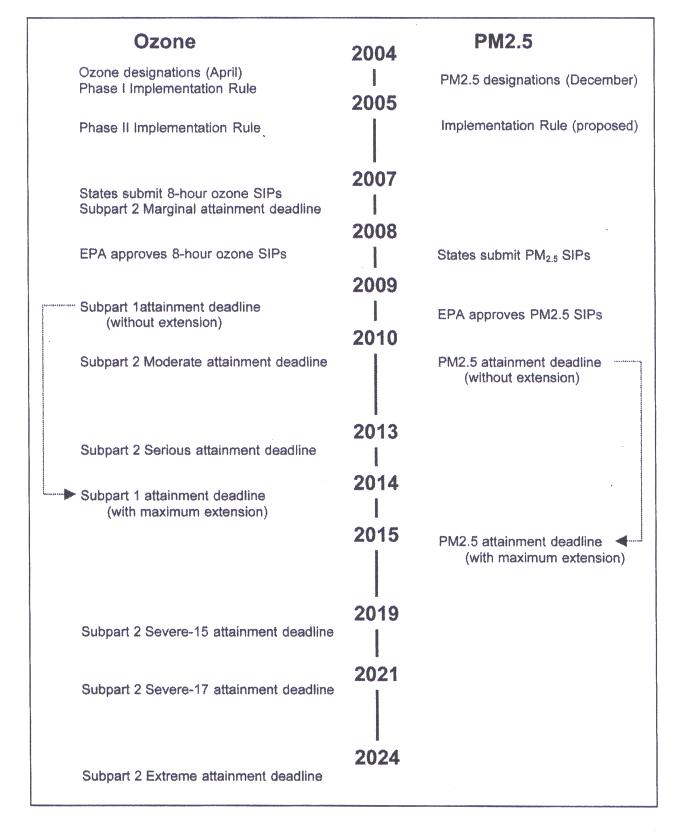
With the designations for both the ozone and PM2.5 non-attainment areas complete, the next formal step required under the CAA is for states to develop and submit State Implementation Plans (SIPs) demonstrating how they intend to meet the new standards by the prescribed deadlines. Control requirements necessary to attain and maintain the National Ambient Air Quality Standards (NAAQS) are a central part of these SIPs. Nonattainment area SIPs are due three years after the effective date of designations, or by June 2007 for ozone and April 2008 for PM2.5. Each SIP must contain measures that will ensure attainment by certain dates. In the case of PM2.5, attainment is expected for all areas of the country as expeditiously as practicable, but not later than five years after the effective date of designations, or by April 2010. Depending on “the severity of nonattainment and the availability and feasibility of pollution control measures,” the EPA Administrator may extend this attainment date by up to five additional years (until 2015).
In the case of ozone, the Clean Air Act Amendments of 1990 laid out a more specific schedule for attainment based on the classification of different areas according to the severity of their nonattainment. Under the new 8-hr standard, Subpart I areas (i.e., areas with 1-hr ozone design values less than 0.121 ppm) have up to five years after designation to reach attainment (until 2009), with a possible five-year extension after that (until 2014). Subpart 2 areas (i.e., areas with 1-hr ozone design values of 0.121 ppm and above, generally the more severely polluted areas) have attainment dates that match their classification: three years after attainment for marginal, six years for moderate, nine years for serious, 15 or 17 years for severe, and 20 years for extreme. Thus attainment deadlines for Subpart 2 areas range from 2007 to (potentially) 2024. At this point, there are no areas classified as extreme, so the latest attainment deadline for any 8-hr ozone nonattainment area is actually 2021. Figure 3 lays out key requirements for ozone and PM nonattainment areas according to the dates by which the actions are expected to occur.
Figure 3.
Lydia Wegman and Erika Sasser of the Air Quality Strategies and Standards Division of EPA’s Office of Air Quality Planning and Standards writes in em that the close alignment of the submittal dates for PM2.5 and ozone SIPs is both a blessing and a curse for states. It requires enormous effort on two fronts simultaneously, but the dual submittal process may allow states to improve the efficiency and effectiveness of their SIPs by considering multipollutant impacts (i.e., measures that impact both NOx and PM, such as mobile source controls) and by creating control measures that address more than one pollutant. Preliminary EPA modeling shows 91 percent of ozone nonattainment areas and 87 percent of PM2.5 nonattainment areas in the eastern United States coming into attainment by 2015.
Back to FGD and DeNOx Newsletter No. 329 Table of Contents