
FABRIC
FILTER
NEWSLETTER
April,
2020
No. 534
PANDEMIC
Coronavirus Impact on the Filtration Market - Large or Small?
Pandemic
Impact on the Filter and Mask Market
POWER GENERATION
ITK
Envifront Receives New Order from ENA Energi AB
Hamon
Korea Supplying Dry Scrubber and Dry Sorbent Injection FGD
Systems
COMPANY NEWS
B&W
Generated Consolidated Adjusted EBITA of $33.3 Million,
Returning to Full-year Profitability on An Adjusted EBITDA Basis
Sargent
and Lundy Acquires Summit Engineering
Andritz
Has Received an Order from Zhejiang Yanpai Filtration Technology
Co., Ltd. in China to Supply Three Needlepunch Lines
Camfil
APC Still Going Strong After Tornado
PRODUCT NEWS
Parker
Hannifin Announces a New Patent Under the BHA® Product Portfolio
New
Metal Fiber Filter from Provair
PANDEMIC
Coronavirus Impact on the Filtration Market - Large or Small?
The
filtration market is being transformed by the COVID-19 virus. Suppliers need
answers to the following:
·
Magnitude of the impact
in the long term
The
answers depend on the following factors:
·
To what extent is the
virus transmitted through the air?
·
Will the virus keep
reoccurring?
·
Will COVID-19
devastation result in permanent upgrades in health expenditures for flu, HAI and
other major infectious diseases?
·
How can masks and air
filters best be used to meet the new goals?
The
market impacts can be categorized from least to most important.
The
range of impacts for surgical and N95 masks is:
·
Least - surge in mask
use for the next six weeks and then an oversupply from China makes for a very
weak long-term market
·
Most - the world and
individual environment is segmented based on safe zones ranging from unsafe to
very safe. Time spent in any unsafe or less safe zone would be with a mask.
The
following chart shows the worst and best case scenarios. The normal scenario
would have been for a small percent increase in sales in 2020 over 2019.
In
the worst and best case-scenario, sales skyrocketed in the first quarter of 2020
with China increasing production to 200 million masks, per day. N95 masks
increased from 200,000 to 1.2 million. In the worst-case scenario, the sales
decline rapidly in the third quarter 2020 and fall to normal levels in 2021.
This causes major supplier problems because of overcapacity.
In
the best case-scenario many of the world’s 8 billion people are routinely
wearing masks in unsafe and semi safe areas. Even if masks are reused 20 times
this is 400 million masks purchased each day.
One
variable is the efficiency of masks selected. You have the lower quality,
the N95 and even the N100 for better virus capture. Another variable is single
use vs reusable. A $15 reusable mask with 20 reuses would generate the
same revenues as a .75 cent disposable mask.
The
range of impacts for HVAC filters and room purifiers is:
·
Least - sales are higher
for the next few months but then revert back to the level which would have been
achieved without the coronavirus
· Most - the recognition of viruses and other infectious diseases spurs a permanent increase in the health care, commercial and residential markets of 30 percent or more. There would be safe zones which are protected by local filtration systems. There would be a need to create safe zones on a temporary basis. This could lead to a big rental market. The number of air changes per hour in many buildings could be increased along with the installation of HEPA filters.
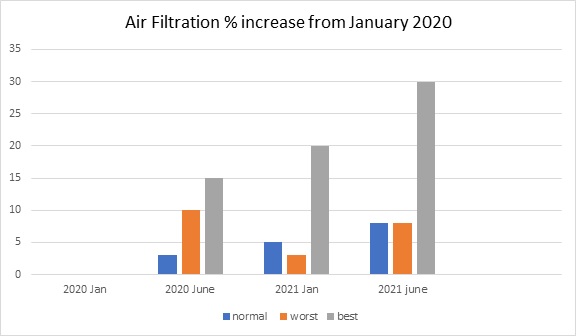
The
normal growth for air filtration in healthcare, commercial and residential would
have been about 5 percent per year. In the worst-case scenario sales are up 10
percent by June of this year. They drop to just 3 percent above the January 2020
level at the beginning of 2021 and are back to pre-corona growth levels by June
2021.
With the best-case scenario sales are up 15 percent from the January level by
June 30. They rise to 20 percent above 2020 by the beginning of 2021. By June
2021 they are 30 percent higher than in January 2020.
The
spread for HEPA filters is more than 100 percent in the sales forecast. For room
air purifiers with HEPA filters the spread is more than 200 percent. The rental
market could develop from 0 to hundreds of millions of dollars worldwide
The
widespread in the size of the future market makes it highly desirable to make
the best possible forecasts and update them continually. McIlvaine is providing
this in Coronavirus Market Intelligence.
Click here for more information,
Bob
McIlvaine can answer your questions at 847.226.2391 or
rmcilvaine@mcilvainecompany.com.
Pandemic Impact on the Filter and Mask Market
The
world needs to address the pandemic with a solution which is safe but allows
near normal functioning of business and society. McIlvaine believes that by
using the latest cleanroom and hospital mitigation technologies, this Distancing
and Sheltering Alternative can be safely cost effective.
The
extent to which it will be employed has major implications for the filter and
mask markets. It could triple the media market and double the filter equipment
sales
/clip_image003.jpg)
The
potential to change the mask market is even greater. In any case the market will
be much larger. In addition, meltblown media may be largely replaced with new
washable and more efficient nanofiber membranes. New mask designs built
around a permanent washable structure with replaceable filtration media inserts
could capture market share.

The
distancing and sheltering alternative involves the following technologies in
combinations in which optimize the life quality costs. Each technology will be
used to the extent that benefits outweigh the costs.

Air
Filters and Systems: Here are some factors which will determine whether the air
filter market boost will be modest or very large.
·
The ability of viruses
to travel long distances including through HVAC systems
·
The ability of HEPA
filters to capture the COVID-19 viruses
·
Percentage of world
population who will contract the disease
·
The ability of the virus
to reappear in areas previously impacted
·
Willingness of
governments to support the investment in filtration systems to address the
problem
·
Coordination in a
proactive program which combines air filtration technology with personal
protective equipment and operating practices
·
Acceptance of a common
metric to measure the life quality impacts as well as economic costs of
alternative strategies (McIlvaine has prepared analyses based on Quality
Enhanced Life Days)
·
Education of
governments, industries, and individuals relative to the science and impact
Masks: The market for face masks will soar over the next few years. Suppliers
need to continually seek answers to the following questions.
·
How big will the market
be in the short term?
·
Will demand drop when a
coronavirus vaccine is in wide use?
·
How much will people pay
for a mask?
·
What will be the ratio
of masks to protect wearers vs the public or both?
·
What will be the ratio
of disposable vs reusable?
·
What materials are most
compatible with various decontamination methods?
·
What will be the role of
nanofibers and other materials to compete with spunbond, meltblown laminates?
·
What will be the market
segmentation between do it yourself, medical masks, surgical masks, N95, N95
medical, elastomeric reusable, novel designs
Geography: There are separate analyses which need to be applied to each country.
·
Projected infection rate
·
Population
·
Mitigation Policies
·
Existing healthcare and
business structure
·
GDP and ability to
undertake an effective program
Associated Technologies: A number of associated technologies will shape the
market.
·
Masks can be
decontaminated and reused
o
What are the economics
of H2O2 vs alcohol, vs ozone, UV, heat etc.?
o
What is the existing
equipment which can be used?
o What is the cost of new equipment?
·
Rooms and HVAC systems
can be treated with UV light
Competition: A number of competitive factors will shape the market for the
individual suppliers.
·
Regional demand
fluctuation. The large surge of mask demand and production in China will have
implications for the worldwide market.
·
Innovative technology:
o
The use of membranes in
filters and masks is likely to greatly influence the markets.
o
There are major
developments in filter and mask designs.
All
of the factors which will shape the market are covered first in the Daily
Coronavirus Market Alerts. They are then analyzed. The conclusions are then
reflected in continuously updated forecasts.
Details on
Coronavirus Market Intelligence are found at
http://home.mcilvainecompany.com/index.php/markets/air/82ai-coronavirus-market-intelligence.
Bob McIlvaine can answer your questions at
rmcilvaine@mcilvainecompany.com cell. 847-226- 2391.
POWER GENERATION
ITK Envifront Receives New Order from ENA Energi AB
ITK
Envifront has signed a contract to design, supply, erect and commission a
complete flue gas cleaning plant to ENA Energi AB in Enköping. This scope
consists of two parallel bag house filters and limestone plus activated carbon
dosing station. The new filter plant will replace an old electrostatic filter
plant. Erection and start-up will be done during summer 2020. Total order value
is more than 22 million SEK (roughly €2.2 million).
The power
plant in Enköping uses biomass to provide 55 MW district heating and 24 MW
electricity to the nearby city. ENA Energi AB invests to improve the local
environment and reduce emissions of both dust and other hazardous compounds.
Hamon Korea Supplying Dry Scrubber and Dry Sorbent Injection FGD Systems
Hamon has successfully supplied its FGD Dry Sorbent Injection System for Sulsel
Barru (100-MW boiler) in Indonesia for PT PLN (Persero) with Toshiba JSW Power
Systems Pvt. Ltd.
In
2015 it installed a circulating dry scrubber system. South Korean electricity
company Gunjang Energy decided to install a new unit, called Seagull, at its
existing power plant at Gunsan city. The circulating fluidized bed (CFB) boiler
size was 275 MW and it needed to fulfil strict emission requirements, which came
into force in January 2015. Therefore, a suitable flue gas desulfurization (FGD)
technology to meet this limit became mandatory. Gunjang Energy wanted to install
the most economical FGD technology for these demands, and therefore selected
circulating dry scrubber (CDS) technology. The contract was awarded to Hamon
Korea in June 2014 and commercial operation started on May 18, 2016.
The
basic principle underlying a CDS is the removal of gaseous components and a
downstream filter for dust removal. The flue gas from the upstream boiler flows
through the CDS and then a filter and is released into the atmosphere via
induced draft fans and stack.
The
main component for the removal of waste gases is the CDS with the high solid
concentration situated inside it. These solids contain the dust brought in by
the raw gas, a metered quantity of hydrated lime as the absorbent, and over 90
percent of FGD product, re-circulated from the downstream arranged filter.
The
FGD is located downstream of the air preheater in the power plant arrangement.
The CDS system itself consists of a CDS absorber, a low-pressure fabric filter
with eight chambers for dedusting downstream of the CDS absorber, the connecting
ductwork including the recirculation duct, the ID fans downstream of the fabric
filter and the connection to the stack. All equipment has been installed in a
compact and space-saving way.
COMPANY NEWS
B&W Generated Consolidated Adjusted EBITA of $33.3 Million, Returning to
Full-year Profitability on An Adjusted EBITDA Basis
Babcock & Wilcox Enterprises, Inc. announced 4th quarter 2019 GAAP
income from continuing operations of $5.5 million, an improvement of $232.8
million compared to a loss of $227.4 million in 4th quarter 2018.
Adjusted EBITDA was a positive $19.3 million, an improvement of $133.5 million
compared to negative adjusted EBITDA of $114.2 million in the prior year period,
resulting in the company's third consecutive quarter of profitability in 2019 on
an adjusted EBITDA basis.
Full year 2019 GAAP income from continuing operations was a loss of $129.7
million, an improvement of $528.3 million compared to a loss of $658.0 million
in 2018. Adjusted EBITDA was a positive $33.3 million, an improvement of $331.0
million compared to negative adjusted EBITDA of $297.7 million in the prior
year, returning the Company to full-year profitability in 2019 on an adjusted
EBITDA basis.
"Our solid performance in the fourth quarter of 2019 shows we have turned the
corner toward profitability and demonstrates the strength of our improved
operational performance and cost-savings efforts. Our GAAP operating income of
$10.0 million and consolidated adjusted EBITDA of $19.3 million in the quarter
directly reflect the value of underlying assets within our core business," said
Kenneth Young, B&W Enterprises Chief Executive Officer. "Before we began to feel
the effects of COVID-19, the business was progressing as planned in the 1st
quarter of 2020. However, like many companies around the world, the global
COVID-19 pandemic and the many measures taken by local and national governments
to control its spread continue to impact our operations, and we are not able to
fully predict the extent or timing of the impact. Many projects are delayed or
deferred as our customers are also following local or national restrictions. We
have implemented work-at-home mandates in many locations and we are deemed an
essential business, so we can continue operations and support when requested."
"We
are in continual contact with our employees, customers, suppliers and government
officials to collaborate on approaches to the challenges the pandemic presents,"
Young continued. "The work we do is essential to the U.S. and global power
generation infrastructure, and our technologies are also used by several
hospitals and pulp and paper industrial customers. We are committed to
supporting our customers during this crisis."
"We
ended 2019 having made significant progress with the implementation of
previously announced cost-savings initiatives, to reach approximately $119
million in annualized savings, as the first step toward optimizing our business
while maintaining our high standards of quality and service," said Louis
Salamone, B&W Enterprises Chief Financial Officer. "We have a proven and
experienced management and employee team that engineered the turnaround of our
business, and they are even more determined as we plan and implement changes
throughout our operations in response to the unprecedented impacts of COVID-19.
We are focused on managing our costs and cash flow through this crisis, while
continually evaluating the effects of the financial market disruption on our
business, to support our customers in the long-term."
Sargent and Lundy Acquires Summit Engineering
Chicago-based engineering consultancy Sargent & Lundy has acquired Summit
Engineering Services Inc, an independent multidisciplinary design engineering
firm that works in the oil and gas sector. The acquisition will increase Sargent
& Lundy's geographical presence across O&G basins in the U.S.
With offices in Colorado, Wyoming and Texas, Summit Engineering employs around
100 staff and works across all O&G verticals. The firm provides a full range of
engineering, design, project and construction management services using
interdisciplinary engineers and designers that become integrated into clients’
own project teams. Its team will join Sargent & Lundy’s energy and industrial
business group led by its EVP Thomas Meehan.
Sargent & Lundy chairman, president and CEO Thomas White said: "Sargent & Lundy
has made strides over recent years to establish a presence in the oil and gas
sector, successfully performing work for several gas pipeline projects. This
acquisition is a strategic next step to build on that progress, expand our oil
and gas service offering and capabilities, and advance our 129-year evolution.
"Summit is a highly respected firm and an excellent fit for us. I'm confident
our new oil and gas specialists will make a great addition to our team.
Summit Chief Executive Officer Jack Hamlin said, "After building our business
and observing the evolution of the energy sector, we decided that now was the
right time to merge with Sargent & Lundy. This transaction will allow us to
offer a new range of services to better respond to industry needs and capture
market share.
Unfortunately for Sargent & Lundy, the timing couldn’t have been worse as global
oil prices slip to lows rarely witnessed since the turn of the millennium (EA
01-Apr-20). And prices may slump further yet (EA
18-Mar-20).
Andritz Has Received an Order from Zhejiang Yanpai Filtration Technology Co.,
Ltd. in China to Supply Three Needlepunch Lines
Startup of the lines, which will produce high-quality needle-punched filter
felts, is planned from the fourth quarter of 2019 to the first quarter of 2020.
The
proven ANDRITZ needle-punch lines will enable YANPAI to obtain high output and
also minimize the downtime required. This order illustrates the important
position ANDRITZ holds in the market with its aXcess equipment, which allows
solutions to be customized to suit the producers’ needs perfectly.
YANPAI is one of the leading producers of nonwoven filters for dust and air
treatment. Established in 1990, YANPAI was at the forefront in development of
new industrial filtration fabrics. YANPAI is a leading company in the production
of woven filter fabrics and one of the world’s major manufacturers of nonwoven
needle felt products. The company mainly manufactures filter fabrics for
solid/liquid separation.
Camfil APC Still Going Strong After Tornado
On
Saturday March 28, 2020 at 5:00 pm local time, an EF-3 tornado damaged the
Camfil APC manufacturing facility in Jonesboro, AR. Thankfully, no employees
were on site, so no one was hurt.
Much of the campus remains intact and fully operational, including
administrative offices, filter cartridge production, raw material storage,
warehousing and shipping. However, the metal fabrication building was destroyed.
On Tuesday March 31, filter cartridge production will resume at full capacity,
with filters in stock and ready to ship. We will continue to manufacture and
ship new filter orders on time as usual.
In
order to quickly restore metal fabrication operations, Camfil APC has activated
its disaster continuity plan with 100 percent support of Camfil AB Stockholm.
With the resources of a multinational company with 30 manufacturing plants, we
have already begun the build-out of a temporary fabrication facility at a nearby
location. That facility will be outfitted with state-of-the art equipment that
will restore Camfil APC to full capacity.
We
have the ability to gain additional metal fabricating support from Camfil
facilities in the USA, Europe and Asia, and will air-ship parts from these
facilities as needed to maintain customer delivery schedules. We're happy to
report that all of these efforts will result in minimal disruption to our
ongoing customer support.
At
the same time, Camfil APC will begin planning to replace the damaged facility in
Jonesboro, where we have enjoyed a long-standing, prosperous relationship with
the community. The Camfil AB board of directors remains committed to Camfil APC
and to keeping the company's manufacturing in Jonesboro, AR.
Of
course, as all of these plans are put in motion, we continue to follow CDC
guidelines for preventing the spread of COVID-19.
Camfil remains financially strong and committed to the success of our customers,
partners and employees.
PRODUCT NEWS
Parker Hannifin Announces a New Patent Under the BHA® Product Portfolio
The
Industrial Gas Filtration and Generation Division of Parker Hannifin
Corporation, announced a patented connector to be used with pleated filter
elements. The connector allows two, two-meter pleated filters to be joined
together without the use of any tools, installation is trouble-free.
This product development provides customers more options to better manage their
baghouse filtration systems. Today the media width constrains the length of a
filter, the longest pleated filter will be about two meters. Now using this
connector Parker can convert a customer using 8, 9 and 10 meter-long bags and
cages to a pleated filter and they will realize all of the benefits pleated
filters offer:
·
Reduced air-to-cloth
ratios
·
Lower operating
differential pressure
·
Energy savings
·
Higher production output
·
Easy installation and
removal of filters
“Providing our customers with products that improve their baghouse maintenance
and performance is rewarding,” said Jeff Canfield, Senior Product Engineer,
Industrial Gas Filtration and Generation Division. “We worked with one of our
power generation customers on this project and they were delighted with the
energy savings and longer filter life using pleated products and the filter
connector.”
The
patented connector was developed in Parker’s Industrial Filter Test Lab and
Customer Experience Center that opened in 2018 in Slater, MO.
New Metal Fiber Filter from Provair
Sinterflo FMC is a new metal-fiber mesh composite for filter elements. The FMC
structure features integrated Bekaert Bekipor technology and is composed of
random fiber webs and woven mesh structures that are sintered to form a
homogenous, yet multiple-layered structure designed to deliver strength and
practicality in cleaning. Alongside this range of metallic Sinterflo filter
elements, the company is able to provide a full range of polymeric disposable
and last-chance filters, as well as a wide range of complementary filter
housings.