FABRIC
FILTER
NEWSLETTER
February,
2020
No. 532
MARKETS
World
Fabric Filter Market Is Growing and Changing
Opportunistic Biomass – CCS Program Is the Route Chosen by the
UK and Japan
Will the
$50 Billion FGD Market Go Up or Down?
BIOMASS BOILERS
GE
Supplying Steam Technology for High Efficiency Biomass Power
Plant in Japan
Andritz
to Supply a Further High-Efficiency PowerFluid Circulating
Fluidized Bed Boiler with Biomass Firing in Japan
METALS
U.S.
Steel Commits to APC Improvements at Clairton Plant
Baghouse
and Scrubber Eliminates the Need for Tall Stack at Copper
Cliff’s Smelter
MINING
Austmine
Ltd. has Carried out a Case Study in Integra Mining’s Use of
Luehr Filter’s Fabric Filter
GLASS MANUFACTURING
Nederman
Reports Strong Level of Orders
MARKETS
World Fabric Filter Market Is Growing and Changing
There are multiple uses of fabric filters. They can be classified into
·
Mechanically generated
dust
·
Fume from combustion or
melting operations
·
Capture of reacted acid
gases and particles
Fabric filters are used to capture dust from grinding and conveying operations.
An example of growth in this segment is their use at manufactured frac sand
plants and then at the drilling sites. There are new rules to protect workers
which do not rely on masks but instead require that hoods and fabric filters
capture any fugitive dust from conveying and storing sand. Developing countries
are passing regulations to improve the dust capture at metal working, stone, and
other operations which generate dust.
Fume from combustion of coal or biomass and from the melting of scrap steel or
other metals is captured in fabric filters which require filter media which can
capture sub-micron particles. These same collectors are also now typically
tasked with removing acid gases, vaporous metals such as mercury, and or
volatile organic compounds. This is accomplished with the use of absorption or
adsorption materials such as lime and activated carbon.
The
McIlvaine Company tracks the markets for the systems, equipment, bags, and media
in every industry in every country. The forecasts are continually adjusted to
reflect the impact of improved technology such as pleated filter elements
or low drag bags. Market shares are tabulated for suppliers at each level
(systems, equipment, bags, and media).
The
World Fabric Filter and Element market report is unique in that it also provides
market and technology insights to expand the market.
It
is contributing by identifying those features which reduce the total cost of
ownership even though they increase initial cost. A major initiative is the
analysis of a new solution for climate change which maximizes use of fabric
filters:
Opportunistic Biomass - CCS Program is the Route chosen by the UK and Japan.
Another initiative involves bag cleaning regimes which maximize the reaction of
lime and other reagents with gas phase pollutants.
The
report is continuously updated and includes the monthly Fabric Filter Newsletter
and Knowledge Network. Custom research is also available.
Details on the report are provided at
http://home.mcilvainecompany.com/index.php/markets/air/n021-world-fabric-filter-and-element-
market.
Bob
McIlvaine can answer your questions at 847-784-0013. His email is
rmcilvaine@mcilvainecompany.com.
Opportunistic Biomass – CCS Program Is the Route Chosen by the UK and Japan
McIlvaine’s recent analysis explained that the Drax National Grid-Equinor
program in the UK for biomass firing and sequestration provides an opportunistic
route for addressing climate change. It pointed out that experts range
from discounting fossil fuels as a cause for climate change to those who predict
a near term tipping point and doomsday scenario.
The
problem is what might be described as doomsday by a wealthy Hawaiian setting up
trusts for his grandchildren might be highly desirable for a poor Indian
family with no power. The analysis points out that life quality measures as
shaped by tribal values and varying discounts of future value vary widely from
person to person and country to country.
Japan is a good example. The Fukishima disaster has shaped the outlook of the
government and the average citizen. There is a greater worry about a Fukishima
repetition than there is about rising sea levels 50 years from now. So the
Japanese policy is to expand coal-fired power generation through 2028.
Simultaneously it has an ambitious program to co-fire biomass and a companion
program to sequester CO2. This is accompanied by a program to help
operators of coal fired boilers around the world improve efficiency.
A
flexible and opportunistic policy is made possible because Biomass-CCS results
in a net reduction of CO2. As Drax says it “sucks CO2 out
of the air”. A corollary of this ability is that an existing coal fired
plant which can be converted to biomass firing and CO2 sequestration
in the future is the most impactful potential tool in the climate change battle.
Here is how the flexibility can be implemented. The trillion tree program is
pursued. Biomass co-firing is initiated. The amount of biomass co-fired and the
amount of CO2 sequestered depend on future assessments of the impact
of fossil fuels on life quality.
The
policy can result in a range from modestly lowering coal fired power plant
emissions all the way to reducing the atmospheric CO2 levels.
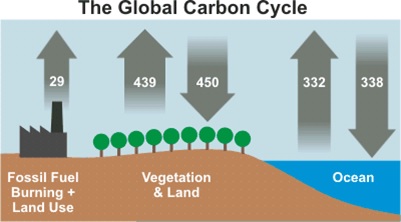
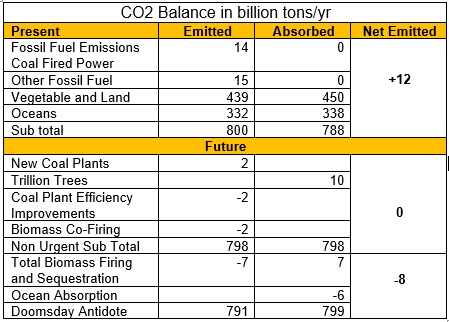
Presently fossil fuels are adding 29 billion tons of CO2 per year to
the atmosphere. Coal plants account for 14 million tons. The oceans are
absorbing more than they are emitting.
The
various biomass co-firing and carbon sequestration programs are continually
analyzed in the Utility Upgrade Tracking System The Opportunistic
Biomass-CCS program can continue to discharge 12 billion more tons than absorbed
or with the trillion trees and some biomass co-firing reduce the net deficit to
0. If doomsday is envisioned the program can be expanded to maximum biomass
combustion and sequestration with the net CO2 at a negative 8 billion
tons per year. So there is no tipping point and the CO2 in ppm
each year is reduced.
http://home.mcilvainecompany.com/index.php/databases/42ei-utility-tracking-system
Will the $50 Billion FGD Market Go Up or Down?
More than $50 billion per year is being spent on removing SO2 from
the stacks at power plants. The flue gas desulfurization (FGD) systems are
operating on combustors burning coal, biomass, and waste. Eighty percent
of sulfur is being removed by wet scrubber systems using ground limestone. The
calcium sulfate is then used in gypsum wall board. About 15 percent of the
sulfur and other acid gases are removed in wet or dry lime systems. The
remaining 5 percent is captured with sodium, amines, magnesium oxide and some
other reagents.
The
future of this market is dependent on the climate change initiatives. A program
oriented around the acceptance of the doomsday scenario would seem to eliminate
all but biomass fired boilers very quickly. However, thanks to technology and
logical breakthroughs it now appears that the best way to deal with the problem
would be to suck the CO2 out of the air. A combination of planting a
trillion trees and co-firing biomass with CO2 sequestration would be
better than wind or solar. The extent to which biomass is cofired (0-100
percent) and the amount of CO2 which is sequestered will be part of
an opportunistic and flexible strategy which is made possible by technologies
addressed in the following news releases.
Opportunistic Biomass - CCS Program is the Route chosen by the UK and Japan
Climate Change and the Quality of Life
The Opportunistic Antidote to the Climate Change Doomsday Scenario
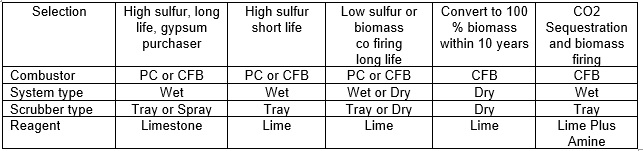
This strategy affects the selection of FGD systems. The full limestone-gypsum
forced oxidation wet system is very capital intensive and is most attractive
with high sulfur coals. If biomass is co-fired the quantity of sulfur is
reduced. Limestone is economically attractive if there is a market for
gypsum and the plant life will be long. Lime is a better choice if the plant
life will be short because it requires a much lower investment in scrubbers. The
capital expense for producing gypsum can be eliminated with natural oxidation
and chemical fixing of the waste for safe disposal as landfill.
An
alternative to natural oxidation wet lime is dry scrubbing with lime injection
into a spray dryer or dry reactor. If circulating fluid bed boilers are used for
combustion the limestone in the boilers plus the lime in the dry scrubber system
remove the acid gases.
The selection of CFB boilers is also dictated by the ease of firing biomass. Here are equipment choices depending on conditions.
The
coal-fired boiler operators, boiler and FGD suppliers can take a reactive role
or they can support the opportunistic Biomass-CCS model and select the
appropriate FGD systems initially which will be the most adaptable. The
Opportunistic Biomass CCS program will result in a larger market for CFB boilers
and lime.
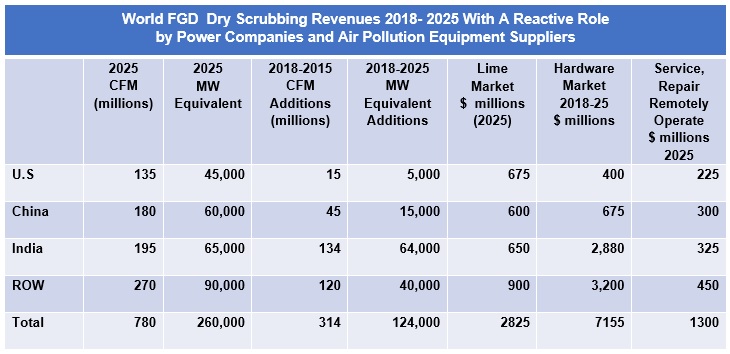
With a reactive role by power companies and FGD suppliers the revenues from sale
of lime, hardware and service for dry scrubbers in the 2018-2025 period will be
$11 billion or $1.6 billion per year. This will increase slightly to has high as
$2 billion per year in the 2025-2030 period and then decline as renewable power
generation starts to take more market share. This decline will continue in the
2040-50 period. In 2050 the revenues are likely to be less than $700
million per year.
With a proactive program the dry scrubber sales will be higher and for a greater
duration. Lime will be preferable to limestone as the reagent.
Duvha power station is a 3600-MW coal-fired power plant located in South Africa.
Fully commissioned in 1984, the base load power plant features six units of 600
MW each. South African electrical utility Eskom is the operator of the plant.
Construction of the power station had begun in November 1975 and was completed
over eight years with a total investment of R1.6bn ($128m). The first two units
were commissioned in 1980, followed by the third unit in 1981, fourth in 1982,
fifth in 1983, and the sixth unit in February 1984.
Duvha power station is located 15km east of the city of eMalahleni (formerly
Witbank) in Mpumalanga province, South Africa.
Duvha power station is a base-load plant consisting of six units of 600MW each.
Three of the units use electrostatic precipitators with sodium trioxide
injection. The remaining three feature ABB Flakt Optipulse pulsejet fabric
filters. The three units were retrofitted with pulsejet fabric filters in 1993.
The
Optipulse pulsejet fabric filter is divided into four isolatable compartments,
each containing 6724 acrylic dralon T bags.
The
power plant is equipped with 667MVA generators, which produce 600 MW each at
full load. It consists of six cooling towers with a total thermal load capacity
of 19,000GJ/h. Each tower amounts to an evaporation of 30ml a day at full load.
BIOMASS BOILERS
GE Supplying Steam Technology for High Efficiency Biomass Power Plant in Japan
GE
announced that it will provide its renewable steam technology for the high
efficiency Kamisu Biomass Power Generation plant in Japan. In a deal signed with
Hitachi Zosen Corporation, acting as the project’s engineering, procurement and
construction (EPC) contractor, GE Steam Power will design, manufacture and
supply all core components of the power block for the project through an
integrated power package including the steam turbine generator as well as the
boiler with its air quality control systems.
Located in Kamisu City, Ibaraki Prefecture in Japan, the Kamisu Biomass Power
Generation plant will use 100 percent biomass comprised of palm kernel shells
and wood pellets to generate 50 megawatts (MW) of reliable and dependable power
to the national grid. The plant will be equipped with GE’s low-NOx circulating
fluidized bed (CFB) boiler, a high-efficiency dust-removal fabric filter and a
reheat steam turbine with its generator.
The
plant is scheduled to start commercial operation in July 2023.
Andritz to Supply a Further High-Efficiency PowerFluid Circulating Fluidized Bed
Boiler with Biomass Firing in Japan
ANDRITZ has received an order from Toyo Engineering Corporation, Japan, to
deliver a PowerFluid circulating fluidized bed boiler with a flue gas cleaning
system. The boiler will be part of a new biomass power plant to be built in
Gamagori in Aichi Prefecture, Honshu Island, some 300 km southwest of Tokyo,
Japan. Commercial operations are scheduled to begin in 2023.
The
PowerFluid boiler to be supplied by ANDRITZ features low emissions, high
efficiency and availability, as well as high fuel flexibility. It forms an
essential part of a high-efficiency biomass power plant for supply of green
energy to the national grid. The biomass power plant fired with wood pellets and
palm kernel shells will generate around 50 MWel of power.
This is the seventh order in two-and-a-half years for supply of an ANDRITZ PowerFluid circulating fluidized bed boiler for the Japanese market.
METALS
U.S. Steel Commits to APC Improvements at Clairton Plant
An
agreement, announced in early February, commits U.S. Steel to investing $200
million in upgraded emissions controls and creates a community advisory panel
that will meet quarterly with U.S. Steel to discuss concerns. It does not
require U,S, Steel to admit any guilt for recent quality problems.
Five local communities will share benefits from a $3-million trust fund as part
of a settlement reached between U.S. Steel and Allegheny County Health Dept.
over alleged pollution violations at Clairton Plant.
Under the terms of the agreement, U.S. Steel also is committed to approximately
$200 million in additional improvements to the coke ovens at Clairton Plant,
said Amanda Malkowski, a company spokeswoman.
Those improvements are in addition to more than $1.5 billion in upgrades that
U.S. Steel has announced at its Mon Valley facilities, including a new, highly
automated casting facility at Edgar Thomson Plant in Braddock, and a
co-generation facility at Clairton Plant that will turn some of the coke gas
into electricity.
The
pollution control upgrades include installation of either a cover or “air
curtain” or both on the Clairton Plant’s B Battery before May 1, 2020, as well
as improved “baghouses:” at the plant.
The
agreement also requires U.S. Steel to complete five annual environmental air
compliance audits, with the first due July 1, 2020.
Baghouse and Scrubber Eliminates the Need for Tall Stack at Copper Cliff’s
Smelter
The
long plumes that used to flow from the Superstack in Copper Cliff have been
reduced to wisps as the mega chimney nears retirement and two mini versions take
over, reports the sudburystar.
“One of the new stacks is currently in operation for venting the fluid bed dryer
and the Superstack is still used for occasional venting of process gases until
the second stack is in operation,” said Danica Pagnutti, with Vale corporate
affairs, in a message to The Star.
She
said there is still some work to do on “required equipment” for the other new
stack before it can also kick into gear.
A
fixture on the Sudbury skyline for almost 50 years, the giant chimney has become
obsolete due to progress made on emissions through the company’s $1-billion
Clean AER project.
A
new wet gas cleaning plant has “reduced sulfur-dioxide emissions from the
smelter by 85 percent,” Pagnutti said, while a secondary baghouse “has reduced
metals particulate by 40 percent,” meaning the miner no longer requires such a
large stack for the smelter.
MINING
Austmine Ltd. has Carried out a Case Study in Integra Mining’s Use of Luehr
Filter’s Fabric Filter
As
part of its new Randall's Gold Project, located around 60 kilometers southeast
of Kalgoorlie, Integra Mining installed a large crushing and screening plant.
This part of the process produces by far the largest amount of dust, which if
left untreated would cause a major environmental problem.
To
address this issue an integrated dust extraction system was designed to capture
the dust and return it to the process. This was achieved by the installation of
a Luehr DF Fabric Filter. The unique feature of this design is its flat
horizontal filter bag arrangement, which allows extremely quick and safe
inspection of the clean air chamber and bags. This design eliminates the need to
use tools or lifting gear to access the filter bags. Bag changing can be
conducted from the generous adjacent access platform and does not require
maintenance personnel to enter the filter.
As
with most Luehr designs, the filters used on this project are based on a modular
concept. This allows the filters to be fully assembled with filter bags, pulse
cleaning system and electrical controls. The complete unit can then factory
tested prior to shipment which not only ensures the filter is fully functional
on arrival at site, it also greatly reduces site installation errors, time and
labor.
The
system was installed on time and commissioned without any issues. The plant has
since been reliably producing hydrated and is meeting all expectations.
GLASS MANUFACTURING
Baghouse Reduces Emissions at Bullseye Glass
Six
new air pollution testing stations are being installed near the Bullseye Glass
factory in southeast Portland as a result of a class action lawsuit over the
company’s emissions of toxic metals.
As
part of a $6.5-million settlement of a lawsuit filed by the factory’s neighbors,
the company agreed to pay for a $1-million air pollution monitoring program.
The
glass manufacturer was accused of emitting unhealthy levels of toxic metals into
the air in 2016 after a scientific study of moss revealed an air pollution hot
spot near its southeast Portland factory.
The
new air monitoring stations will test for arsenic, cadmium, chromium and
hexavalent chromium, as well as diesel pollution and particulate matter.
The
agency developed new regulations for colored glass manufacturers that are
designed to reduce the emissions of toxic metals like cadmium and chromium,
which are used to make blue and green glass.
Once Bullseye Glass installed a baghouse to reduce its air pollution, Wirtis
said, emissions of cadmium and hexavalent chromium dropped dramatically.
COMPANY NEWS
Nederman Reports Strong Level of Orders
Nederman developed well in the fourth quarter of the year. Total orders received
amounted to SEK 1141 million (968), equivalent to currency-neutral growth of
18.1 percent. Organic growth amounted to 11.4 percent. Net sales totaled SEK
1087 million (1069), equivalent to currency-neutral growth of 1.8 percent. A
relatively large share of the orders received arrived late in the quarter and it
was thus not possible to convert them into sales before the end of the quarter,
which meant that the result for the period was somewhat lower than anticipated.
Adjusted operating profit was SEK 113 million (129), yielding an adjusted
operating margin of 10.4 percent (12.1). This should be seen from the
perspective that the corresponding quarter of 2018 was Nederman’s most
profitable quarter ever.
Orders received for the full year amounted to SEK 4168 million (3480),
equivalent to currency-neutral growth of 15.2 percent. Net sales totaled SEK
4308 million (3554), equivalent to currency-neutral growth of 16.6 percent.
Adjusted operating profit for the full year was SEK 349 million (319), yielding
an adjusted operating margin of 8.1 percent (9.0).
On
December 9, Nederman acquired the Finnish company Gasmet Technologies Oy. Gasmet
is a world-leading supplier of FTIR gas analysis solutions and supplies system
solutions for continuous emission monitoring, mercury and dioxin monitoring
systems and portable gas analyzers. The company is based in Helsinki, Finland,
and also has global presence through wholly owned entities in Germany, the UK,
Canada, Hong Kong and Austria. The company focuses on developing, manufacturing
and marketing products and complete systems for a range of applications in
industry, the environment and safety.
Gasmet’s EBITDA margin exceeds that of the Nederman Group, but taking
acquisition costs into account, and the fact that the business was only
consolidated for a brief period in the 2019 financial year, the acquisition had
only a slightly positive impact on the Group’s net earnings.
Through this acquisition, we gain access to world-leading technology that
significantly strengthens our offering in Monitoring & Control Technology and
digital solutions. This moves us further in the direction of our vision of being
able to offer Clean Air as a Service and strengthens our position as an industry
leader in future-proof solutions for clean air.
Many of our markets, not least the US and China, and recently also Germany to a
certain extent, continue to be characterized by uncertainty, not least from the
recent development of the corona virus. Trade conflicts and financial
uncertainty mean that decisions on major investments are being prolonged and
that large projects are often being postponed, resulting in considerable
volatility in orders received. We have also noted increasing signs of a general
slowdown in the world economy. Despite these challenges, our basic view is one
of cautious optimism. Environmental issues will remain important for our
customers, which can be expected to soften the effects of a weaker economy to a
certain degree, and we are continuing to strengthen our positions in several key
areas where we see that future growth will occur. In Europe and North America,
we will build on Nederman's strengths as a leading environmental technology
company. In regard to the developments in Asia, which are not aligned with our
ambitions, we are continuing our intensive efforts to reverse the trend.”
Back to Fabric Filter Newsletter No. 532 Table of Contents