FABRIC
FILTER
NEWSLETTER
January,
2020
No. 531
MARKETS
Two Game
Changers for Flow and Treat Companies
Determining Flow and Treat Market Shares and Rankings
Market
Share and Rankings Analysis Needs
U.S.
Coal Fired Flow and Treat Market Will Be Diminished But
Significant
COAL-FIRED BOILERS
S.E. Asia Yearly Coal-fired Power Investment to Exceed That of
the U.S. in the Boom Years
Coal-fired Power Will Remain Stable Over the Next Five Years
Enforcement Action Launched Over One of Eskom’s Coal Plants
Babcock
& Wilcox Announces Renewal of Maintenance Contract for New
Mexico Power Plant
Indian
Coal-fired Power Plants Will Ignore Pollution Control Deadline
PAINT SHOPS
Dürr
Chosen by BMW as General Contractor for Three Paint Shops in
China and Hungary.
COMPANY NEWS
LiqTech
Successfully Installs New Furnaces to Expand Manufacturing
Capacity
Valmet
to Start Co-determination Negotiations in the Fabrics Business
Unit in Finland
FLSmidth
to Adjust its Workforce
MARKETS
·
Market shares for
competitors
·
Predicted purchases by
each major prospect
Knowledge about your competitors share in each application in each geography is
immediately useful to everyone from the local salesman to the CEO.
More than 99 percent of all flow and treat products are purchased by companies
which already own the product. Even in Biotech where startups are a factor the
universities and other entities involved are well known. Flow and Treat
purchases can be predicted well in advance
The
McIlvaine initiative provides market forecasts by industry sub segment. In
mining this means forecasts for lithium mining are included. In coal fired power
it means identifying every retrofit FGD project in India. In food and beverage
in means focus on each sub segment such as edible oil. Further
segmentation analyzes palm oil in Indonesia versus corn oil in the U.S. In the
case of sugar it means analyzing cane sugar in Brazil and India and beet sugar
in Europe
This intelligence is made cost effective by the use in prediction of hundreds of
specific flow and treat products as explained at http://home.mcilvainecompany.com/images/Market_Wisdom_2019-12-19.pdf.
Determining Flow and Treat Market Shares and Rankings
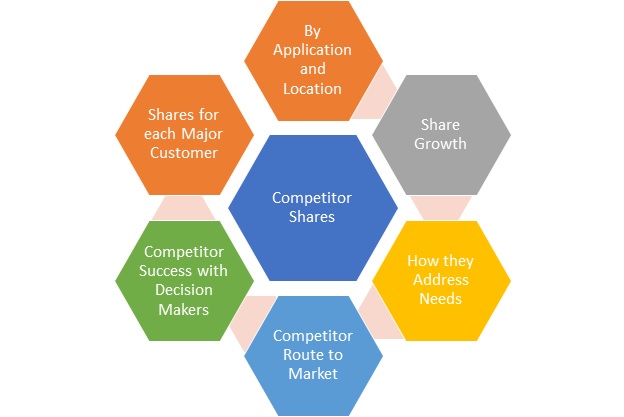
Flow and treat suppliers set a high priority on determining the market share for
their products as well as their ranking among competitors. There is promotional
as well as strategic value. The research needed to generate promotional value is
modest. The research needed to maximize the strategic value is considerable.
Scope: To create promotional value it is relatively easy to pick a market
scope which favors the company. To create strategic value it is desirable to
carefully assess the following definitions:
·
Product which is being
evaluated
·
Application
Industry
Process
Medium
(gases, liquids, free flowing solids)
·
Geographic scope
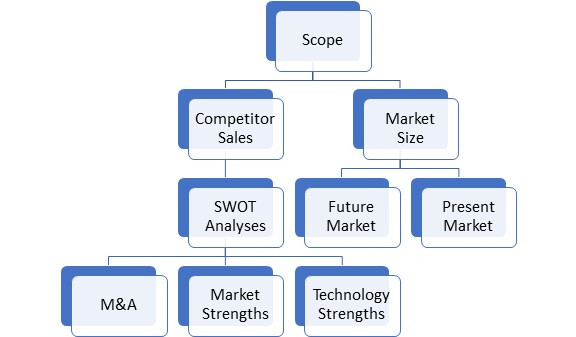
Market Size: The true market size often requires understanding of the
industries, the applications and even the equipment choices. What percentage of
sewage sludge is dewatered in belt filter presses, centrifuges, or recessed
chamber filter presses? If you sell filter cloths or filter belts this is
an important investigation.
Determination of the future market is very important. If the supplier can gain
market share in an expanding market the impact on revenues is substantially
greater than gaining market share in a stable or shrinking market.
Competitor Sales: It is desirable to not
only assess the present sales of the major competitors but also predict their
future sales and market shares. This requires considerable effort but there are
multiple values. McIlvaine analyzes the participation of flow and treat
companies in hundreds of exhibitions around the world. Some are industry
oriented such as ACHEMA. Some are equipment oriented such as Valve World or
FILTXPO. Exhibitions such as PowerGen are held in Asia, the U.S. and Europe. So
insights on geographical strategy can also be ascertained.
It
is also desirable to conduct SWOT analyses for major competitors and to assess
their product development activity. The McIlvaine Company has services on air
pollution control, water pollution control, combustion, drying, separation and
other processes which provide unique insights on product development progress
and needs.
Market share is impacted by mergers and acquisitions which are resulting in
larger and larger companies with increasing market share. Suppliers need to keep
analyzing the consequence of a merger among competitors. In some cases market
ranking may drop but market share will increase. For example two smaller
competitors could merge but then their combined sales do not reach the level
that they would have reached as independent companies.
With the broad range of market and technical services offered the McIlvaine
Company is uniquely qualified to assist flow and treat companies with market
share and ranking analysis. For more information contact Bob McIlvaine at
847-784-0013 or
rmcilvaine@mcilvainecompany.com.
U.S. Coal Fired Flow and Treat Market Will Be Diminished But Significant
Flow and treat product suppliers should not overlook the U.S coal-fired
generator market. It will be significant through 2040. The U.S. coal-fired
capacity will shrink to less than 50 percent of the 2010 peak. Operating hours
will shrink even further as coal plants are used in conjunction with solar and
wind. However, coal can maintain a contribution equivalent of 40 percent of that
in 2010 if wise upgrade investments are made.
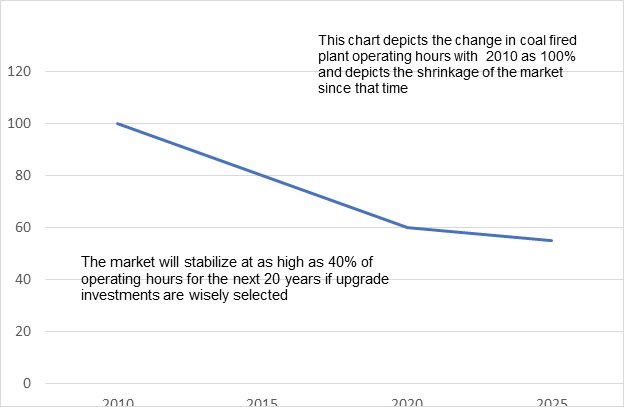
U.S.
Coal Fired Power Operating Hours as a % of 2010
There are many uncertainties but the variables which are under control of the
industry are more important than the political variables. The biggest
factor affecting coal use in the U.S will be the price of natural gas
which in turn will be closely tied to world oil prices as LNG plants are
built in the U.S. and create a big gas export market.
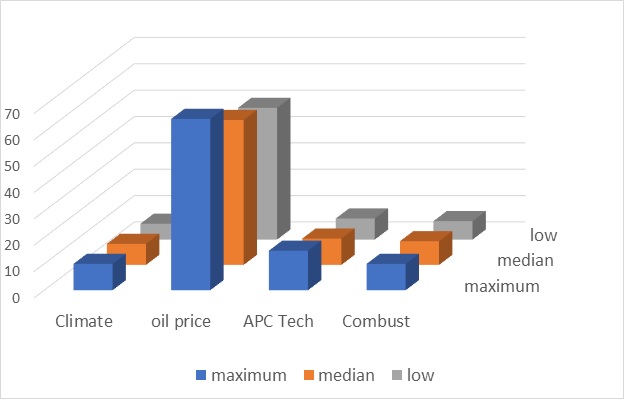
Impact
of Factors on U.S. Coal Megawatt Hours
Assuming that any movement to prohibit hydraulic fracturing would be rebuffed
the continued low price of oil and gas is highly predictable. As a result the
gas price will be a large but predictable factor reducing coal use. Climate
policy over the period through 2040 is likely to be a minor factor regardless of
whether there is a Democratic or Republican Congress and Administration. There
are not going to be any new coal fired plants. There will be continuing pressure
to operate existing plants more efficiently to reduce CO2 and with reduced air
pollution.
Investments in combustion and air pollution control technology will have more
impact on operating hours than will climate change. These investments can make
coal plants more flexible and able to operate more efficiently at reduced loads
and in a cycling mode.
China is taking the approach of upgrading coal fired plants to make them equal
to gas fired plants in terms of emissions. This includes upgrades to
ultra-supercritical operation. Given an assumption of retirement in 2040 only a
minority of U.S. plants will be able to justify this investment. However there
are many investments with a high return over just a few years.
Injecting hydrated lime ahead of the SCR and the air heater can lower the SO3
concentrations enough to avoid maintenance and turn down issues. Injecting
enough sorbent further upstream in the flue gas means utilities can lower load
and capture waste heat that would typically escape from the stack. This
also gives utilities flexibility to run the coal-fired units at a lower load,
typically at night, and be more efficient. Buckeye Cardinal Unit 2 in Brilliant
Ohio initiated this change in 2017 and is experiencing a high ROI.
There are many other initiatives which can be pursued. Here are some.
·
Catalytic filters with
DSI ahead of the air heater and capture of heat and water which otherwise is
lost through the stack (ideal where hot precipitators are still being used)
·
By-products such as rare
earth feedstocks, hydrochloric acid, pure white gypsum to compete with
precipitated calcium carbonate, ammonium sulfate, and sulfuric acid all have
potential for certain site specific situations
·
CO2 as a
product: SaskPower supplies CO2 for enhanced oil recovery from its
Boundary Dam plant. BHE in Utah directs CO2 from its gas turbine
stack to a commercial tomato greenhouse on site. Most commercial greenhouses
purchase CO2. Hydraulic fracturing with CO2 is promising
as a way to reduce water consumption and sequester greenhouse gases.
All
of these initiatives and the fate of each coal -fired plant is being analyzed
and tracked in the McIlvaine Utility Tracking System:
http://home.mcilvainecompany.com/index.php/databases/42ei-utility-tracking-system.
Bob
McIlvaine can answer your questions at 847-784-0013 or
rmcilvaine@mcilvainecompany.com.
COAL-FIRED BOILERS
S.E. Asia Yearly Coal-fired Power Investment to Exceed That of the U.S. in the
Boom Years
The
latest IEA forecast predicts growth in coal-fired power in South East Asia from
143 MTOE in 2018 to 272 MTOE in 2040. This compares to the 2017 usage in the
following countries.
|
COUNTRY |
MTOE |
|
China, People's Republic of
|
2000 |
|
India
|
384.3 |
|
United States
|
335.1 |
|
Japan
|
116.4 |
|
Russian Federation
|
106.3 |
|
South Africa
|
96.3 |
|
Korea
|
83.0 |
|
Germany
|
70.9 |
|
Poland
|
50.0 |
In
the case of China nearly 700 MTOE is used for other purposes including coal-to-
chemicals. By comparison, the S.E. Asia coal-fired power generation in 2040 will
equal about 70 percent of the U.S. consumption at the peak. It also means that
the yearly capital expenses will exceed those in the U.S. peak since they are
compressed into 20 years rather than 50.
Southeast Asia is well on the way to achieving universal access to electricity
by 2030. Millions of new consumers have gained access to electricity since 2000,
yet some 45 million people in the region are still without it today and many
more continue to rely on solid biomass as a cooking fuel.
Southeast Asia’s growth in electricity demand, at an average of 6 percent per
year, has been among the fastest in the world, but a number of power systems in
the region are facing significant financial strains.
Since 2000, overall energy demand has grown by more than 80% and the lion’s
share of this growth has been met by a doubling in fossil fuel use. Oil is the
largest element in the regional energy mix and coal — largely for power
generation — has been the fastest growing. This has underpinned the region’s
development and industrial growth but has also made air pollution a major risk
to public health and driven up energy-related carbon dioxide (CO2)
emissions.
Southeast Asia has considerable potential for renewable energy, but (excluding
the traditional use of solid biomass) it currently meets only around 15 percent
of the region’s energy demand.
Hydropower output has quadrupled since 2000 and the modern use of bioenergy in
heating and transport has also increased rapidly. Despite falling costs, the
contribution of solar photovoltaics (PV) and wind remains small, though some
markets are now putting in place frameworks to better support their deployment.
In
the IEA forecast, Southeast Asia’s overall energy demand grows by 60 percent to
2040. The region’s economy more than doubles in size over this period, and a
rise of 120 million in the population is concentrated in urban areas.
The
projected rate of energy demand growth is lower than that of the past two
decades, reflecting a structural economic shift towards less energy intensive
manufacturing and services sectors, as well as greater percent efficiency.
Nonetheless, it still represents some 12 percent of the projected rise in global
energy use to 2040.
Coal-fired Power Will
Remain Stable Over the Next Five Years
Global coal demand is expected to decline in 2019 but remain broadly stable over
the next five years, supported by robust growth in major Asian markets,
according to the International Energy
Agency’s latest market analysis and forecasts.
The
weakness in coal demand this year results mainly from coal-fired electricity
generation, which is set to experience its largest ever decline — over 250
terawatt hours (TWh), or more than 2.5 percent. This drop is led by double-digit
falls in the United States and Europe, according to Coal 2019, which was
released this week and contains forecasts through 2024.
It
is too soon to say whether the expected global decrease in coal power generation
this year will be the start of a lasting trend. The IEA forecasts that renewable
sources will supply a major portion of the increase in global electricity demand
over the next five years. Electricity generation from coal will rise only
marginally over that period, at less than 1 percent per year — and its share
will decline from 38 percent in 2018 to 35 percent in 2024. This means coal
remains by far the single largest source of power supply worldwide.
Ultimately, global trends will depend largely on China, where half of the
world’s coal is produced and consumed.
In
Europe and the United States, coal power generation is sinking to levels not
seen in decades. Growth in solar PV and wind, low natural gas prices and
stagnating electricity demand have created a perfect storm for coal in both
regions, where coal plant retirements continue to take place. These trends will
continue through 2024, although the speed of the declines is expected to slow
unless coal comes under additional pressure from stronger climate policies or
lower-than-expected natural gas prices.
“Wind and solar PV are growing rapidly in many parts of the world. With
investment in new plants drying up, coal power capacity outside Asia is clearly
declining and will continue to do so in the coming years,” said Keisuke Sadamori,
the IEA’s Director of Energy Markets and Security, who is launching the report
in Johannesburg today alongside Gwede Mantashe, South Africa’s Minister of
Mineral and Energy Resources.
“But this is not the end of coal, since demand continues to expand in Asia,” Mr.
Sadamori added. “The region’s share of global coal power generation has climbed
from just over 20 percent in 1990 to almost 80 percent in 2019, meaning coal’s
fate is increasingly tied to decisions made in Asian capitals.”
The
report highlights that countries in South and Southeast Asia, such as India,
Indonesia and Vietnam, are relying on coal to fuel their economic growth.
Natural gas and oil have traditionally been the main sources of power generation
in Pakistan, but the country has commissioned 5 gigawatts (GW) of coal power
capacity since 2017, and another 5 GW is set to come online in the next few
years. In Bangladesh, where natural gas has long generated the bulk of
electricity supply, coal will gain share in the coming years, with 10 GW of
capacity in the pipeline.
“In
2019, global coal power generation will experience the biggest drop ever and
coal power generation in India will probably decline for the first time in 45
years,” Mr. Sadamori said. “The global picture, however, has not changed much.
Coal is disappearing in many advanced economies, but it remains resilient and is
even continuing to grow in developing Asia. The low coal power generation in
India this year was due to unusually low growth in electricity demand and
exceptionally high hydropower output. It is not at all clear that it will be
repeated.”
The
IEA forecast for global coal demand in this year’s report is very similar to
those in previous years, but Coal 2019 warns that potential threats to
the sector are increasing. Public opposition to coal is building, many countries
are mulling stronger climate and environmental policies, and renewables and
natural gas are becoming more and more competitive.
Enforcement Action Launched Over One of Eskom’s Coal Plants
In
late December 2019 the South African
Dept. of Environmental Affairs’ Environmental Management Inspectorate, also
referred to as the Green Scorpions, issued a compliance notice to Eskom
requiring it to submit a maintenance plan by January 12 to improve its
compliance with the minimum air quality standards” for its 4116 MW Kendal coal
plant. In July 2019 Eskom acknowledged that poor maintenance at its plants
during 2018 had resulted in increased pollution and that bag filters had failed
on four units at the plant. While the department said the timing of the
compliance plan rests with Eskom, the government-owned utility is under pressure
to close its two most polluting units, with a combined capacity of 1200 MW, and
detail what it will do about the other four polluting units. In June 2019 the
Centre for Environmental Rights, representing groundwork and the Vukani Justice
Movement in Action, launched legal action against the South African Government
over pollution in Mpumalanga region from Eskom’s 12 coal plants, including
Kendal, and Sasol’s Secunda coal-to-liquids plant.
Babcock & Wilcox Announces Renewal of Maintenance Contract for New Mexico Power
Plant
Babcock & Wilcox Enterprises, Inc. announced that its subsidiary, Babcock &
Wilcox Construction Co., LLC (BWCC), has received a contract renewal valued at
more than $4 million to provide maintenance services for Public Service Company
of New Mexico’s (PNM) San Juan Generating Station in 2020.
BWCC will continue to provide a variety of services at the power plant next
year, including general plant maintenance, coal pulverizer equipment maintenance
and outage support, as it did in 2019.
“We very much appreciate our long-term relationship with PNM and this
opportunity to continue to support them,” said Jimmy B. Morgan, Senior Vice
President, The Babcock & Wilcox Company. “We’re pleased that our customer has
renewed our contract and shown confidence in our services and ability to keep
this critical plant operating at peak performance.”
Omni Warner, Director, San Juan Generating Station Plant Manager, said “We’re
pleased with the commitment to safety, high level of service and support BWCC
has provided us in 2019 and look forward to working closely with them in 2020.
BWCC provides a cost-effective approach as PNM continues to transition to a
plant closure in 2022.”
BWCC Vice President and General Manager Mike Hidas also expressed his
appreciation to PNM for continuing its relationship with BWCC.
“B&W supplied one of San Juan Generating Station’s current boilers, as well as
other key equipment,” Hidas said. “We have unmatched expertise and depth of
experience to service and maintain our own and competitors’ equipment anywhere
in the world. I thank PNM for the opportunity to continue providing our services
for its facilities.”
BWCC provides outage services, installation, refurbishment, mechanical repair
and maintenance services for a variety of industries, equipment and plant
installations, regardless of the original manufacturer.
Indian Coal-fired Power
Plants Will Ignore Pollution Control Deadline
Over 90 percent of the coal-fired plants directed to comply with new pollution
standards by a December 31 deadline will not have installed the required flue
gas desulfurization (FGD) units. The plants have a combined capacity of 14,000
MW. The new standards were first announced in December 2015 with the initial
deadline for compliance in December 2017 extended to December 2019 following
lobbying from power utilities. The bulk of the plants set to breach the
standards are located in the states of Haryana, Punjab and Uttar Pradesh. A
further 26,330 MW of coal units have been directed to meet the emission
standards by December 2020 and over 64,000 MW in each of 2021 and 2022. To date
contracts for FGD units have only been awarded for 35,200 MW of the total
capacity.
PAINT SHOPS
Dürr Chosen by BMW as General Contractor for Three Paint Shops in China and
Hungary
BMW
is relying on Dürr's experience and technological leadership to expand its
painting capacities in Asia and Europe. In Shenyang (China), Dürr is building a
new paint shop and extending an existing painting system. BMW is also working
with Dürr on a further new paint shop in a new plant in Debrecen, Hungary. Dürr
sets standards in the painting process with state-of-the-art technology. The
orders for the construction of the two plants in China were posted in the 4th
quarter of 2019.
Dürr has confirmed its position as a market leader in China
with two orders for BMW. In Dadong district in Shenyang, BMW has been operating
a Dürr paint shop since 2016 and is now increasing its capacity. In Tiexi
district in Shenyang, where BMW has already been using Dürr painting technology
since 2013, Dürr will build a further paint shop in a new manufacturing
facility. In addition, BMW is already planning a second expansion stage in Tiexi
and has agreed the future expansion with Dürr. An agreement has also been made
with Dürr on the construction of a paint shop in Europe, with a new BMW plant in
Debrecen (Hungary) scheduled to commence production in the summer of 2023.
BMW
will use sustainable, resource-saving technology throughout the three new paint
shops. The Dürr products for paint separation — EcoDryScrubber, in China
and EcoDry X in Hungary — boast strong environmental credentials. EcoDryScrubber
is based on paint separation using limestone powder, while EcoDry X uses
cardboard filter boxes as a separating agent. The Dürr technology thus does not
involve any polluting methods that use a mixture of water and chemicals. The
recirculation of up to 95 percent of the air used in Dürr's separation processes
also enables a 60 percent reduction in energy consumption in the paint booth.
The
EcoInCure oven, which will be used in the new plant in Tiexi as well as
in Debrecen in the top coat section, will additionally boost the energy
efficiency of the plant. The oven’s exhaust air can be purified using just one
afterburning system of the type Ecopure® TAR. A comparable double oven
with conventional continuous flow technology would need two air pollution
control systems. This reduces the amount of fresh air required, and thus the
energy demand. EcoInCure uses a new technology for drying: the air
flowing in through the opening for the windshield heats the body parts from the
inside out, resulting in particularly uniform and fast drying of the bodies –
even special body shapes like those of electric vehicles.
COMPANY NEWS
LiqTech Successfully Installs New Furnaces to Expand Manufacturing Capacity
LiqTech International, Inc., a clean technology company that manufactures and
markets highly specialized filtration technologies, today announced the
successful installation of a brand new customized furnace for use in the
manufacture of the company’s proprietary silicon carbide membrane filters. The
new furnace has throughputs that are more than 3x the company’s existing
furnaces due to size and efficiency.
The
installation of this initial new furnace is the first step of a multi-phase
process to increase overall capacity with modernized equipment that should also
benefit the company’s gross margins. The company expects to install a second new
furnace by February 2020, and two additional new furnaces by June 2020. Upon
successful installation of all four, brand new efficient furnaces in June 2020,
the company expects to completely retire its current older, less efficient
furnaces. Overall, the company’s manufacturing initiatives are expected to
result in total capacity of between $150 and $200 million on an annualized basis
by mid-2020.
Valmet to Start Co-determination Negotiations in the Fabrics Business Unit in
Finland
Valmet is planning changes in the Fabrics Business Unit which is part of the
Services Business Line in order to secure the unit’s profitability and future
competitiveness. The most important action in the preliminary plan is to move
the dryer fabric and wide filter fabric production from Tampere in Finland to
Valmet’s unit in Portugal. The possible actions will have employee impacts. The
functions under consideration are part of Valmet Technologies Oy.
Fabrics Business Unit develops and manufactures press felts, shoe press belts,
dryer fabrics and wide filter fabrics in Tampere. Valmet’s location in Portugal,
to which the dryer fabric and wide filter fabric production possibly is
relocated, develops and manufactures filter fabrics and other industrial
textiles.
Active review of operations’ locations is part of Valmet’s normal business
development globally. In recent years, for example, Valmet’s production of
evaporation plants from Sweden and the production of Quality Control Systems
(QCS) from China have been relocated to Finland. Valmet employs 5,100 persons in
Finland of which 2,000 in Tampere. At the moment Valmet has approximately 160
open positions in Finland.
FLSmidth to Adjust its Workforce
FLSmidth is adjusting the number of employees by approximately 500 as part of
the business improvement initiatives announced towards the end of 2019 and as a
consequence of current industry caution and delays tied to large capital
investments.
To
improve efficiency and adapt to the anticipated business activity in 2020,
FLSmidth has decided to reduce the number of employees by approximately 500
globally. The reductions will include approximately 80 situated at the
headquarter in Copenhagen, Denmark, as well as another approximately 420 staff
in offices around the world.
FLSmidth CEO Thomas Schulz comments, “Despite a healthy pipeline, this is an
unfortunate yet necessary action given the weakening market for large capital
investments in 2019 and our ongoing efforts to improve internal efficiency. In
connection with Q3, we announced a need to make necessary business adjustments,
and we take this step now to position FLSmidth for future profitable growth.”
Back to Fabric Filter Newsletter No. 531 Table of Contents