FABRIC
FILTER NEWSLETTER
September 2019, No. 527
MARKETS
·
Why Can India
Justify Coal-fired Power Plant Expansion?
·
Determining True
Cost for Dry Scrubbing Through Coal Fired Power Plant Decisions
·
How ACE Affects
Today’s Utility Plants
·
Coalition of U.S. States and Cities Challenges Trump Coal Pollution
Wind-back
·
Doosan Lentjes to Supply Fabric Filters in the Czech Republic
WASTE -TO-ENERGY
·
36,000 Hours of
Operation for P84+PPS Bags at Eskom
·
Valmet to Supply a Biomass Boiler and a Flue Gas Treatment Plant to BS
Energy’s Combined Heat and Power Plant in Braunschweig, Germany
·
MHIEC Receives Order to Refurbish the Hiroshima Naka Waste to Energy Plant
WELDING FUMES
·
Nederman Offers Solution to the Dangers of Welding Fumes
COMPANY NEWS
·
Donaldson Achieved Record Sales in 2019
·
All Babcock & Wilcox Business Segments Showed Improved Results
·
Porvair Acquires Dahlman Industrial Group B.V.
·
Hangzhou Grace Envirotech Offers High Efficiency Filtration Solutions
·
BWF Group Opens Second Sales Location in the Czech Republic
Dry Scrubber Market
Will Grow to $5 billion/yr
Dry scrubbers are
taking market share away from the wet scrubbing alternative in coal-fired
power, biomass combustion, cement, steel, waste to energy and other
applications involving hot acid gases and particulate
The advantages of
dry scrubbers are the reduced need for water, the elimination of wastewater,
and the capture of mercury, dioxins, and sulfuric acid mist. The negative
aspect is the elimination of valuable by-products. If the acid gas ratio in
the fuel is low dry scrubbing has the lowest total cost of ownership. The
higher the acid content the less competitive dry scrubbing is to wet.
Dry scrubbing is the
preferred choice in glass plants, waste to energy, and cement plants. In
some other applications it has half the market share. In coal fired power
generation it has less than a 6 percent share. A major change is taking
place in India where coal fired power plants are expected to use dry
scrubbing for one third of the requirements. As a result, India will be a
leading purchaser of dry scrubber hardware, lime and services in the future.
It will spend just under $3 billion for dry scrubber hardware and
construction over the seven-year period ending in 2025. It will be spending
$650 million/yr for lime for dry scrubbing by 2025 and $325 million for
service, repair and remote operation and maintenance.
|
|
2025
CFM (millions) |
2025 MW |
2018-2015
(millions) |
2018-2025
Additions |
Lime Market
$ millions (2025) |
Hardware
market 2018-25
$ millions |
Service, Repair
Remotely Operate
$ millions 2025 |
|
U.S |
135 |
45,000 |
15 |
5,000 |
675 |
400 |
225 |
|
China |
180 |
60,000 |
45 |
15,000 |
600 |
675 |
300 |
|
India |
195 |
65,000 |
134 |
64,000 |
650 |
2,880 |
325 |
|
ROW |
270 |
90,000 |
120 |
40,000 |
900 |
3,200 |
450 |
|
Total |
780 |
260,000 |
314 |
124,000 |
2825 |
7155 |
1300 |
Cement, waste to
energy and furnace applications are sized based on CFM. Equivalent MW is
provided as a convenience.
MW - CFM equivalent
is 3000 CFM at 240°F
U.S lime at $150/ton
and 100 tons per equivalent MW
Lime in China,
India, and ROW at $100/ton and 100 tons per equivalent MW
Hardware for new
plants is $45,000/equivalent MW in India and China and $80,000/equivalent MW
in U.S. and ROW.
Service, repair and
remotely operate is $5000/ MW/yr
The world market for
dry scrubbing hardware will average $710 million/yr over the period to 2025.
Lime purchases will be just under $3 billion by 2025 while service, repair
and remote O&M will rise to over $1.3 billion/yr.
Forecasts for both
wet and dry scrubbing for each country are contained in two McIlvaine
reports. One is focused on coal-fired boilers and the other on the
industrial market. More information is available at
N027 FGD Market
and Strategies
N008 Scrubber/Adsorber/Biofilter
World Markets
Bob Mcilvaine can
answer any questions at cell 847-226-2391 or
rmcilvaine@mcilvainecompany.com.
Why Can India
Justify Coal-fired Power Plant Expansion?
India is expanding
coal-fired power capacity and can justify it based on the
Sustainability
Universal Rating System.
India expects
coal-fired power capacity to grow by 22 percent in three years. That’s
according to the Chief Engineer at the country’s Federal Power Ministry,
Ghanshyam Prasad, who Reuters reported as stating coal capacity is likely to
reach 238 GW by 2022.
India’s Coal
Minister, Pralhad Joshi previously said annual coal demand rose by 9.1
percent during the year ending March 2019, noting the figure hit 991.35
million tons, driven primarily by utilities, which accounted for
three-quarters of total demand. The anticipated growth is likely to affect
efforts to cut emissions and could risk worsening already poor air quality.
India’s electricity demand rose by 36 percent in the seven years up to April
2019, while coal-fired generation capacity during the period rose by
three-quarters to 194.44GW.
Pralhad Joshi said,
despite the growth rate in thermal capacity outpacing electricity
consumption in the last few years, more coal-fired power plants will still
be needed in the future to meet growth. He added: “If we have to meet demand
and address the intermittencies we have with solar and wind, we have no
choice but to keep depending on coal-based generation in the near future.”
India must address
the question of balancing the benefits to the world vs. the benefits to
citizens of India. Cardinal Health contracted with McIlvaine to answer a
similar question relative to single-use surgical garments. Should a hospital
throw away surgical garments after each use or wash them? Washing exposes
local hospital clients to the risks of viruses in the water while
manufacturing the garments generates CO2 somewhere. One risk is
personal and immediate. The other risk is long term and general.
McIlvaine realized
that it was necessary to develop a common metric to measure harm and good.
This metric is labeled Quality Enhanced Life Days (QELD). It is described in
a hospital magazine article.
https://www.healthcaredevelopmentmagazine.com/.../quality-enhanced-life-days-a-ne... In
terms of decision making, QELD is radically different from the accepted
medical metric Quality Adjusted Life Years (QALY).
Let’s say an Indian
without electricity sleeps more hours at night. Without a large income he
eats more fruit and vegetables and less ice cream and pizza. The Indian
without electricity lives to age 90 while the Indian with electricity only
lives to age 88. The QELD metric would rate the electricity option as
superior while the QALY metric rates the “no electricity” scenario as
superior. It is only common sense. Would you rather be in solitary
confinement for the next 50 years or only live 40 years longer leading your
present life?
The quality of life
must be taken into account in any government policy. If coal-fired power can
give reliable electricity to millions 10 years earlier than a plan that
excludes coal, then the quality of life benefits has to be taken into
consideration. Discounted future value has to be considered. The millionaire
in the U.S. setting up a trust fund for his grandchildren enhances his life
quality with this sacrifice. The Indian grandfather worried about the basic
needs of his grandchildren will take satisfaction from making life better
for them now. Since many of the negative impacts of greenhouse gases are
long term, there is the necessity to realize that the discounted future
value is dependent on the personal QELD of the individual.
It would be possible
for the Indian government to estimate the cumulative QELD for all Indians
for any policy and then choose the one with the greatest aggregate QELD. Bob
McIlvaine welcomes your thoughts on this metric. You can reach him at
847-784-0013, cell 847-226-2391 or
rmcilvaine@mcilvainecompany.com.
Determining True
Cost for Dry Scrubbing Through Coal Fired Power Plant Decisions
Dry scrubbing is one
of the options used by coal fired power plant operators to capture SO2,
sulfuric acid mist and other acid gases.
44I Coal Fired
Power Plant Decisions
provides a forum for end users and suppliers to determine which pollution
control options are best for a specific plant. Because of lack of water, low
SO2 concentrations, weak gypsum market demand, and other factors
a dry rather than wet scrubbing solution may be the best choice.
The choice is made
more complex by the need to address multiple pollutants. Dry scrubbing is
effective in removing SO3 whereas this is not true of wet
scrubbers. With the addition of activated carbon, dry scrubbers can also
remove mercury. There are multiple dry scrubber designs. Some are better
with higher sulfur levels. So, the fuel becomes one variable in the pursuit
of the lowest total cost of ownership solution.
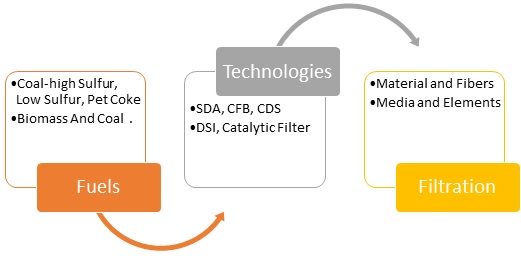
There are multiple
dry scrubbing technologies. One is the spray dryer absorber (SDA). This
utilizes the same principle used in manufacturing instant coffee or powdered
soft drinks. A slurry is sprayed into a vessel through which the hot gas
flows. The liquid evaporates. The acid gas reacts with the absorbing
particles. The particles are then captured in a fabric filter.
The circulating
fluid bed (CFB) scrubber functions by passing the acid gas through a
fluidized bed of lime particles. Circulating Dry Scrubbers (CDS) entrain and
then separate the particles. Lime or sodium particles are injected into the
flue gas duct with Dry Sorbent Injection (DSI) systems. The catalytic filter
uses the DSI principle ahead of a ceramic filter medium with embedded
catalyst for both particulate control and NOx reduction.
There are a number
of materials, fibers, media configurations and element designs which are
utilized. The collection media in the fabric filter has a major impact on
cost. The optimum gas velocity can vary depending on the media selected. If
the velocity can be doubled then the size of the unit can be halved. Instead
of 4000 bags for a big installation maybe only 2000 would be needed.
On the other hand,
the cost of ownership is significantly affected by the bag life. If bags
last one year rather than four or five years, then bag costs become a
significant part of the total expense. The energy cost is also a factor.
Energy consumption increases in direct proportion to velocity. It also
increases in direct proportion to the thickness of the dust cake on the
filter media.
In the case where
only particulate is to be captured it is best to establish a semi-permanent
cake on the bags and then pulse off the new cake. In accounting terms this
is last in first out (LIFO). However, for dry scrubbing it is best to remove
the reacted gypsum and retain the fresh lime (FIFO). The industry has not
formally addressed FIFO versus LIFO and needs to do so.
The need to maximize
acid gas capture and the resultant substantial increase in particulate
loading affects the choice of fibers and filter media. The type of cleaning
(reverse air or pulsing with compressed air) also determines the selection
of the lowest true cost medium.
The fuel or product
being calcined or treated also impacts the medium. If a high sulfur fuel is
burned, the costs of dry scrubbing are comparatively higher than if a low
sulfur fuel is burned. Various fibers react differently to various
combinations of acid gases, temperature and humidity. One fiber may handle
SO2 and HF in relatively humid conditions at 300° F whereas
another cannot.
Temperature
resistance is important for several reasons. One is that a fiber which can
withstand the temperature excursions will have a longer life than one which
is dependent on more perfect operation of the system. Another consideration
is the potential to recover heat.
An alternative to
glass and polymeric resins is a ceramic fiber matrix. Elements can contain
embedded catalysts. Dry sorbent injection ahead of the ceramic media can be
utilized to provide removal of dust and acid gases while reducing NOx.
The resultant clean hot gas at 600° F or higher can then be directed to an
efficient heat exchanger and most of the potential energy recovered.
The material, fiber
design, media construction and filter element shape all have to be designed
to address the unique requirements of the application and the technology
being employed.
The two major fiber
types are glass and polymers.
|
Type of Fiber |
Glass |
Polymers |
|
Construction
|
Woven generally but also
some non-woven |
Non-woven
|
Performance varies
both in terms of temperature, abrasion and chemical resistance.
|
Fiber |
Type |
Max Continuous Temperature |
Chemical Resistance |
Abrasion Resistance |
|
PPS |
Felted |
375 |
Excellent |
Excellent |
|
PTFE |
Woven
|
450 |
Excellent |
Fair |
|
Fiberglass
|
Woven
|
450 |
Good |
Fair
|
|
P84 |
Felted |
500 |
Very Good |
Excellent |
There are
differences in laminates with multiple non-woven layers being employed with
varying support materials and designs. Fiber shape is also a variable.
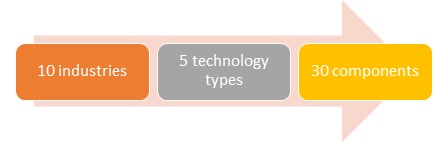
How complex are the
decisions: There are at least 1500 combinations to assess.
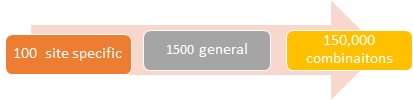
But there are also
site-specific considerations such as cost of electricity, reagents,
pollution limits, plant life, existing equipment. So, these can present
another 100 variables resulting in 150,000 factors.
There are mountains
of information available on all the different variables. Determining which
information will help select the lowest total cost of ownership product is a
daunting task. The answer is “shared responsibility and collaboration”.
Organizations focused on components such as filter media or reagents can
contribute but only if there is a clear path on how to do so. The Dry
Scrubber Users Group which is focused on the subject in the broadest terms
can be the catalyst to help bring other organizations into what can be
titled a True Cost program. The program can provide access to the needed
evidence for validation of lowest total cost of ownership. Conferences and
exhibitions can provide a forum for actual validation of supplier claims.
The categories include component related conferences as well as industry
conferences.
Shared
responsibility and collaboration are best driven by suppliers who are
convinced that their product has the lowest true cost and are willing to
help provide all the evidence pro & con to support their position. Coal
Fired Boiler Decisions has a Dry Scrubber Decision Guide, a monthly FGD
newsletter and another newsletter just on Fabric Filters. Information has
been compiled for this service for 45 years. Collaboration with publishers
and conference organizers includes dry scrubbing tour maps and networking at
exhibitions.
Coal-Fired Power
Plant Decisions is being offered free of charge to utility operators.
Suppliers are able to participate with just a $1600/yr subscription. For
more information click on
44I Coal Fired
Power Plant Decisions.
Bob McIlvaine can
answer your questions at 847-784-0013; email
rmcilvaine@mcilvainecompany.com.
COAL-FIRED BOILERS
How ACE Affects
Today’s Utility Plants
The Affordable Clean
Energy (ACE) Rule, which was finalized June 19, replaces the Obama
Administration’s Clean Power Plan (CPP). ACE is similar to what was
originally proposed as Building Block 1: a list of “energy efficiency
measures” that power plants will need to install; each unit will be
prescribed its control measures individually by its state. “States will
evaluate applicability to their existing sources of the six candidate
technologies and improved operating and maintenance practices and take into
consideration source-specific factors in establishing a standard of
performance at the unit level.”
The rule did not set
specific limits. It demands the State determine the limits. The rule only
applies to certain existing coal-fired Electric Generating Units (EGUs) and
excludes integrated gasification combined-cycle (IGCC) facilities.
ACE applies to
plants which:
·
Were operating or in
construction before January 8, 2014,
·
That sell greater
than 25 megawatts (MW) to the grid
·
Have a base load
rating greater than 250 MMBtu/hr, and
·
Burn greater than
10-percent coal as part of the plant’s average annual heat input
ACE excludes:
·
Simple cycle
combustion turbines
·
Combined cycle
combustion turbines
·
Combined heat and
power combustion turbines
·
IGCC
Heat Rate
Improvement is the best system of emission reduction, but at least eight
technologies must be evaluated by the states. Each of these eight
technologies must be evaluated for what improvement (limit) they could
achieve. Then each technology is accepted or rejected based on cost,
feasibility, other reasons that are supported in the evaluation. However,
similar to a Best Available Control Technology (BACT) analysis under PSD,
the rule did not define what is “too costly.”
(1)
Neural network
(2)
Intelligent
sootblowers
(3)
Boiler feed pumps
(4)
Air heater and duct
leakage control
(5)
Variable frequency
drives
(6)
Blade path upgrade
(applicable to a steam turbine)
(7)
Redesign or replace
the economizer
(8)
Improved O&M
practices, such as operator heat rate improvement training, on site
appraisals, and condenser cleaning
States must set an
emission rate and it is anticipated this rate will be in terms of net or
gross pounds of greenhouse gas per megawatt (lb./MW). The state must specify
how these limits will be verified (continuous emissions monitors, annual
stack test, etc.). States have flexibility in setting these limits, which
can be set at various averaging periods or different rates can be set for
different loads. Where rates not readily verified or measured, operating
practices could be the solution. States can consider source specific factors
like remaining useful life of an existing source in applying performance
standards to that source, which gives a state the ability to exempt an older
unit from compliance or setting a less stringent standard for older assets.
Averaging across designated facilities at a single plant and
averaging/trading between plants is NOT permissible.
Technologies that do
not have to be reviewed include:
·
Natural gas
repowering
·
Natural gas
co-firing
·
Natural gas
refueling
·
Carbon capture and
storage
·
Co-firing with
biomass is not allowed to be reviewed
·
Carbon capture and
storage, full or partial
States have three
years to evaluate all the units and submit a State Implementation Plan (SIP)
to the EPA. The EPA has six months to determine if the SIP is complete or
not. he EPA will act on the SIP within 12 months after determination if it
is complete or 18 months after it is submitted if no completeness
determination is made. The EPA has two years to issue a Federal
Implementation Plan (FIP) after SIP is incomplete or disapproved, or failure
of State to issue a SIP.
Finally, and
importantly, the EPA has not finalized anything regarding proposed changes
to New Source Review (NSR) for “energy efficiency projects,” which can
easily trip Prevention of Significant Deterioration (PSD) permitting and
installation of Best Available Control Technology (BACT) for non-greenhouse
gas pollutants. The EPA intends to take final action on the proposed NSR
reforms in a separate final action at a “later date.” Until then, EPA
advises consult with your legal staff for evaluation the PSD implications of
implementing the ACE rule.
Coalition of U.S. States and Cities Challenges Trump Coal Pollution
Wind-back
A coalition of 22
states, the District of Columbia and six cities have filed a legal challenge
in the U.S. Court of Appeals
against the Environmental Protection Agency’s (EPA) regulation to replace
President Obama’s Clean Power Plan. The Clean Power Plan set state-by-state
targets for greenhouse gas emission reductions from coal-fired power plants
while the latest EPA plan leaves emissions cuts up to each state. The legal
challenge argues that the EPA’s replacement rule does not “meaningfully” cut
greenhouse gas emissions and is not consistent with the Clean Air Act.
Doosan Lentjes to Supply Fabric Filters in the Czech Republic
Doosan Lentjes is pleased to announce that it has signed a contract for the
supply of fabric filters for a power plant in Chvaletice, Czech Republic.
The main contractor is the local company ZK Termochem.
The power plant with its 4 x 205 MWe boilers is owned and operated by the
Czech energy supplier Seven Energy. All four units will be equipped with new
filter systems, with the filters for boilers 3&4 being installed first,
followed by those for boilers 1&2.
The current contract includes the delivery of two new low-pressure bag house
filters downstream of boilers 3 & 4; the contract for the delivery of the
filters for the units 1&2 will be concluded separately.
Doosan Lentjes’ scope of work in the project will include engineering,
delivery of key filter internals and the flyash transport system.
WASTE -TO-ENERGY
36,000 Hours of
Operation for P84+PPS Bags at Eskom
Eskom owns and operates more than 40 GW of installed
capacity and is the largest utility in Africa. The Arnot Power Station
consists of six nominally rated 350-MW coal-fired units originally installed
between 1968 and 1975. The station burns a relatively poor South African
bituminous coal composed of 25 percent ash with a heating value of 26 to 27
megajoules per kilogram (MJ/kg). The plant has posted 92.07 percent average
availability over the past three years.
Arnot Power Station was upgraded from ESPs to baghouses in the 1990s as part
of a project to increase plant capacity. Phase 1 added baghouses to Boilers
4, 5 and 6 (each containing 11,000 bags) with a maximum gas-to-cloth ratio
of 3.5 CFM/ft2. Phase 2 added baghouses (each with 14,000 bags)
to the remaining three boilers with a maximum gas-to-cloth ration of 2.8
CFM/ft2.
Once Eskom understood that blinding was the predominant bag failure
mechanism across the various plants, it embarked on research aimed at
retarding the blinding rate, hence extending bag life and performance. After
a number of trials, and in collaborative effort with fiber and fabric
suppliers (including the full-scale evaluation at Arnot), the solution
chosen was to install composite bags with a P84 cap applied to a PPS
substrate, which ensured the formation of a porous and stable dust cake that
promoted complete acid neutralization and surface filtration. The service
life of the latest sets of P84+PPS bags is more than 36,000 hours, with less
than 10 percent failure of the 27,000 bags installed per unit.
The switch to P84+PPS bags has resulted in significant savings for Eskom,
about $500,000 annually. That figure does not include reduced costs for
labor, or production losses, which can be significant. In one instance,
prior to the switch to P84+PPS bags, two boilers were shuttered for four
months waiting for replacement bags.
https://www.powermag.com/improve-baghouse-performance-with-custom-filtration-media/?pagenum=3
Valmet to Supply a Biomass Boiler and a Flue Gas Treatment Plant to BS
Energy’s Combined Heat and Power Plant in Braunschweig, Germany
Valmet will supply a biomass-fired boiler and a flue gas treatment plant to
BS Energy's combined heat and power (CHP) plant in Braunschweig, Germany.
The order was included in Valmet's orders received of the second quarter
2019. The total value of the order is around €50 million.
The boiler with its auxiliary equipment will be part of BS Energy’s energy
production strategy 2030. The primary target of the investment is to replace
the coal-fired boiler, which will be removed from production in 2022. In
addition, the new biomass-fired CHP plant will support BS Energy's objective
of environmentally friendly and carbon-neutral production, as it will serve
as a base-load unit to meet the district heating and electric power needs of
the Braunschweig municipality.
The biomass-fired CHP plant will produce approximately 20 megawatts of
electricity and 60 megawatts thermal of district heat. The takeover of the
biomass-fired CHP plant is scheduled for early 2022.
The CYMIC circulating fluidized bed boiler included in Valmet's delivery
will use recycled wood as its primary fuels. The boiler generates 27 kg/s of
high-pressure steam at a pressure of 75 bar and a temperature of 525°C. Its
steam-generating capacity is 78 MWth.
The flue gas cleaning system included in the delivery will enable fulfilling
the tightening emission standards for the future, with the help of a
two-phase dust removal system and a semi-dry sorbent injection system.
MHIEC Receives Order to Refurbish the Hiroshima Naka Waste to Energy Plant
Mitsubishi Heavy Industries Environmental & Chemical Engineering Co., Ltd.
(MHIEC), a Group company of Mitsubishi Heavy Industries, Ltd. (MHI), has
received an order from the Hiroshima city government to refurbish the
combustion facilities at the Naka Waste to Energy Plant for a municipal
solid waste (MSW) in Minamiyoshijima, Naka-ku, Hiroshima, with a total waste
treatment capacity of 600 tonnes per day (tpd). MHIEC will refurbish and
improve stoker type incinerators (1) and related equipment, extending the
working life of the facility and enhancing its energy efficiency. The
contract is valued at 5.84 billion. Completion is scheduled for in March
2023 (four-year project).
The Naka Waste to Energy Plant was designed and built by MHI and completed
in February 2004. It has three stoker type incinerators, each with a
capacity of 200 tpd that operate continuously 24-hours per day, and related
equipment. The facility generates 15.2 MW of electricity to power the
equipment in the factory, selling the remainder.
The renovation contract comprises the renewal of superannuated core
components at the facility, including the receiving and feeding equipment,
combustion facilities, exhaust gas cooling equipment, ventilation systems,
ash extractors, and instrumentation. The renovation will incorporate MHIEC's
patented New Incineration Control System to support stable incineration, as
well as the use of high-efficiency motors and inverters to increase energy
efficiency. These measures will reduce CO2 emissions by around 9.6 percent
annually, helping to curb global warming.
WELDING FUMES
Nederman Offers Solution to the Dangers of Welding Fumes
The Nederman website discusses the health risks of welding fume, and how to
reduce them in the workshop.
Some of the components of welding fume, such as oxides of chromium, nickel,
cadmium and manganese, are known or suspected carcinogens. As
stainless-steel welding fume has a higher content of these alloying elements
(as well as carbon) than mild steel welding fume does, the former was up
until recently thought to be significantly more hazardous. What the IARC
discovered is that while mild steel welding fume contains much lower
concentrations of these elements, the concentrations are still potent enough
to cause cancer in humans.
The fume created by welding processes is made up of solid particulates
(ranging from 10 nanometers to 20 microns in size), which are formed when
metallic vapors condense. Much of this fume is respirable and can penetrate
deep into the lungs, where it can do significant harm and also spread into
the bloodstream.
What further exacerbates the risk of exposure is that the act of welding
requires the welder to locate his or her head – and, hence, breathing zone –
close to the point of fume generation, as the welder simply needs to see the
weld progressing. Unless there is adequate fume capture in place, the welder
will be exposed to a high concentration of hazardous fumes.
While the proximity to the fume source (and its significant fume
concentration) puts the welder at an especially high risk of exposure,
fugitive emissions may affect other personnel as well. This a key reason why
effective at source capture is the recommended engineering control method,
as it prevents the fume from entering and spreading throughout the general
atmosphere. It is also for this reason that general ventilation without at
source capture, with the welder alone wearing respiratory protection (once a
common method of fume control), is no longer recommended.
Nederman has developed an industry-leading portfolio of at source fume
capture products which minimize the welder’s exposure to hazardous welding
fume. They are able to offer efficient solutions for any welding
application, whether it is high air volume, easy to position extraction arms
or FilterCart. Fume Eliminator, and multi-user fixed weld fume extraction
systems.
COMPANY NEWS
Donaldson Achieved Record Sales in 2019
Donaldson Company, Inc. reported 2019 net earnings of $58.0 million in 4th
quarter and $267.2 million for the full year, compared with $102.4 million
and $180.3 million, respectively, in 2018. Excluding certain one-time items
in the current and prior years, adjusted earnings per share (EPS) were $0.61
in 4th quarter and $2.21 for the full-year 2019, an increase of
5.2 percent and 10.5 percent, respectively, from 2018.
“We generated record sales and profit in 2019, due in part to strong
performance in our Advance and Accelerate businesses, and we made a record
level of investments to drive long-term profitable growth,” said Tod
Carpenter, Chairman, President and
Chief Executive
Officer.
“We were pleased with sales results
last quarter, which matched our forecast, and earnings were also in line as
a better-than-expected tax rate offset the impact of demand volatility on
gross margin.
“Our fiscal 2020 plan reflects focused portfolio management in an uneven
demand environment. It is likely that uncertainty related to global trade
and the political environment will keep our customers cautious, and some of
our engine-related end markets are nearing the peak of their economic cycle.
As these factors affect demand, our innovative products with recurring
revenue, combined with disciplined expense planning, give us greater
stability and flexibility as we remain focused on the future. We are making
incremental investments to drive our strategic priorities in 2020, and we
are aggressively pursuing gross margin improvement opportunities. Our
company is aligned on our strategic and operational objectives, and we are
excited about our path to delivering another year of record profit.”
The 4th quarter sales of Industrial Products (Industrial)
increased 3.3 percent from last year. Industrial realized benefits of 3.9
percent from BOFA and 0.5 percent from pricing, partially offset by a
negative impact from currency translation of 2.2 percent. Sales of
Industrial Filtration Solutions (IFS) increased 6.2 percent, reflecting
benefits from BOFA and replacement parts, partially offset by lower sales of
new equipment. Gas Turbine Systems (GTS) sales increased due to the timing
of new equipment sales, and the Special Applications (SA) sales decline was
due to Disk Drive filters.
The
4th
quarter 2019 operating income as a rate of sales (operating margin) declined
to 14.4 percent from 14.9 percent in 2018,4
including a negative impact of 0.1 percentage point from revenue
recognition.
The
4th
quarter gross margin was 33.5 percent, compared with 34.9 percent in 2018,
including a negative impact of 0.2 percentage points from revenue
recognition. The year-over-year gross margin decline was driven by
unfavorable mix of product sales within markets, combined with higher raw
materials and supply chain costs. These gross margin pressures were
partially offset by pricing benefits. Operating expense as a percent of
sales (expense rate) improved 0.8 percentage points to 19.2 percent from
20.0 percent in 2018, reflecting lower incentive compensation expense,
partially offset by higher salary and other employee-related expenses.
Donaldson expects fiscal 2020 GAAP EPS between $2.21 and $2.37, compared
with fiscal 2019 GAAP and adjusted EPS of $2.05 and $2.21, respectively.
Compared with 2019, fiscal 2020 sales are projected in a range between a 2
percent decline and a 4 percent increase, including a negative impact from
currency translation of 1 to 2 percent that is partially offset by price
benefits of approximately 1 percent.
Industrial sales are expected to increase from fiscal 2019 between 2 and 8
percent, reflecting growth in IFS and GTS, partially offset by declining
sales in SA. Within Industrial, growth in IFS is due in part to one quarter
of incremental benefits from the acquisition of BOFA. Currency translation
is expected to negatively impact both segments by 1 to 2 percent.
All Babcock & Wilcox Business Segments Showed Improved Results
Babcock & Wilcox Enterprises, Inc. ("B&W Enterprises") announced 2nd
quarter 2019 GAAP net loss from continuing operations improved by $181.3
million to $28.3 million compared to $209.7 million in 2nd
quarter 2018. Adjusted EBITDA also improved by $90.4 million to a positive
$8.0 million compared to negative $82.4 million in the prior year period,
returning the company to profitability on an adjusted EBITDA basis.
"Our performance in the 2nd
quarter of 2019 shows we are continuing to gain steam following our recent
strategic actions and cost-saving efforts. Our consolidated business
improved operating margins significantly and returned to profitability on an
adjusted EBITDA basis of $8.0 million. Our Babcock & Wilcox segment
continued its strong performance and across the company we are making steady
progress on our strategy to improve profitability by focusing on our core
technologies and businesses," said Kenneth Young, B&W Enterprises Chief
Executive Officer. "With our equitization transactions complete, we are
preparing to re-finance as planned to support our ongoing financial
recovery. As 2019 continues, we look forward to demonstrating the underlying
core strengths of our businesses to our customers and shareholders."
"This quarter we identified more cost efficiencies and as a result we've
begun to implement $19 million in additional savings initiatives, for a
total of $119 million in annualized savings," Young continued. "We expect to
see improvement each quarter as our cost-savings measures continue to
translate to bottom-line results and the effects of the EPC loss contracts
continue to decline. We are committed to our ongoing transformation,
confident in our dedicated employees and world-class technologies, and
optimistic about our strategic path to sustained profitability."
Babcock & Wilcox
segment
revenues increased 1.6 percent to
$201.0 million in the 2nd
quarter of 2019 compared to $197.8 million in the prior-year period, mainly
driven by large construction new build projects, including industrial
projects, partially offset by a decrease in parts and retrofit sales. Gross
profit in the Babcock & Wilcox segment in 2nd
quarter 2019 was $37.9 million, compared to $30.0 million in the prior-year
period, primarily due to higher construction volume and lower warranty
costs. Gross profit margin was 18.8 percent, compared to 15.2 percent in the
same period last year. Adjusted EBITDA in 2nd
quarter 2019 increased 92 percent to $19.0 million, compared to $9.9 million
in last year's quarter; adjusted EBITDA margin was 9.5 percent compared to
5.0 percent in the same period last year.
Porvair Acquires Dahlman Industrial Group B.V.
Porvair plc, has acquired Dahlman Industrial Group B. V. ("Royal Dahlman"),
a Dutch industrial filtration business, trading as Royal Dahlman.
Based in the Netherlands, the company supplies filtration services and
technology to customers worldwide, with particular expertise in
petrochemical filtration engineering.
The Dahlman brand will be maintained in continental Europe. It’s two
divisions, each with a distinct offering in the filtration market, will
continue to operate within their current structure, Dahlman Filter
Technologies (DFT) and Dahlman Filter Services (DFS).
Tom Liddell, Managing Director of Porvair Filtration Group stated: “The
acquisition brings us a valuable wealth of filtration experience that will
help strengthen our offering to customers worldwide.”
Ben Stocks, Chief Executive of Porvair plc, said: "Royal Dahlman brings
engineering expertise in petrochemical emissions control applications where
regulations are expected to tighten.
It also has excellent routes to market in Benelux and Northern Europe for
industrial filtration through which the combined business can offer a much
wider product range.
Hangzhou Grace Envirotech Offers High Efficiency Filtration Solutions
Hangzhou Grace Envirotech Co., Ltd, with the brand "ECOGRACE," is one of the
subsidiaries of Grace Filter MFG, based in U.K. and developed in China.
Grace Filter stands for high efficiency filtration solutions and expertise
service for filtration industry. They have had success in dust emission
control and purifying projects in coal-fired boiler power plants,
blast-furnaces in steel plants, asphalt mixing sites and cement kilns and
chemical industries, etc.
Their production and service scope is as follows:
·
Filter
Media/Filtration Felt
·
Dust collector filter bags
·
Dust collector equipment/Bad Dust collection systems
They are dedicated to providing the most economical, efficient and optimized
filtration solutions, with emission control <15mg/ m3, totally
solving the PM2.5 control standard. Dust filters working life
will be 20 percent longer than others.
BWF Group Opens Second Sales Location in the Czech Republic
The new sales office of BWF Envirotec in Ostrava, Czech Republic, offers the
complete product range, from filter bags to application technology
consulting, through to services such as filter bag installation,
commissioning, and maintenance and repair for industrial filtration. The
focus is on large filter systems, such as those found in coal-fired power
plants, waste incineration plants, steelworks, and cement kiln filters.
With a population of almost 300,000, Ostrava is the third largest city in
the Czech Republic and in recent years has developed into the economic
center of Moravia-Silesia. Ostrava is situated on the north-eastern border
of the Czech Republic and thus directly on the border with Poland and
Slovakia.
The greater Ostrava area is home to numerous large industrial groups. The
traditional focus of the region is on coal and heavy industry. But the city
also offers excellent development opportunities for other branches of
industry, such as research and development and the IT sector.
The new sales office of BWF Envirotec, Czech Republic, offers the complete
product range, from filter bags to application technology consulting through
to services such as filter bag installation, commissioning, and maintenance
and repair for industrial filtration. The focus is on large filter systems,
such as those found in coal-fired power plants, waste incineration plants,
steelworks, and cement kiln filters.