FABRIC
FILTER NEWSLETTER
August 2019, No. 526
MARKETS
·
India Will Be A
Major Purchaser of Dry Scrubbers
·
Selling To the 500
Coal Plant Owners Who Make 99 Percent of the Purchases
METALS
·
Sail Durgapur Awards
SMS Group with Turnkey Modernization for New Converters and Environmental
Facilities
·
SMS Group
Successfully Commissioned the Compact Cold Mill at Aisha Steel Mills Ltd.
·
NioCorp Files its
Elk Creek Project Construction Air Permit Application with the State of
Nebraska
·
Primetals
Technologies Develops Break-through Technology for Carbon-free,
Hydrogen-based Direct Reduction for Iron Ore Fines
·
Nordic Air
Introduces Pleated Bag Filters Cartridges for Ultra-Low Emission Projects
COAL-FIRED BOILERS
·
Gore to Reduce
Mercury Emissions from Combined Heat and Power Plant in the Czech Republic
3D PRINTING
·
Nederman
Participating In Additive Manufacturing Research Laboratory
COMPANY NEWS
·
CECO Reports Strong
Bookings and Growing Backlog
·
Parker Reports All
Time Quarterly Record
·
Babcock & Wilcox
Segment Nearly Doubled Adjusted EBITA to $19.0 Million
·
Lydall Second
Quarter Results Show Improvement
·
Black & Veatch
Announces New Global Power Structure to Enhance Focus on Integrated
Generation and Grid Modernization
MARKETS
India is predicted
to purchase dry scrubbers to clean 180 million cfm over the next five years.
This is the latest forecast in
N027 FGD Market and
Strategies.
The bulk of the investment will be for coal-fired power plants. There will
be some installations in waste to energy, cement, steel and other industrial
applications.
India will join
China and the U.S. as the leading three dry scrubber purchasers. Dry
scrubbing includes semi dry scrubbers, circulating dry scrubbers and direct
sorbent injection. United Conveyor Corp. has an order for 4 x 250-MW direct
sorbent injection systems at the Dadri plant of NTPC.
The market surge
will be due to new rules that allow older smaller power plants to discharge
higher levels of SO2 than others. It is anticipated that 50,000
MW of Indian power plans will be fitted with dry scrubbers over the next
three years.
Dry scrubbers are
more economical than wet scrubbers when the emission rates are higher and
the sulfur in the fuel is lower. Dry scrubbers use higher cost lime or
sodium compounds whereas wet scrubbers utilize ground limestone. However,
the capital cost of wet scrubbers is more than twice that of CDS and semi
dry scrubbers. Direct sorbent injection is very low in capital cost but very
high in reagent cost.
Direct sorbent
injection can be used to supplement other systems. DSI can be used in
conjunction with semi dry systems to maintain efficiency at higher sulfur
levels. DSI can also be used ahead of the air heater to react with SO3
and allow the air heater to be operated to extract more heat without
corrosion.
For more information
on this report click on
N027 FGD Market and
Strategies.
Bob McIlvaine can
answer your questions at office 847-784-0013 cell 847-226-f2391 or email him
at
rmcilvaine@mcilvainecompany.com.
Selling To the 500
Coal Plant Owners Who Make 99 Percent of the Purchases
Suppliers of
Combust, Flow, and Treat (CFT) products and services for coal-fired power
can now develop sales programs focused on each individual owner. Coal-fired
power represents one of the largest markets for CFT product suppliers. In
the last 20 years an average of 50,000 MW per year of new coal fired power
plants have been added to the world generation capacity. Over the next ten
years 40,000 MW per year of new capacity will be added. This will be
partially offset by retirement of 13,000 MW per year of existing capacity.
Annual new plant
investment will exceed $160 billion per year. The installed base of plants
has now reached 2 million MW and will increase by 270,000 MW over the next
decade. The investment in the installed base exceeds $4 trillion. Potential
for third party upgrades, repair, service, and remote operation will exceed
$200 billion per year. This includes major environmental upgrades in India
and other countries in Asia, Eastern Europe, and Africa.
McIlvaine has
compiled enough information on each process at each plant to enable
relatively precise forecasting as per the following example for valves.
|
Corporate Name: EVN |
Unit size: MW 660 |
|
Plant Name: Genco 3 Vinh Tan
2 |
Vĩnh Tân commune, Tuy Phong
district, Bình Thuận
province. Vietnam |
|
Unit # 1 |
Specific product purchases
2019 $1000 |
|
Forecasts can be supplied
for sixteen types of valves,
four types of pumps,
actuators, limestone, lime,
precipitator internals, dust
bags, gas instrumentation,
liquid instrumentation,
controls, treatment
chemicals, ammonia, urea,
catalyst, cartridges,
dewatering filter belts,
membrane modules, linings,
nozzles, mist eliminators,
fans, air compressors,
oxidation compressors,
motors, VFD, seals, packing,
hose, couplings, compressed
air filters, lubrication
filters |
Ball valves $170,000 |
|
Butterfly Valves: $120,000 |
|
|
Globe Valves $190,000 |
|
|
Plug Valves: $100,000 |
|
|
Gate Valves: $150,000 |
|
Coal Fired Capacity
for Individual Owners |
||
|
Above MW |
Planned Cumulative # |
Operating |
|
80,000 |
1 |
|
|
60,000 |
2 |
|
|
50,000 |
3 |
|
|
40,000 |
3 |
|
|
30,000 |
8 |
|
|
20,000 |
2 |
10 |
|
10,000 |
8 |
27 |
|
5000 |
25 |
63 |
|
3000 |
50 |
110 |
|
2000 |
70 |
164 |
|
1500 |
90 |
196 |
|
1000 |
150 |
255 |
|
700 |
200 |
307 |
|
500 |
250 |
379 |
|
300 |
300 |
491 |
|
200 |
350 |
570 |
|
100 |
400 |
710 |
|
˂ 100 |
|
900 |
Country Forecasts are based on aggregating forecasts for individual owners.
|
Coal Plants by Country (MW)
Installed Base |
|
|
|
||||
|
Country |
2018 |
2019 |
2020 |
2021 |
2022 |
2023 |
2024 |
|
Albania |
0 |
0 |
0 |
0 |
0 |
0 |
0 |
|
Argentina |
350 |
350 |
350 |
350 |
350 |
350 |
350 |
|
Australia |
24,442 |
24,442 |
24,442 |
24,442 |
24,442 |
24,442 |
24,442 |
|
Austria |
635 |
635 |
635 |
635 |
635 |
635 |
635 |
|
Bangladesh |
525 |
1,200 |
2,500 |
5,500 |
8,000 |
10,000 |
12,000 |
|
Belarus |
0 |
0 |
0 |
0 |
0 |
0 |
0 |
|
Belgium |
0 |
0 |
0 |
0 |
0 |
0 |
0 |
|
Bosnia & Herzegovina |
2,073 |
2,073 |
2,073 |
2,073 |
2,073 |
3,000 |
4,000 |
|
Botswana |
600 |
600 |
732 |
732 |
732 |
1,200 |
1,200 |
|
Brazil |
2,804 |
2,804 |
2,804 |
2,804 |
2,804 |
3,400 |
3,400 |
|
|
|
|
|
|
|
|
|
|
|
|
|
|
|
|
|
|
|
|
|
|
|
|
Brazil Plant Details
|
Unit |
Sponsor |
Parent |
Capacity
(MW) |
Year |
City |
State |
|
MPX Itaqui power project |
Eneva |
E.ON, EBX Group |
360 |
2013 |
Itaqui |
Maranhão |
|
Porto do Pecém I Unit 1 |
Eneva, EDP Energias do
Brasil |
Eneva, EDP |
365 |
2012 |
São Gonçalo do Amarante |
Ceará |
|
Porto do Pecém I Unit 2 |
Eneva, EDP Energias do
Brasil |
Eneva, EDP |
365 |
2013 |
São Gonçalo do Amarante |
Ceará |
|
Porto do Pecém II Unit 1 |
Eneva |
E.ON, Eneva |
365 |
2013 |
São Gonçalo do Amarante |
Ceará |
|
Porto do Pecém-1Unit 1 |
EDP Energias do Brasil |
EDP |
365 |
2012 |
São Goncalo do Amarante |
Ceará |
|
Porto do Pecém-1 Unit 2 |
EDP Energias do Brasil |
EDP |
365 |
2013 |
São Goncalo do Amarante |
Ceará |
|
Porto do Pecém-2 Unit 1 |
Eneva |
E.ON, EBX Group |
365 |
2013 |
São Goncalo do Amarante |
Ceará |
|
Presidente Médici-A Unit 1 |
Companhia de Geração Térmica
de Energia Elétrica |
Eletrobras |
63 |
1974 |
Candiota |
Rio Grande do Sul |
|
Presidente Médici-A Unit 2 |
Companhia de Geração Térmica
de Energia Elétrica |
Eletrobras |
63 |
1974 |
Candiota |
Rio Grande do Sul |
|
Presidente Médici-B Unit 1 |
Companhia de Geração Térmica
de Energia Elétrica |
Eletrobras |
160 |
1986 |
Candiota |
Rio Grande do Sul |
|
Presidente Médici-B Unit 2 |
Companhia de Geração Térmica
de Energia Elétrica |
Eletrobras |
160 |
1987 |
Candiota |
Rio Grande do Sul |
|
Presidente Médici-C Unit 1 |
Companhia de Geração Térmica
de Energia Elétrica |
Electrobras |
350 |
2010 |
Candiota |
Rio Grande do Sul |
High quality
forecasts now allow a supplier to project purchases for each owner. A large
percentage of coal plant CFT products are purchased based on decisions of a
group and a consensus built up over time. Therefore, the continuous pursuit
rather than response to a sales lead is more productive. Larger purchasers
can be pursued differently than those in the middle or those at the bottom.
Here are utilities in the middle with 6000 – 9000 MW range of existing and
planned capacity. J Power is the only company appearing on both lists.
|
Planned Coal Fired |
|
|
Company |
MW |
|
Power Finance Corporation |
8,000 |
|
Egyptian Electricity Holding
Company |
7,920 |
|
KEPCO |
7,698 |
|
China Resources |
7,035 |
|
NLC India |
6,700 |
|
TANGEDCO |
6,640 |
|
J-POWER |
6,356 |
|
Eskom |
6,352 |
|
UPRVUNL |
6,270 |
|
Operating Coal Fired |
|
|
Company |
MW |
|
8,772 |
|
|
J-POWER |
8,482 |
|
Inter RAO |
8,372 |
|
Vedanta Resources |
8,327 |
|
Xcel Energy |
7,915 |
|
Henan Investment Group |
7,840 |
|
Beijing Energy Group |
7,772 |
|
Engie |
7,387 |
|
Damodar Valley Corporation |
7,240 |
|
AES |
7,025 |
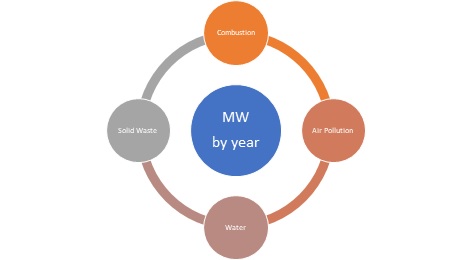
The CFT purchases
can all be related to existing and new MW. Details on each process for each
owner also are important. McIlvaine has details on FGD, SCR, precipitators,
fabric filters, and other components in databases which have been compiled
and augmented since the 1970s.
The combustion
segmentations are by boiler design, e.g., fluid bed or pulverized coal.
Also, the efficiency division: subcritical, supercritical, and
ultra-supercritical is important. China is upgrading more than 100,000 MW of
subcritical and supercritical to ultra-supercritical.
Intake water, boiler
feedwater, type of cooling, wet FGD, and wastewater treatment can be
identified. A number of plants are improving their wastewater treatment and
often opting for zero liquid discharge and maximum water reuse.
Solid waste is a
challenge due to increasingly stringent standards. Switching from wet to dry
flyash handling and dewatering ponded flyash are major opportunities.
By-product sales potential is also a driver.
Various air
pollution control approaches are used for reducing SO2, NOx,
particulate, mercury, VOCs and even CO2 (sequestering). It is
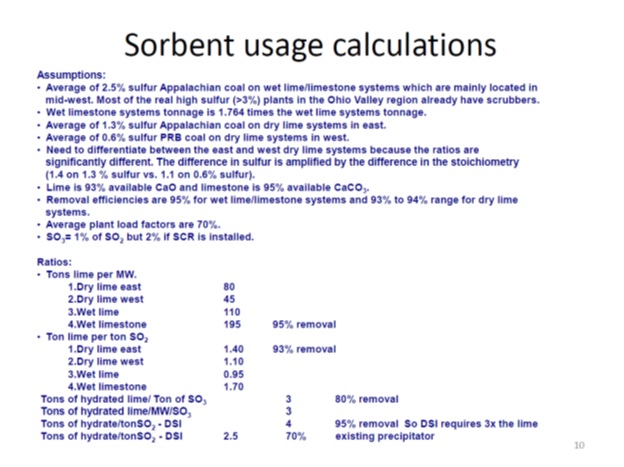
impossible to make precise determinations for each plant because of
variations in the fuel and other site-specific factors. Rules of thumb
provide a relatively accurate way of forecasting as per the following
sorbent example.
The coal-fired power
industry is unique in that relatively few companies make nearly all the
purchases. Details on their operations are available. This means that a CFT
supplier can structure his sales program around these specific companies and
pursue the most profitable markets. This program is explained at
www.mcilvainecompany.com.
Details on coal
plants by country and on the individual plants are tabulated in
42EI Utility
Tracking System.
Bob McIlvaine can
answer your questions at 847-784-0013, cell 847-226-2391, email
rmcilvaine@mcilvainecompany.com.
METALS
Sail Durgapur Awards
SMS Group with Turnkey Modernization for New Converters and Environmental
Facilities
Steel Authority of
India Limited (SAIL) Durgapur, India, has awarded SMS group a turnkey
contract for the supply of three new 110-ton converters for its steelmaking
plant No. 2 to replace the converters SMS group supplied 25 years ago. The
new converters will be rated for ten percent more volume.
Moreover, SMS group
will supply secondary dust collecting systems for the three converters. The
new systems will be installed in the works for the first time and will more
than meet the relevant environmental requirements.
Commissioning of the
complete plant is scheduled for September 2020.
SMS Group
Successfully Commissioned the Compact Cold Mill at Aisha Steel Mills Ltd
By rolling the first
coil, SMS group has successfully put into operation the new CCM®
(Compact Cold Mill) of Aisha Steel Mills Limited (ASML) in Karachi,
Pakistan. Since 2015, this has already been the third successful
installation of the two-stand type of cold rolling mill by SMS group in
Pakistan.
The CCM®
at ASML is designed for an annual cold strip production capacity of 500,000
tons. The new facility enables ASML to supply the local market with
high-grade cold strip according to international standards and helps the
company to make its contribution to reducing the country`s dependency on
high-quality cold strip imports. The products rolled on the CCM®
are up to 1,250 millimeters wide and down to 0.15 millimeters thin.
The CCM®
features two mill stands in four-high design with the proven roll shifting
technology CVC®plus (Continuously Variable Crown) by SMS group.
CVC®plus is supplemented by further actuators to infinitely
adjust the roll gap, for example positive and negative work roll bending.
The quality-determining technical highlights of the plant include two
X-Shape flatness measurement rolls, installed at the entry and exit sides,
together with multi-zone cooling system and automatic flatness control.
The
highly-productive CCM® is equipped with the holistic X-Pact®
electrical and automation system from SMS group. SMS group supplied the
complete plant with all auxiliary equipment, such as modern technological
instrumentation, emulsion plant, high- and low-pressure hydraulics as well
as the fume exhaust system.
With this CCM®
from SMS group, ASML operates a high-quality and modern plant technology
suited to meet present and future requirements.
NioCorp Files its
Elk Creek Project Construction Air Permit Application with the State of
Nebraska
NioCorp is
developing a superalloy materials project in Southeast Nebraska that will
produce Niobium, Scandium, and Titanium. Niobium is used to produce
superalloys as well as High Strength, Low Alloy (“HSLA”) steel, which is a
lighter, stronger steel used in automotive, structural, and pipeline
applications. Scandium is a superalloy material that can be combined with
Aluminum to make alloys with increased strength and improved corrosion
resistance. Scandium also is a critical component of advanced solid
oxide fuel cells. Titanium is used in various superalloys and is a key
component of pigments used in paper, paint and plastics and is also used for
aerospace applications, armor and medical implants.
NioCorp Developments
Ltd announced it has submitted a State Construction Air Permit application
for its Elk Creek Superalloy Materials Project (the “Project”) with the
Nebraska Department of Environmental and Energy (“NDEE”).
The permit review
process will be led by NDEE personnel. The advanced emissions control
technologies included as part of the planned Project are expected to result
in prospective air emissions that are below levels that trigger the need for
a permit under the Prevention of Significant Deterioration (“PSD”) program.
As a result, the Project is expected to be able to navigate a more efficient
permitting process than is typically encountered under the PSD process.
The Project’s
relatively low planned emissions profile resulted from NioCorp’s early
efforts to recycle process reagents and its plans to deploy various
emissions control technologies, such as baghouses, scrubbers, low nitrogen
oxide (NOx) combustion systems, state-of-the-art acid regeneration, and
other technologies.
Primetals
Technologies Develops Break-through Technology for Carbon-free,
Hydrogen-based Direct Reduction for Iron Ore Fines
Primetals
Technologies has developed the world's first direct reduction process for
iron-ore concentrates from ore beneficiation not requiring any preprocessing
like sintering or pelletizing. Primetals can resort to the comprehensive
experience from the earlier Finmet development and plant installations. The
new technology can be applied to all types of beneficiated ore and particle
sizes of 100 percent smaller than 0.15 mm. As primary reduction agent, the
new process uses H2 from renewable energy or alternatively H2 rich gases
from conventional steam reformers or H2 rich waste gases. This results in a
low or even a zero CO2 footprint. The direct reduction plant
comes in a modular design with a rated capacity of 250,000 tons per year and
module, making it available for all sizes of steel plants. A pilot plant for
testing purposes will be set up at voestalpine Stahl Donawitz, Austria and
is due to be commissioned in the second quarter of 2020.
The use of DRI/HBI
is expected to continue to grow due to the need to reduce greenhouse gas
emissions and the growing number of electric arc furnaces in service
worldwide. Currently, all available technologies require agglomeration, like
pelletizing to produce DRI or HBI. An additional challenge steel producers
face, is the reduced quality of iron ore, resulting in the need to
beneficiate the iron ores. In order to progress to a CO2-free
steel production, a process using mainly H2 is most desirable. The solution
developed by Primetals Technologies takes care of all the above
considerations.
The pilot plant will
consist of three parts: a preheating-oxidation unit, a gas treatment plant
and the actual reduction unit. In the preheating-oxidation unit, fine ore
concentrate is heated to approx. 900° C and fed to the reduction unit. The
reduction gas H2 is supplied over the fence from a gas supplier.
A waste heat recovery system from the off-gas ensures optimal energy use and
a dry dedusting system takes care of dust emissions from the processes
involved. The hot direct reduced iron (HDRI) leaves the reduction unit at a
temperature of approx. 600° C, which can be subsequently used in an electric
arc furnace or to produce Hot Briquetted Iron. The aim of the pilot plant is
to verify the break-through process and to serve as a testing facility to
provide the data basis for setting up an industrial scale size plant at a
later date.
Nordic Air
Introduces Pleated Bag Filters Cartridges for Ultra-Low Emission Projects
The theme of the
forum was "New Beginning of Green Development of China Steel & Ultra-Low
Emissions Leading Revolution.” The forum, the leaders and experts of the
conference focused on a series of issues such as ultra-low emission
regulations within the steel industry, carbon emissions and the improvement
of green and low carbon development capacity of steel enterprises, sharing
advanced environmental protection, energy-saving technologies, and
successful experiences.
Ultra-low emissions
are a new starting point for the green development of the steel industry.
This will inevitably require further innovation in technology and will also
lead to revolutionary changes in the traditional steel manufacturing
industry.
Bona Bo, IAF Sales
Director of Nordic Filter Systems (Kunshan) Co., Ltd., was invited to talk
about the plan against heavy pollution within steel enterprise in 2019. He
shared his experience about air pollution curbing and controlling concerning
steel enterprise in key cities, by introducing the pleated bag filter
cartridges usage in the ultra-low emission projects for iron and steel
industry.
COAL-FIRED BOILERS
Gore to Reduce
Mercury Emissions from Combined Heat and Power Plant in the Czech Republic
New EU regulations
limiting mercury and SO2 emissions are due to come into force by
2021, and for operators of coal-fired power plants, it’s time to act.
The Czech Republic,
like many other countries in Central and Eastern Europe, will rely on coal
for power production for many more years. A proven, reliable and low cost
technology to reduce emissions is needed to meet current and future
regulations and to minimize negative environmental impact.
An innovative system
made by W. L. Gore & Associates (Gore), is providing the solution.
In the CEZ Group’s
Mělník I plant, which supplies heat and power to Prague, GORE®
Mercury Control Modules will be installed in one of the plant's
desulphurization scrubbers as a demonstration project, treating
approximately 1,000,000 Nm³/h of flue gas.
Additional modules
can be added to that unit and to a second line, bringing both lines into
compliance with EU Industrial Emissions Directive regulations.
This is part of an
overall strategy of CEZ to reduce emissions according to EU standards and to
be fully compliant with all of their plants in the Czech Republic and other
countries in the EU.
The GORE Mercury and
SO2 Control System (GMCS) is a passive system for flue gas
cleaning that consists of modules installed in a plant’s wet scrubber.
The Gore system
eliminates the need to add chemical additives, and the modules are designed
for a service life of several years without maintenance. This eliminates
many of the undesirable complications and high operating costs associated
with traditional mercury control systems.
The GORE Mercury and
SO2 Control System has already been proven for four years in
several US coal-fired power plants. Mělník is the fifth power plant in
Europe to test or apply the Gore technology. It joins two plants in Poland (Belchatow
and Patnow) and two in Germany (Schkopau and Chemnitz).
CEZ is confident
that Mělník will again confirm the suitability of the system, especially for
European lignite-based power plants.
3D PRINTING
Nederman
Participating in Additive Manufacturing Research Laboratory
As more and more
companies use 3D printing in their operations, questions have been raised
regarding associated health and safety issues. There is a concern about the
fumes, dust and odors created during the printing and post processes. With
3D printing being a relatively young industry, scientists have only recently
begun to investigate this. And there are studies indicating potential health
risks associated with using the technologies. This is the case regardless if
you are using the printing process of, for example, material extrusion,
binder jetting or powder bed fusion. Study results show that printers emit a
significant amount of ultrafine particles (UFPs) and hazardous volatile
organic compounds (VOCs). Post processes of gluing, grinding and painting
the product have also been shown to generate potentially hazardous
pollutants.
Depending on which
material and printing process you are working with, the pollutants can be
both
combustible
and cause various health problems if inhaled. This applies especially in
cases of large-scale manufacturing where several machines run
simultaneously. Good ventilation and customized fume and dust extraction
systems are therefore important to ensure a safe work environment.
As a provider of
clean air solutions, Nederman is participating in the construction of an
additive manufacturing research laboratory at Swerea IVF. The Swedish
research institute conducts research for industrial renewal and sustainable
development. One of their current projects is to set up a production line
for additive manufacturing of metallic materials. The aim is to facilitate
the industrialization of additive manufacturing by creating a platform for
innovative products, materials and processes. In addition, the research
laboratory will function as a showroom to display 3D printing applications
to interested parties.
The Additive
Manufacturing Research Laboratory includes desktop 3D printers as well as a
system for large-scale manufacturing. Nederman is providing air filtration
and fume extraction solutions for both of these areas. As for now, we have
installed benchtop extraction kits for the desktop 3D printers. The kits
include a fan, filter, fan speed controller, hoses, table brackets and
connectors. Next, they will provide a fume and dust extraction solution for
the large-scale manufacturing system. Their solution will extract fumes
during the printing process and dust during the machining process. This is
done using the same vacuum unit.
COMPANY NEWS
CECO Reports Strong
Bookings and Growing Backlog
CECO Environmental
Corp. reported its financial results for the 2nd quarter
and first six months of 2019.
Revenue in the 2nd
quarter of 2019 was $81.2 million, up $0.1 from $81.1 million in the
prior-year period. Excluding revenue of $1.2 million attributable to the
businesses divested in 2018, organic revenues increased 1.6 percent.
Operating income was
$2.0 million for the 2nd quarter of 2019, compared with $2.6
million in the prior-year period. Non-GAAP operating income was $4.4 million
for the 2nd quarter of 2019 (5.4 percent margin), compared with
$5.2 million in the prior-year period (6.4 percent margin).
Net income was $5.5
million for the 2nd quarter of 2019, compared with net loss of
$0.9 million in the prior-year period. Net income on a non-GAAP basis was
$3.0 million for the 2nd quarter of 2019, compared with $1.8
million in the prior-year period.
Net income per
diluted share was $0.15 for the 2nd quarter of 2019, compared
with net loss per diluted share of $0.03 in the prior-year period. Non-GAAP
net income per diluted share was $0.08 for the 2nd quarter of
2019, compared with $0.05 for the prior-year period.
Cash and cash
equivalents were $28.8 million and bank debt was $77.0 million as of June
30, 2019, compared with $43.7 million and $76.1 million, respectively, as of
December 31, 2018.
Total backlog at
June 30, 2019 was $208.8 million as compared with $182.1 million on December
31, 2018 and $200.0 million on June 30, 2018. During the 2nd
quarter of 2019, the company removed $6.7 million of orders that were
previously disclosed as backlog in prior quarters, due to cancellations by
customers. In the 2nd quarter of 2018, $9.0 million of backlog
was attributable to the divested businesses. Adjusted for divestitures,
backlog increased $17.8 million from 2nd quarter 2018 to 2nd
quarter 2019.
Bookings were $103.0
million for the 2nd quarter of 2019, compared with $100.4 million
in the prior-year period. Excluding bookings of $1.3 million attributable to
the businesses divested in 2018, 2019 organic bookings increased $3.9
million, or 3.9 percent. Bookings were $200.3 million for the first six
months of 2019 compared with $195.4 million for the prior-year period.
Excluding the impact of divestitures, bookings increased $10.9 million
during the first six months of 2019.
CECO's Chief
Executive Officer Dennis Sadlowski commented, "CECO continues to execute
well in the market as new orders once again exceeded $100 million driving
backlog up to near record levels. Unfortunately, several customer driven
project delays dampened revenue in the quarter which led to second quarter
profitability below expectations. Going forward, our strong backlog, solid
margins, and a growing sales pipeline are expected to generate improved
results in the second half of 2019."
Mr. Sadlowski added,
"We remain committed and on track to deliver our 2021 financial targets. Our
investments in sales and innovation have us well positioned to take
advantage of the healthy demand across our growing end markets. We are
building a reputation as the go to resource in the expanding low carbon
economy with solutions that deliver efficiency and sustainability for our
customers."
Parker Reports All
Time Quarterly Record
Parker Hannifin
Corp. reported results for the fiscal 2019 4th quarter and full
year ended June 30, 2019. Fiscal 2019 4th quarter sales were
$3.68 billion, compared with $3.82 billion in the prior year quarter. Net
income increased 17 percent to an
all-time quarterly record of $413.7 million, compared with $353.3 million in
the 4th quarter of fiscal 2018. Fiscal 2019 4th
quarter earnings per share increased 21 percent to $3.17, compared with
$2.62 in the prior year quarter. Fiscal 2019 4th quarter adjusted
earnings per share were $3.31, compared with adjusted earnings per share of
$3.22 in the prior year quarter.
For the full year,
fiscal 2019 sales increased to a record $14.32 billion, compared with $14.30
billion in fiscal year 2018. Organic growth of 3 percent was offset by
currency translation and a divestiture in fiscal year 2018. Net income was a
record at $1.51 billion, a 43 percent
increase, compared with $1.06 billion in fiscal 2018. Earnings per
share increased 47 percent to a record of $11.48, compared with $7.83 per
share in the prior year. Adjusted earnings per share increased 14 percent to
$11.85, compared with $10.42 per share in fiscal 2018.
Cash flow from
operations for fiscal 2019 was a record at $1.73 billion or 12.1 percent of
sales, compared with $1.60 billion or 11.2 percent of sales in the prior
year period. Excluding a discretionary pension contribution, cash flow from
operations for fiscal 2019 was 13.5 percent of sales.
“Our strong 4th
quarter results contributed to what was an outstanding year for Parker, as
we delivered record sales, EPS, net income, total segment operating margin
and cash flow from operations," said Chairman and Chief Executive Officer,
Tom Williams. "The actions we have taken under The Win Strategy™ to
strengthen our business and simplify our operations are driving record
financial performance and positions Parker to generate sustainable long-term
shareholder value. With the dedication of our global team members, in fiscal
2019 we achieved 17.0 percent as reported total segment operating margin for
the first time in our history, which was a full year ahead of our original
target."
Diversified
Industrial Segment: North American 4th quarter sales decreased 3
percent to $1.7 billion, and operating income increased 2 percent to $318.2
million, compared with $313.5 million in the same period a year ago.
International 4th quarter sales decreased 9 percent to $1.3
billion, while operating income decreased 1 percent to $201.0 million,
compared with $203.3 million in the same period a year ago.
Babcock & Wilcox
Segment Nearly Doubled Adjusted EBITA to $19.0 Million
Babcock & Wilcox
Enterprises, Inc. ("B&W Enterprises") announced 2nd quarter 2019
GAAP net loss from continuing operations improved by $181.3 million to $28.3
million compared to $209.7 million in 2nd quarter 2018. Adjusted
EBITDA also improved by $90.4 million to a positive $8.0 million compared to
negative $82.4 million in the prior year period, returning the company to
profitability on an adjusted EBITDA basis.
"Our performance in
the 2nd quarter of 2019 shows we are continuing to gain steam
following our recent strategic actions and cost-saving efforts. Our
consolidated business improved operating margins significantly and returned
to profitability on an adjusted EBITDA basis of $8.0 million. Our Babcock &
Wilcox segment continued its strong performance and across the company we
are making steady progress on our strategy to improve profitability by
focusing on our core technologies and businesses," said Kenneth Young, B&W
Enterprises Chief Executive Officer. "With our equitization transactions
complete, we are preparing to re-finance as planned to support our ongoing
financial recovery. As 2019 continues, we look forward to demonstrating the
underlying core strengths of our businesses to our customers and
shareholders."
"This quarter we
identified more cost efficiencies and as a result we've begun to implement
$19 million in additional savings initiatives, for a total of $119 million
in annualized savings," Young continued. "We expect to see improvement each
quarter as our cost-savings measures continue to translate to bottom-line
results and the effects of the EPC loss contracts continue to decline. We
are committed to our ongoing transformation, confident in our dedicated
employees and world-class technologies, and optimistic about our strategic
path to sustained profitability."
Babcock & Wilcox
segment revenues increased 1.6 percent to $201.0 million in the 2nd
quarter of 2019 compared to $197.8 million in the prior-year period, mainly
driven by large construction new build projects, including industrial
projects, partially offset by a decrease in parts and retrofit sales. Gross
profit in the Babcock & Wilcox segment in second quarter 2019 was $37.9
million, compared to $30.0 million in the prior-year period, primarily due
to higher construction volume and lower warranty costs. Gross profit margin
was 18.8 percent, compared to 15.2 percent in the same period last year.
Adjusted EBITDA in 2nd quarter 2019 increased 92 percent to $19.0
million, compared to $9.9 million in last year's quarter; adjusted EBITDA
margin was 9.5 percent compared to 5.0 percent in the same period last year.
Lydall Second
Quarter Results Show Improvement
Dale G. Barnhart,
President and Chief Executive Officer, stated, “Second quarter results
showed improvement, with organic sales growth in all segments and
consolidated growth of nearly 4 percent. Adjusted gross margin improved 60
basis points quarter-on-quarter and was at the highest level since 1st
quarter 2018. Sequentially, adjusted EBITDA margin improved 150 basis points
since 1st quarter 2019 driven by higher margin sealing product
sales in the Performance Materials segment, and productivity and price
increases in the Technical Nonwovens segment. Cash generation continued to
be healthy in the quarter, enabling us to pay down $18 million of
outstanding borrowings, while continuing to invest in capital to fund growth
initiatives."
2nd
Quarter 2019 Results
Net sales increased
by $34.4 million, or 18.5 percent, to $220.8 million, compared to $186.4
million in the 2nd quarter of 2018 primarily from the acquisition
of Interface Performance Materials ("Interface"), which increased
Performance Materials ("PM") segment net sales by $32.7 million. Organic
sales growth was 2.0 percent in the PM segment driven by improved sales of
filtration products. The Thermal Acoustical Solutions ("TAS") segment
reported 4.8 percent organic sales growth primarily from increased parts
sales in North America. The Technical Nonwovens ("TNW") segment reported
organic sales growth of 2.6 percent from improved demand for industrial
filtration products, partially offset by lower advanced materials sales.
Gross margin was
20.5 percent, an improvement of 110 basis points from the 2nd
quarter of 2018 but excluding the impact of TNW segment restructuring
related expenses from both periods, consolidated adjusted gross margin
improved 60 basis points. The PM segment reported improved gross margin from
sealing product sales, while increased pricing improved the TNW segment's
gross margin. The TAS segment reported lower gross margin primarily due to
increased costs at the company's European automotive facilities.
The company reported
income tax benefit of $8.2 million in the 2nd quarter, including
a tax benefit of $10.5 million associated with the Plan settlement. The
company's effective tax rate excluding the Plan settlement was 22.7 percent,
compared to 13.7 percent in the 2nd quarter of 2018. The 2nd
quarter 2018 effective tax rate was positively impacted by discretionary
Plan contributions and geographical mix of earnings.
Net loss was ($6.9)
million, or ($0.40) per diluted share, compared to net income of $10.5
million, or $0.60 per diluted share in the 2nd quarter of 2018.
Adjusted earnings per share were $0.41, including incremental intangibles
amortization of $0.18 per share, compared to $0.70 per share in the 2nd
quarter of 2018.
Mr. Barnhart
concluded, "As we enter the third quarter, in the Performance Materials
segment, we are experiencing favorable conditions in filtration markets and
demand consistent with the first half of the year for sealing products. In
the Thermal Acoustical Solutions segment, demand remains generally steady in
the North American Market but the segment is expected to be impacted by
typical seasonal customer shut-downs, as well as softness in the European
automotive market. We expect demand to be steady in the Technical Nonwovens
segment. Overall, we continue to focus on margin improvement and cash flow
generation."
Black & Veatch
Announces New Global Power Structure to Enhance Focus on Integrated
Generation and Grid Modernization
“Re-Powering” of
Power industry is key to meeting dynamic energy transition needs. In
response to growing client demand for tailored solutions balancing
conventional and renewable generation sources, as well as more distributed,
resilient power sources and grid infrastructure, Black & Veatch announced
the reorganization of its global power business.
The new organization elevates focus on Black & Veatch Power’s
Renewables business and launches a Distributed Energy operating group,
strictly focused on distributed energy resources (DERs) and power
distribution as emerging fuel sources continue to transform the industry.
The structure also enhances global focus on Black & Veatch’s traditional
conventional and power transmission businesses.
The changes, led by
Mario Azar, President of Black & Veatch’s global power business, re-align
the company’s core generation, renewables, transmission and distributed
energy teams to more nimbly address client demand in critical and diverse
global geographies. They will also help grow the company’s decades-long
leadership position in North America and Southeast Asia, where population
growth and grid reliability demands are calling for a variety of power
solutions from zero-carbon generation sources to conventional technologies.
These diverse and fundamental changes are forcing a “re-powering” of the
more-than-century-old power industry.
“Working with
clients of differing scale and development it’s become clear that
generation, transmission and distribution can no longer operate in
isolation,” said Azar. “Demand for renewable energy continues to grow, with
its generation now impacting the operations of the traditional transmission
and distribution sectors. Investments in distributed energy require a more
flexible grid to ensure reliability and offer clients a greater choice of
power generation solutions.”
Utilities must also
turn to new technologies that improve their efficiencies and respond to
savvy customers increasingly wanting a digital, always-on experience with
their utility, including apps that enable consumers to manage in the palm of
their hands their energy usage and accounts.
“In this complex,
multifaceted energy ecosystem where there’s no one-size-fits-all dynamic,
the industry must become more flexible and nimbler,” said Azar. “Renewable
energy from solar and wind is providing an increasing share of power
generation production while conventional resources remain the backbone of
the balanced generation portfolio mix across most of the globe. Similarly,
millions of electric vehicles (EVs) are expected to transform the
transportation sector over the next several years creating pressure for
power providers to accommodate charging needs that are both distributed and
concentrated.”
Black & Veatch’s
Power business offers a range of services to full EPC in conventional,
renewable, and distributed power generation, transmission and distribution,
microgrids, and behind the meter services. The re-alignment also centralizes
sales and marketing and global project services resources forming an agile,
collaborative team.