FABRIC
FILTER NEWSLETTER
June 2019, No. 524
MARKETS
·
Factors Shaping the
Combust, Flow and Treat (CFT) Market
·
Large Maintenance
and Repair Market for World’s Coal-Fired Boilers
·
Maximizing CFT
Profits in the Coal Fired Power Generation Industry
COAL-FIRED BOILERS
·
Dry Scrubbers in
Chile
SHIP EMISSIONS
·
French Ferry
Installs Dry Scrubber
FOOD INDUSTRY
·
New Industrial Dust
Collection System Safely Contains Food Processing Dusts
COMPANY NEWS
·
Donaldson Company
Full Year Sales Forecast up 3.5 to 4.5 Percent
·
Longking is World’s
Largest APC Company
·
Dürr Acquisition of
Megtec Expands Portfolio in Exhaust Air Purification Technology
·
CECO Environmental
Announces New $190 Million Credit Agreement
·
Babcock & Wilcox
Path to Profitability
·
Donaldson Company
Breaks Ground for New Material Research Center at its Corporate Headquarter
in Bloomington, MN
ENFORCEMENT ACTIONS
·
Empire Iron Mining
Cited for Particulate Violations
·
Consent Decree
Lodged Against ArcelorMittal
MARKETS
Factors Shaping the
Combust, Flow and Treat (CFT) Market
There are
significant changes underway in the Combust, Flow, and Treat (CFT) industry.
They are triggered by the following:
·
The market is
internationalizing faster
·
The profit
opportunities are in high performance rather than general performance
products
·
The purchases will
be based on lowest total cost of ownership
·
The Chinese
government is a positive force with new rules
·
The large
international purchasers will shape the market rather than countries or
regions
·
Individual companies
need to develop organic and acquisition growth strategies taking into
account these factors
The market is
internationalizing faster.
Combust, flow, and
treat (CFT) suppliers have to deal with the reality that Asia is where the
game will be won or lost. 1n 1946 the U.S. generated most of the coal fired
power. It produced most of the steel, chemicals, and pharmaceuticals. Today
China produces more than half the world’s coal-fired power, cement and
steel. Asian countries are rapidly building generic drug plants. Taiwan,
South Korea, China and Japan dominate semiconductor wafer fabrication.
European suppliers
such as KSB and Metso have long coped with the reality of small domestic
markets. They have become true international suppliers with substantial
Asian market share. U.S. companies have not fared so well. GE, Babcock &
Wilcox, and a number of the pump and valve companies have failed to become
Asian leaders.
There are
exceptions. Thermo Fisher has set up its world air pollution research center
in China. Let’s consider the intellectual property implications. The company
is affirming that they have loyal employees who will guard intellectual
property regardless of where they are located. In fact, international
business is based on trust.
In the coal-fired
power business MHPS based in Japan and Doosan based in South Korea have
built relationships with partners around the world and have succeeded
whereas Combustion Engineering, Foster Wheeler and Babcock & Wilcox who once
dominated coal fired power are now part of other companies or have a reduced
role. The Chinese boiler system suppliers are playing a large role not only
within China but in the rest of Asia.
The U.S. has one big
advantage. It is producing low cost oil and gas thanks to hydraulic
fracturing. However, U.S. CFT suppliers will look over their shoulder to see
Sinopec in pursuit. Sinopec is supplying complete fracking truck systems in
the U.S. using Chinese made pumps and valves. Sinopec has just purchased
some of stock of Boqi, who is one of the three largest air pollution
companies in China.
The profit
opportunities are in high performance rather than general performance
products
For high performance
products, International suppliers will justify greater R&D based on the
expanded sales potential. This will lead to better products and higher
margins. Local suppliers of general performance products will reduce the
international opportunities in this segment.
The purchases will
be based on lowest total cost of ownership.
Higher performance
products are purchased based on life cycle costs. Purchasers are
increasingly relying on data analytics and remote monitoring to enable them
to accurately determine the TCO.
The Chinese
government is a positive force with new rules.
China is now a
manufacturer of high-performance products. The fact that Neway Valve is
supplying valves to the nuclear industry around the world is one example.
China is now operating far more ultra-super critical coal fired boilers than
the rest of the world combined. The air pollution systems are subject to the
tightest standards worldwide.
In possibly the most
important initiative China is encouraging ultra-low emissions by supporting
third party operation of air pollution control systems. This is allowing
system suppliers such as Boqi to transform their business model from build
to build, maintain and even own. Contracts are let based on meeting emission
limits for a fixed fee. This creates a big opportunity for international
suppliers with better pumps, valves, nozzles, filter bags, or fans to
participate in the Chinese market. The BOO operators become major CFT
product purchasers.
The development has downside risks
for international suppliers. Since China operates close to 50 percent of the
world’s coal fired boilers, the development of the best products will most
likely happen in China. Therefore, the international suppliers will need to
have superior R&D and superior products to win.
The large
international purchasers will shape the market rather than countries or
regions.
End users such as
BASF and Arcelor Mittal are making CFT decisions for plants scattered
throughout the world. More than half the CFT purchases will be made by just
10,000 companies. Suez and Veolia are major worldwide CFT purchasers because
of their third part operation initiatives. Now a whole new wave of Chinese
companies will also be in this category. This includes not only operations
within China but all along the new Silk Road with the Chinese Belt and Road
Initiative (BRI).
Taking into account
these factors, individual companies need to develop organic and acquisition
growth strategies.
Success is not going
to be predicted from the extension of past financial results. Companies such
as B&W, Eastman Kodak, IBM, U.S. Steel and many others have learned this the
hard way. When one valve or pump company is considering acquisitions, a
major question should be “how will this impact market share in Asia.” A CFT
company will not be able to dominate regions representing 40 percent of the
world while allowing competitors to dominate the other 60 percent.
Further analysis of
the CFT market by individual product is found in the McIlvaine Market
Reports. They are described at
http://home.mcilvainecompany.com/index.php/markets.
A program to
effectively pursue the international CFT markets is outlined under Most
Profitable Market Program at
www.mcilvainecompany.com.
Bob McIlvaine can
answer your questions at 847 -84-0013;
rmcilvaine@mcilvainecompany.com,
Large Maintenance
and Repair Market for World’s Coal-Fired Boilers
The capacity of installed coal-fired power plants will increase from 2
million MW to close to 2.3 million MW between 2018 and 2022. For some
countries such as Belgium, coal has been phased out. But for others such as
Bangladesh, there will be sixteen times as much coal-fired capacity in place
in 2022 as in 2018.
|
Coal Plants by Country (MW)
Installed Base |
|
|
|
|
|
|||||
|
Country |
2018 |
2019 |
2020 |
2021 |
2022 |
2023 |
2024 |
|||
|
Albania |
0 |
0 |
0 |
0 |
0 |
0 |
0 |
|||
|
Argentina |
350 |
350 |
350 |
350 |
350 |
350 |
350 |
|||
|
Australia |
24,442 |
24,442 |
24,442 |
24,442 |
24,442 |
24,442 |
24,442 |
|||
|
Austria |
635 |
635 |
635 |
635 |
635 |
635 |
635 |
|||
|
Bangladesh |
525 |
1,200 |
2,500 |
5,500 |
8,000 |
10,000 |
12,000 |
|||
|
Belarus |
0 |
0 |
0 |
0 |
0 |
0 |
0 |
|||
|
Belgium |
0 |
0 |
0 |
0 |
0 |
0 |
0 |
|||
|
Bosnia & Herzegovina |
2,073 |
2,073 |
2,073 |
2,073 |
2,073 |
3,000 |
4,000 |
|||
|
Botswana |
600 |
600 |
732 |
732 |
732 |
1,200 |
1,200 |
|||
|
Brazil |
2,804 |
2,804 |
2,804 |
2,804 |
2,804 |
3,400 |
3,400 |
|||
|
Bulgaria |
4,889 |
4,889 |
4,889 |
4,889 |
4,889 |
4,889 |
4,889 |
|||
|
Cambodia |
505 |
505 |
505 |
505 |
1,200 |
1,200 |
2,000 |
|||
McIlvaine has published a new database for coal-fired
power capacity additions through 2024 for every country of the world. This
database is included in
42EI Utility Tracking System.
Maximizing CFT
Profits in the Coal Fired Power Generation Industry
Coal-fired power
represents the largest single opportunity for suppliers of combust, flow and
treat (CFT) equipment. The replacement and repair for existing plants far
exceeds that of any other application. There is so much new plant
construction in Asia that coal-fired generators remain the leading
purchasers of new systems and components. The market is very challenging for
CFT suppliers because the geographies and decision makers keep changing.
Who would have
predicted that in terms of CFT products for new plants, the U.S. would not
be in the top 50 countries and that India, Vietnam, Indonesia and Turkey
would be near the top behind China? Who would have predicted that China
would have tougher standards for the combination of greenhouse gases and air
pollutants than any other country?
Non-Chinese
suppliers of instruments, valves, pumps, nozzles, seals, mist eliminators,
filter bags, precipitator rappers and DeNOx catalyst need to be innovative
to keep leadership positions when more than 50 percent of the market is in
China. The emergence of Chinese coal-fired generator and APC system
suppliers on the world stage has both negative and positive implications for
the international CFT suppliers. The negative aspect is that the suppliers
will tend to use Chinese components. The positive aspect is that many of
these companies are now supplying build, own, operate systems. If an
international supplier has the lowest total cost of ownership (LTCO)
product, then he has a chance to sell to Chinese system suppliers who are
charging owners a fixed price per kW.
This opportunity can
be seized with the aid of tools developed by the McIlvaine Company which are
outlined in the Most Profitable Market Program explained at
www.mcilvainecompany.com.
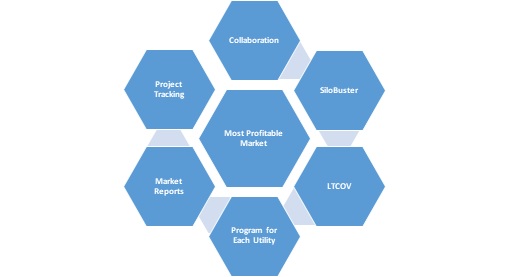
Collaboration
The future is in
total solutions. A valve or a pump is no better than the way it is used in a
system. Many of the opportunities will take place in countries where
the supplier does not have a strong sales presence. Working with local
entities is one option. Another is to collaborate with other suppliers of
complimentary products and jointly chart a sales strategy for a particular
country. McIlvaine will be participating in a half-day session at PowerGen
to discuss these options.
SiloBuster Program
In many cases the
supplier already has representatives or company personnel in the target
country. These people can be most effectively used by busting the
geographical and application silos. These people can become more effective
if there is a forecast of the product sales potential at each major
prospect. In most cases a successful sale needs the efforts of multiple
people at disparate locations. Maximizing their contribution is a goal of
the SiloBuster program.
LTCOV Program
Success is
contingent on providing the lowest total cost of ownership (LTCO) and then
validating it (LTCOV). With remote monitoring and data analytics the cost
and performance of each CFT product will be tracked. Suppliers need to
understand the processes, adapt their products to make them superior and
then validate this superiority through all the means available including
exhibitions, media and some innovative routes to market as explained in
44I Coal Fired Power
Plant Decisions.
Program for Each
Utility
Purchases at each large power plant are large enough that a specific revenue
opportunity can be generated and a program to pursue it put in place.
|
Corporate Name: EVN |
Unit Size: MW 660 |
|
Plant Name: Genco 3 Vinh Tan
2 |
Vĩnh Tân commune, Tuy Phong
district, Bình Thuận
province. Vietnam |
|
Unit # 1 |
Specific product purchases
2019
|
|
Forecasts can be supplied
for sixteen types of valves,
four types of pumps,
actuators, limestone, lime,
precipitator internals, dust
bags, gas instrumentation,
liquid instrumentation,
controls, treatment
chemicals, ammonia, urea,
catalyst, cartridges,
dewatering filter belts,
membrane modules, linings,
nozzles, mist eliminators,
fans, air compressors,
oxidation compressors,
motors, VFD, seals, packing,
hose, couplings, compressed
air filters, lubrication
filters. |
Ball Valves - $170,000 |
|
Butterfly Valves -
$120,000 |
|
|
Globe Valves - $190,000 |
|
|
Plug Valves - $100,000 |
|
|
Gate Valves - $150,000 |
A complete profile on EVN as well as every major utility is provided in the
Utility Tracking System along with capacity in MW for thousands of operators
and 15,000 individual units.
Market Reports
The Utility Tracking System
42EI Utility Tracking System
provides coal-fired capacity forecasts for each country. The capacity will
increase from 2 million MW to close to 2.3 million MW between 2018 and 2022.
For some countries such as Belgium, coal has been phased out. But for others
such as Bangladesh, there will be sixteen times as much coal-fired capacity
in place in 2022 as in 2018.
|
Coal Plants by Country (MW) |
|
|
|
|
|
||||
|
Country |
2018 |
2019 |
2020 |
2021 |
2022 |
2023 |
2024 |
||
|
Albania |
0 |
0 |
0 |
0 |
0 |
0 |
0 |
||
|
Argentina |
350 |
350 |
350 |
350 |
350 |
350 |
350 |
||
|
Australia |
24,442 |
24,442 |
24,442 |
24,442 |
24,442 |
24,442 |
24,442 |
||
|
Austria |
635 |
635 |
635 |
635 |
635 |
635 |
635 |
||
|
Bangladesh |
525 |
1,200 |
2,500 |
5,500 |
8,000 |
10,000 |
12,000 |
||
|
Belarus |
0 |
0 |
0 |
0 |
0 |
0 |
0 |
||
|
Belgium |
0 |
0 |
0 |
0 |
0 |
0 |
0 |
||
|
Bosnia & Herzegovina |
2,073 |
2,073 |
2,073 |
2,073 |
2,073 |
3,000 |
4,000 |
||
|
Botswana |
600 |
600 |
732 |
732 |
732 |
1,200 |
1,200 |
||
|
Brazil |
2,804 |
2,804 |
2,804 |
2,804 |
2,804 |
3,400 |
3,400 |
||
|
Bulgaria |
4,889 |
4,889 |
4,889 |
4,889 |
4,889 |
4,889 |
4,889 |
||
|
Cambodia |
505 |
505 |
505 |
505 |
1,200 |
1,200 |
2,000 |
||
Individual market reports are also provided.
World Fabric
Filter and Element Market,
N027 FGD Market
and Strategies,
N035 NOx Control
World Market,
N056 Mercury Air
Reduction Market,
N031 Industrial
IOT and Remote O&M,
5AB
Air Pollution Management,
N029 Ultrapure
Water: World Market,
N028 Industrial
Valves: World Market,
N026 Water and
Wastewater Treatment Chemicals: World Market,
N024 Cartridge
Filters: World Market,
N020 RO, UF, MF
World Market,
N019 Pumps World
Market,
N006 Liquid
Filtration and Media World Markets,
N005
Sedimentation and Centrifugation World Markets
These reports cover
coal-fired power along with other applications.
Project Tracking
The Alert
41F Utility
E-Alert
provides project news. Background details can be found in the tracking
system database. The SiloBuster program can be used to coordinate the sales
effort. The revenue forecast for specific products at each plant provides a
long-range tool for which this updated information is just a small piece of
the puzzle. The program is geared to provide maximum value to those
suppliers selling high performance products. Success comes with a long-term
program that convinces the customer to include the supplier on a bid list
whenever the opportunity arises.
Although the
coal-fired market is challenging the Most Profitable Market Program provides
a route to market to maximize success. For more information on the program
contact Bob McIlvaine 847-784-0013;
rmcilvaine@mclvainecompany.com.
COAL-FIRED BOILERS
Dry Scrubbers in
Chile
Andritz supplied dry
scrubbers to the Chilean electricity generation company AES Gener S.A. and
its subsidiary Norgener S.A. It
supplied two turnkey flue gas desulfurization (FGD) plants, including two
fabric filters, for the 280-MW Tocopilla coal-fired power plant owned by the
Chilean electricity generation company AES Gener S.A. and its subsidiary
Norgener S.A. Andritz also supplied an FGD plant and a fabric filter
for Unit 1 and a bag filter plant for the Ventanas coal-fired power station.
This contract
generated over €100 million ($131.7 million) in revenue for Andritz. Both
plants use the Andritz Energy and Environment (AE&E) TurboSorp dry
desulfurization technology. The scope of supply included design,
engineering, manufacture, installation and startup of the plants on an EPC
basis. The units have been operating since 2014.
SHIP EMISSIONS
French Ferry
Installs Dry Scrubber
A new scrubber
technology that does not use water to remove sulfur from exhaust gases has
been installed without drydocking on La Méridionale ro-pax ferry, Piana.
The 42,180-GT ferry,
which sails between Marseille and Bastia on the island of Corsica, had one
of two exhaust channels fitted with a dry scrubber system from supplier
Andritz in April 2019. By eliminating water, the system reduces power
consumption (by water pumps, for example) while avoiding regulatory
uncertainty concerning wash water discharge.
The exhaust ducts on
the Piana are routed through two casings in its starboard and port
funnels. In the first installation phase, three scrubber chambers were
connected to the starboard side funnel ducts, which handle part of the
exhaust from the vessel’s seven Wärtsilä engines, with a total power output
of 42.18 MW
Andritz Sales
Manager for southern Europe, Marco Dierico, explained that Piana was
a good candidate for the first dry installation because its two side funnels
meant that the retrofit could be performed with no loss of cargo space and
no impact on the ship’s appearance from the side. The fixed sailing route
will allow the companies to optimize the supply chain for the reagent,
sodium bicarbonate. Truck loading is easier for ferries than for most other
vessels and big ferries also offer greater stability, which can be a concern
when installing heavy scrubber technologies on a higher deck of the ship.
The installation was
completed in less than two weeks without drydocking, and the ship’s
acceptance and performance tests will take place over June and July this
year.
FOOD INDUSTRY
New Industrial Dust
Collection System Safely Contains Food Processing Dusts
Because a dusty food
processing facility is hazardous to both workers and consumers, Camfil APC
has introduced the Gold Series X-Flo (GSX) industrial dust collection
system. It handles toxic, nuisance and combustible food dusts including
fine, fibrous and heavy dust loads. The GSX system collects airborne dust
particles to provide a clean work environment and prevent
cross-contamination of food products.
The GSX system is
ideal for dry food ingredients like coarse grains, fine spices, and
additives, as well as sticky dusts like sugar and whey. It can capture food
dust at its source using stainless steel pickup hoods at each production
station or by directly hooking to batch mixers or high-velocity slot hoods
behind weigh stations. Capturing dusts at their source prevents worker
exposure to airborne contaminants and keeps dust from travelling throughout
the facility.
The GSX system helps
food processing and manufacturing facilities exceed OSHA indoor air quality
standards. When equipped with a Camfil explosion vent, the GSX system offers
the highest combustible dust explosion protection in accordance with MFPA
and ATEX standards. Other explosion protection options are available
including isolation valves, integrated safety monitoring filters and
fire-retardant filter cartridges.
The GSX is built
modularly, and each module handles airflows up to 6000 cubic feet per minute
using four HemiPleat Gold Cone™ filter cartridges. The filters stay cleaner
and last longer than conventional pleated filters, because they eject the
maximum amount of dust into the hopper with each pulse of compressed air.
COMPANY NEWS
Donaldson Company
Full Year Sales Forecast up 3.5 to 4.5 Percent
Donaldson Company,
Inc. reported 3rd quarter net earnings of $75.2 million, an
increase of 7.6 percent from $69.9 million in 2018. The 3rd
quarter 2019 GAAP earnings per share (EPS) increased 9.4 percent to $0.58
from $0.53 last year.
“We remain on pace
to deliver record levels of sales and profit in 2019, with third quarter
performance reflecting strong growth in our strategically important ‘Advance
and Accelerate’ businesses and modest year-over-year gross margin
improvement in both segments,” said Tod Carpenter, Chairman, President and
Chief Executive Officer. “While we built momentum in gross margin, a notable
decline in customer backlogs and orders toward the end of the quarter
resulted in lower-than-expected sales against our already modest forecast.
“Volatility
continued into this quarter as uneven demand and apparent destocking suggest
that our customers are taking an increasingly cautious stance in light of
market uncertainties. Given these dynamics, we revised our 4th
quarter sales and profit projections for Off-Road, Aftermarket and
Industrial Filtration Solutions to reflect the current operating
environment.
“In all market
conditions, we focus on operational excellence and strong execution of our
strategic priorities. To deliver our sales targets and meaningful operating
margin growth through fiscal 2021, we are balancing cost-optimization with
further investments in strategically important businesses, like process
filtration and our innovative air and fuel products. We also remain
committed to returning cash to shareholders, illustrated by the recently
announced 10.5 percent increase to our quarterly dividend and a new share
repurchase authorization. With our focused approach to planning and
disciplined capital deployment, we believe we are well-positioned to deliver
long-term profitable growth.”
The 3rd
quarter sales of Industrial Products (Industrial) decreased 1.9 percent from
last year, including benefits of 4.4 percent from BOFA and 1.1 percent from
pricing, partially offset by a negative impact from currency translation of
4.2 percent. Sales of Industrial Filtration Solutions (IFS) increased
1.9 percent, reflecting benefits from BOFA and replacement parts, partially
offset by lower sales of new equipment. Gas Turbine Systems (GTS) sales were
down due to lower new equipment sales, and the Special Applications (SA)
sales decline was due to Disk Drive filters.
Donaldson now
expects fiscal 2019 EPS between $2.20 and $2.24, compared with prior
guidance of $2.27 to $2.41.
The company now
expects full-year sales will increase between 3.5 and 4.5 percent, which
includes a negative impact from currency of approximately 3 percent and a
benefit from BOFA of 1 percent. The midpoint of the revised sales guidance
range is approximately 3 percent below prior guidance, driven by changes to
the Aftermarket, Off-Road and IFS forecasts. Sales forecasts for all other
business units are consistent with prior guidance.
Fiscal 2019 Engine
sales are projected to increase between 3.5 and 4.5 percent, including a
negative impact of approximately 3 percent from currency that is partially
offset by 1 percent from revenue recognition. Fiscal 2019 sales of On-Road,
Aftermarket and Aerospace and Defense are expected to increase from 2018,
while Off-Road sales are expected to decline.
Fiscal 2019
Industrial sales are projected to increase between 4.0 and 5.0 percent,
including a benefit from BOFA of approximately 4 percent that is partially
offset by a negative impact from currency translation of 3 percent. Fiscal
2019 sales in IFS are expected to increase from 2018, while the Company
continues to forecast sales declines in GTS and SA.
Longking is World’s
Largest APC Company
Fujian Longking Co., Ltd is the largest
manufacturer of air pollution protection equipment in the world with total
assets of more than 2.1 billion USD and over 6000 employees. The annual
sales exceeded 1.2 billion USD. Moreover, it has built manufacturing bases
and R&D centers at Shanghai, Xi'an,Wuhan, Tianjin, Zhangjiagang, Suqian,
Yancheng, Urumchi and Xiamen in China
Longking became the
China’s first listed company in air pollution control industry in Shanghai
stock market in December 2000 (Stock Code: 600388). The company has been
focusing on the R&D and application of air pollution control technology and
equipment for more than forty years, and it has become one of a few
companies that can provide not only innovative equipment like flue gas dust
collection, FGD, SNCR, bulk material conveying, and electrical control
equipment, but also the one package solutions for flue gas pollutants and
project BOT operation mode. Longking is now active in more than 40 foreign
countries and regions.
Longking supplies
conventional type ESP, low-low temperature ESP, Wet ESP, electromechanical
two-stage ESP, moving electrode, power-off rapping, non-leakage GGH device
etc. The BEH type ESP independently researched and developed by Longking, a
combination of advanced technologies and capable to realize the low dust
emission requirements, has been applied to more than 750 projects with an
installed capacity of more than 300GW.
Examples include
·
BEH type ESP for
2×1000-MW units of Xuzhou Power Plant
·
ESPs for 660-MW
units of Tiroda Power Plant in India
Longking has a
separate group providing dry scrubber systems. This group is the world’s
largest supplier of dry scrubber systems.
The company has presented in several McIlvaine webinars and will be
attending the Dry Scrubber Users Group meeting in Kansas City in September
Dürr Acquisition of
Megtec Expands Portfolio in Exhaust Air Purification Technology
Dürr will present an
expanded portfolio of exhaust air-purification at LIGNA 2019. It is the
world’s leading trade fair for woodworking and wood processing plant,
machinery and tools. With the acquisition of Megtec, Dürr combined the
environmental resources of both companies and created a single-source supply
platform offering a complete solution for the engineered wood products
industry. Clean air solutions from Dürr address regulations such as the
National Emission Standards for Hazardous Air Pollutants (NESHAP) issued by
the US Environmental Protection Agency. They are also in compliance with
European as well as the forthcoming stricter German Technical Instructions
for Air Quality Control (TA Luft) regulations.
Treatment and
processing of wood gives rise to different emissions. The main pollutants
are wood dust, volatile organic compounds (VOCs) and hydrocarbons. For many
years Megtec’s core expertise has been the effective control of VOCs and
hazardous air pollutants (HAPs) from dryers and press vents in the
engineered wood products industry. With the newly expanded range of
environmental solutions, Dürr now provides an even stronger global platform
for serving customers. At LIGNA, Dürr will present its expanded suite of
environmental control technologies and services needed for this industry.
Regenerative thermal
and catalytic oxidizers control VOCs and HAPs. Dürr’s CleanSwitch®
regenerative thermal oxidizer (RTO) is a highly efficient solution for VOC
destruction. It has an annihilation efficiency of 99 percent or more and a
thermal efficiency of 95 to 97 percent. The successful deployment of
CleanSwitch® in a yellow pine OSB dryer application in Southern
USA has delivered a VOC destruction efficiency up to 99 percent. The product
properties are the very latest, well matched to the highest standards and
guarantee durability. Alkali-resistant heat exchange media and
corrosion-resistant materials of construction match the specific application
and help maximize uptime and equipment life. The engineered ceramic heat
recovery beds offer a low-pressure drop and excellent bed-washing
characteristics. The electric motor valve drive provides quiet operation and
is reliable in virtually all climate conditions. In addition, the modular
construction minimizes installation time.
The venturi and
cyclonic pre-scrubber designs from Dürr ensure water saturation of exhaust
stream, as well as achieving considerable removal of coarse filterable
particulates. This step is important in many applications to reduce
particulate build-up on the connecting ductwork and downstream wet ESP. The
wet ESP can, therefore, operate at a higher corona power for improved
collection efficiency. Pre-cleaning of coarse particulates allows for a
longer period between washdowns. A dry ESP is used in the control of
particulates on biomass-based heat generators. Additional particulate
control is provided by pulse jet fabric filters (baghouses) and cyclonic
dust collectors. This ESP of Dürr has high reliability and performance, a
design utilizing proven collector-plate designs, rigid discharge electrodes,
and top-mounted electrically driven, externally maintainable collector and
discharge electrode rappers.
Together with Megtec,
Dürr’s environmental control solutions include turnkey installations as well
as equipment rebuilds, upgrades, preventive maintenance programs and energy
optimization services. The company has installed thousands of easy to use
and clean oxidizer systems in many process industries across the globe. It
is also experienced in engineering and service for exhaust air-purification
systems, including those from other manufacturers. Dürr leverages its
process knowledge and technology capabilities to deliver an integrated
solution for dryers with a complete system including scrubber, wet ESP and
RTO.
CECO Environmental
Announces New $190 Million Credit Agreement
CECO Environmental
Corp. announced the successful closing of a new $190 million credit
agreement that includes a $140 million five-year revolving credit facility
and a $50 million five-year term loan.
"We are very pleased
to have completed this new credit agreement as CECO has been able to lower
its costs, increase our financial flexibility and further strengthen our
balance sheet. In addition, our banking syndicate now includes several
multi-national banks that will further enhance our global operations and
growth requirements," said CECO's Chief Executive Officer Dennis Sadlowski.
Babcock & Wilcox
Path to Profitability
"Our performance in
the 1st quarter of 2019 reflects the impact of the strategic
actions we have taken over the past several months. Combined with the
settlements we reached in March 2019 and our additional financing, we have
momentum on our path to profitability," said Kenneth Young, Chief Executive
Officer. "Our Babcock & Wilcox segment continues to perform well, and our
change in strategy for the SPIG segment is beginning to drive results. As
2019 progresses, we expect the core strengths of our businesses to continue
to become more visible to our customers and shareholders. We are also making
progress on our cost-savings initiatives, and looking forward, we continue
to target a run-rate adjusted EBITDA of approximately $100 million as we
exit 2020, not including corporate overhead."
“Over the past six
months, our customers and employees have seen a major transformation at
Babcock & Wilcox Enterprises and are responding positively as we have made
significant changes to improve our business and have shared new information
about our strategic path to profitability," Young continued. "We are
optimistic as we see new opportunities emerging as a result of our recent
efforts. Going forward, we expect to see improvement each quarter as our
cost-savings initiatives continue to impact bottom-line results and as we
minimize EPC contract losses under the terms of the settlements we achieved
in March 2019. Our dedicated employees continue to deliver world-class
products and services that reflect the strengths of our more than 150-year
heritage. We are laser-focused on delivering high-quality technologies that
provide solutions for our customers and strong results for our shareholders.
Consolidated
revenues in 1st quarter 2019 were $231.9 million, down 8.4
percent compared to 1st quarter 2018 primarily due to several EPC
contracts being in the final stages of completion in the 1st
quarter of 2019 The GAAP operating loss in 1st quarter 2019 was
$32.0 million compared to an operating loss of $106.4 million in 1st
quarter 2018. Prior to the 1st quarter of 2019, the most
significant drivers of the company's operating losses were the charges for
the six European engineering, procurement and construction (EPC) loss
contracts. In the 1st quarter of 2019, the most significant
drivers of our operating losses were settlement costs, restructuring
activities, and advisory fees. Adjusted EBITDA was negative $5.0 million
compared to negative $77.6 million in 1st quarter 2018.
Babcock & Wilcox segment
revenues increased 18.5 percent to $188.6 million in the 1st
quarter of 2019 compared to $159.1 million in the prior-year period, mainly
driven by large construction new build and industrial projects, partially
offset by a decrease in parts sales. Gross profit in the Babcock & Wilcox
segment in 1st quarter 2019 was $31.1 million, compared to $30.9
million in the prior-year period, reflecting the increase in lower-margin
construction revenue as a percentage of total revenue including construction
services at no margin for the SPIG segment on its single loss project in the
U.S. Gross profit margin was 16.5 percent, compared to 19.4 percent in the
same period last year. Adjusted EBITDA in 1st quarter 2019
increased 115 percent to $9.0 million, compared to $4.2 million in last
year's quarter; this increase is mainly attributable to the impact of
cost-savings initiatives partially offset by an approximately $2.3 million
increase in the level of corporate overhead being absorbed by the segment
compared to the prior-year quarter. Adjusted EBITDA margin was 4.8 percent
compared to 2.6 percent in the same period last year.
SPIG segment
revenues decreased 21.3 percent to $28.9 million in 1st quarter
2019 compared to $36.7 million in 1st quarter 2018, mainly due to
lower volume of new build cooling system projects as expected following the
change in strategy to improve profitability by more selectively bidding and
focusing on core geographies and products, and a lower volume of aftermarket
services. Gross profit improved to a positive $3.7 million in 1st
quarter 2019, compared to a gross profit of negative $2.8 million in the
prior-year period. This improvement was primarily due to the effects of the
new strategy and to continued progress made on the small number of remaining
legacy new build cooling systems contracts in the quarter without
significant increases in estimated costs, compared to the 1st
quarter of 2018 when higher estimated costs to complete were incurred.
Adjusted EBITDA improved by $8.0 million to positive $0.7 million compared
to negative $7.3 million in the same period last year, driven by the
improvement in gross profit and the benefits of cost-savings initiatives.
Vølund & Other Renewable segment
revenues in the
segment were $29.5 million for 1st quarter 2019, compared to
$60.0 million in 1st quarter 2018. The 1st quarter
revenues were lower compared to the prior year quarter as several of the
European EPC loss contracts were in the final stages of completion in 2019,
resulting in lower construction revenue being recognized than in 2018. The
quarter-over-quarter variance was also driven by the sale of Palm Beach
Resource Recovery Corp. (PBRRC) in September 2018 and the previous decision
to limit bidding on Vølund renewable energy contracts.
Donaldson Company
Breaks Ground for New Material Research Center at its Corporate Headquarter
in Bloomington, MN
Donaldson Company,
Inc. broke ground recently on a $15-million Material Research Center at its
corporate headquarters in Bloomington, MN.
At the
groundbreaking ceremony, Michael Wynblatt, Vice President and Chief
Technology Officer, said, “The secret to leading in the filtration market is
having great filter media, and that's enabled by having great scientific
fundamentals. This new Material Research Center will enable our continued
growth and leadership in filtration innovation for years to come.”
As customers'
equipment and technology advance, Donaldson's engineering, technology and
operations staffs continually develop original solutions that anticipate and
exceed these evolving requirements. The company currently holds more than
1,800 active U.S. and international patents, has over 100 technical
laboratories and employs hundreds of engineers, scientists and technicians.
Research and development investments like the Material Research Center help
Donaldson attract the technical talent necessary for Donaldson’s success in
innovation and commercialization of materials and technologies.
ENFORCEMENT ACTIONS
Empire Iron Mining
Cited for Particulate Violations
On May 10, 2019, the
Dept. of Justice lodged a proposed Consent Decree with the United States
District Court for the Western District of Michigan in the lawsuit entitled
United States v. Empire Iron Mining
Partnership, Civil Action No. 19–096.
The United States
filed a Complaint in this lawsuit under the Clean Air Act (CAA), naming
Empire Iron Mining Partnership as the defendant. The Complaint seeks
injunctive relief and civil penalties for violations of the environmental
regulations that govern taconite mines and processing plants and the
emission of particulate matter from certain sources at defendant’s taconite
processing plant in Palmer, Marquette County, MI. Under the proposed Consent
Decree, Empire Iron Mining Partnership agrees to implement procedures to
improve future compliance with the CAA and State regulations and pay $75,000
in civil penalties. In return, the United States agrees not to sue the
defendant
Consent Decree
Lodged Against ArcelorMittal
On May 13, 2019, the
Dept. of Justice lodged a proposed Consent Decree with the United States
District Court for the Northern District of Indiana in the lawsuit entitled
United States, State of Indiana, and
State of Ohio v. ArcelorMittal USA LLC, ArcelorMittal Burns Harbor LLC, and
ArcelorMittal Cleveland LLC, Civil Action No. 2:19–cv–00179.
The proposed Consent
Decree resolves a Complaint filed against ArcelorMittal USA LLC,
ArcelorMittal Burns Harbor LLC, and ArcelorMittal Cleveland LLC as the
owners and operators of the three steel plants in Indiana and one plant in
Ohio that are the subject of the action. The Complaint asserts 18 claims
pursuant to the Clean Air Act (‘‘CAA’’) for violations of: (1) National
Emission Standards for Hazardous Air Pollutants; (2) the New Source
Performance Standards, and the regulations governing electric arc furnaces
at steel facilities, (3) Title V of the CAA, and Title V’s implementing
federal, Indiana, and Ohio regulations; and (4) the federally enforceable
CAA State Implementation Plans for Indiana and Ohio, which incorporate
and/or implement the above-listed federal requirements.
Under the proposed
Consent Decree, ArcelorMittal USA, ArcelorMittal Burns Harbor, and
ArcelorMittal Cleveland shall pay a total aggregate civil penalty of
$5,002,158. Of the total civil penalty, $2,594,829 will be paid to the
United States; $2,035,469.50 will be paid to the State of Indiana; and
$371,859.50 will be paid to the State of Ohio. The proposed Consent Decree
includes injunctive relief in the form of various compliance monitoring
activities and recognizes that during the course of the negotiations,
defendants expended an estimated $22 million to address sulfur dioxide,
nitrogen oxide, particulate matter, volatile organic compounds and carbon
monoxide emission concerns. Additionally, the proposed Consent Decree
provides for the transfer of five acres of Lake Michigan beachfront
property, appraised at $350,000, from ArcelorMittal USA LLC to the City of
East Chicago, IN, for community benefit as a State of Indiana Supplemental
Environmental Project.