FABRIC
FILTER
NEWSLETTER
PRINTER FRIENDLY COPY
May,
2019
No. 523
MARKETS
Eliminating Silos
Can Increase Profits in Air, Water and Energy
·
Identify new profit
opportunities
·
Spur R&D
·
Result in new
products with lowest total cost of ownership
·
Reduce costs for
operators
The identification
of new profit opportunities requires:
·
Detailed knowledge
of specific processes
·
Performance of
products in those processes
·
Elimination of silos
between industries. Geographies, and technologies
·
Insights to global
developments and needs
The silos between
industries need to be penetrated and collaboration among disparate suppliers
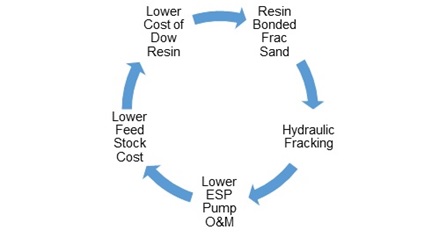
encouraged. A good case in point is the use of resin bonded sand for
hydraulic fracturing. Dow Chemical introduced a new resin for sand coating
in 2014. The polyurethane offers more elasticity than phenolics. As a result
the fractures do not collapse. Collapsing leads to sand particles in the
product. As the product is transported by the electric submersible pump, the
sand abrades the impellers. Pumps with an initial cost of over $100,000 can
experience life cycles measured in months.
This life has been
extended when resin coated sand is utilized. The overall cost of oil
extraction is lessened. With lower feedstock costs, the resin is less costly
to manufacture. This can lead to lower resin prices and give even more
reason to select resin coated over uncoated sand. Suppliers of pumps, frac
sand plants, resin, friction reducers and other products need to understand
the relationship between products.
The need for
breaking down silos between technologies is exemplified in rare earth
extraction. DOE and the Chinese government are pursuing a technology which
micronizes flyash from landfills and then adds hydrochloric acid. There is
already a free rare earths feedstock in a 30 percent acid stream available
as explained at
HCl Scrubbing and Rare Earth Recovery from Coal-Fired Power Plants and
Gasifiers are the Perfect Marriage.
For more information
on the Most Profitable Market Program click on
www.mcilvainecompany.com
Bob McIlvaine can answer your questions at
rmcilvaine@mcilvainecompany.com or 847-226-2391.
Coal-Fired Power
Plant Combust, Flow and Treat Purchases will Exceed Those for Wind, Solar,
Nuclear, and Gas Turbine Plants
In the last 20 years
an average of 50,000 MW per year of new coal fired power plants have been
added to the world generation capacity. Over the next 10 years 40,000 MW per
year of new capacity will be added. This will be partially offset by
retirement of 13,000 MW per year of existing capacity.
Annual new plant
investment will exceed $160 billion per year. The installed base of plants
has now reached 2 million MW and will increase by 270,000 MW over the next
decade. The investment in the installed base exceeds $4 trillion. Potential
for third party upgrades, repair, service, and remote operation will exceed
$200 billion per year. This includes major environmental upgrades in India
and other countries in Asia, Eastern Europe, and Africa.
The climate change
issue is dominant in certain countries but not relevant in others. The
McIlvaine Company has created a metric to assess individual and national
goals. The metric is Quality Enhanced Life Days (QELD). A struggling
Pakistani farmer is offered the choice of electricity or helping to protect
the earth fifty years from now. He will assign a much higher QELD to
construction of coal plants in Pakistan than will a wealthy American who is
creating trusts for his grandchildren.
Sustainability Universal Rating System.
China is making a
contribution to raising the standard of living for poor citizens of many
Asian and African countries. It is financing new power plants to supply the
electricity needed by industry and families. Despite the investment in new
coal plants or in many cases because of it the Chinese CO2
emissions have been positively impacted by the reduction of inefficient
fossil and biomass combustors in residential and commercial establishments.
Despite the claimed
certainty relative to greenhouse gas damage by both sides of the issue, the
science is not well understood. The intense debate over SO2
emissions which has been waged for half a century has had many twists and
turns. McIlvaine testified before senate sub committees as an EPA contractor
at the time it was thought that acid rain would kill forests throughout the
world. It was later determined that this impact would be much less than
anticipated. However, it was then determined that SO2 reacts with
sodium and ammonia in the atmosphere to form small particles with more
impact on health than any other pollutant.
It is not only the
health impacts which are unclear, there is considerable debate about the
costs of various solutions. The U.K. already generates 11 percent of its
electricity from biomass combustion. The large coal fired Drax plant has
switched from coal to biomass. A pilot program has been initiated to
sequester the CO2 with the claim that this is the only way for a
combustion process to reduce CO2. The slogan is “Suck the CO2
out of the air.”
Use of CO2
for enhanced oil recovery and sequestration has been practiced for many
years. Proximity is the issue. SaskPower is operating the first commercial
coal-fired power plant EOR system at its Boundary Dam plant. The use of CO2
to replace water in hydraulic fracking looks very promising. We could return
to the 1980s era activity in the U.S. where multiple small coal fired
boilers were constructed in the California oil fields for EOR.
Longer term solar
and wind will gather market share in all regions of the world. In the short
term countries without natural gas, limited solar and wind potential, and in
urgent need of electricity will continue to build coal plants. Energy
storage developments could alter the picture. In any case in the last half
of this century coal will play a diminished role in power. But over the next
ten years there will be substantial activity in many regions.
Africa: New
coal-fired capacity is planned for seven countries with coal-fired capacity
and eleven with no coal-fired capacity. South Africa, Egypt and Zimbabwe are
planning 40,000 MW of additional coal fired capacity. In many of the African
countries the first coal plants will be owned by and for mining companies.
Asia: China and
India are planning more than 300,000 MW of new coal fired capacity. Vietnam
is moving forward with 40,000 MW of capacity followed by Indonesia with
30,000 MW and Bangladesh with 25,000 MW. China, South Korea and several
other Asian countries have significant coal to chemicals programs.
Eurasia: Georgia,
Kazakhstan and Russia have more than 60,000 MW of coal plants in operation
and have plans for an additional 10,000 MW.
Europe: Despite the
pressure from the EU, thirteen countries have new coal fired power plants in
the planning stage. The total in Turkey is over 30,000 MW, Poland, 9,000 MW,
and Bosnia-Herzegovina, 4000 MW.
Americas: No new
plants are planned in the U.S and Canada. Four Latin American countries are
planning a total of 4000 MW of new coal-fired capacity. However, the
continent will continue to operate nearly 300,000 MW of coal-fired units at
least over the next fifteen years.
The purchases of
combust, flow and treat products and services by coal-fired utilities
worldwide will continue to exceed those by any other fuel source. In part
this is because sources other than nuclear spend much less per MW for CFT
products and services. The
- provides forecasts of new capacity for each plant, each owner, and by
country. Specific forecasts by plant and owner for purchases of valves,
pumps, chemicals, filtration equipment, FGD systems, NOx control
systems, fabric filters, precipitators, cooling towers, fans and other power
plant products are displayed in the McIlvaine market reports shown at
http://home.mcilvainecompany.com/index.php/markets.
Bob McIlvaine can
answer your questions at rmcilvaine@mcilvainecompany.com 847-226-2391.
Manufactured Frac
Sand Transforming the Combust, Flow, and Treat Markets for Granular
Materials
Sand, gravel,
crushed stone and sediment production and treatment generate billions of
dollars of annual revenue for suppliers of combust, flow, and treat (CFT)
worldwide. The market in the U.S. is changing considerably due to the rapid
growth in manufactured shale frac sand. CFT expenditures for manufactured
frac sand plants in the U.S. will exceed CFT expenditures for all the other
granular related activities.
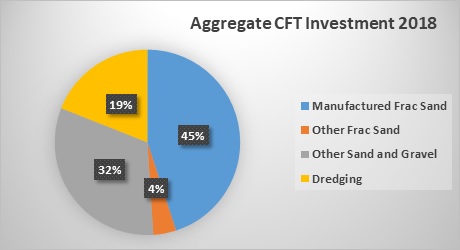
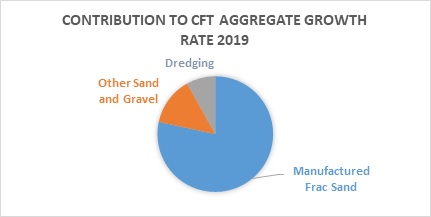
The importance of the manufactured frac sand on the U.S. CFT market is shown in the following chart. The tons of manufactured frac sand is small but the CFT expense per ton is high. Also the growth rate will be much higher than other granular categories. As a result most of the revenue growth in 2019 will be in manufactured sands.
|
U.S. CFT Expenditures for
Aggregate Production |
||||||
|
Granular Type |
2018 million tons |
CFT Expense Ratio |
Factor |
percent |
Growth Rate % |
Total Growth 2019 % |
|
Manufactured Frac Sand |
50 |
20 |
1000 |
45 |
13 |
5.8 |
|
Other Frac Sand |
50 |
2 |
100 |
4 |
-1 |
0 |
|
Other Sand And Gravel |
700 |
1 |
700 |
32 |
3 |
1 |
|
Dredging |
400 |
1 |
400 |
19 |
3 |
0.6 |
|
Total |
1200 |
|
2200 |
100 |
|
7.4 |
The total production
of frac sands in the U.S. will exceed 100 million tons this year at an
average selling price of over $60 ton creating a $6 billion market. The
revenues for CFT suppliers are much higher per ton of product because much
of the production is shifting to local manufactured sands. So the big cost
is in the processing and not the freight.
This fundamental
shift in U.S. frac sand production is away from the Midwest, home to the
highest quality Northern White, to lesser-grade sands which are then
upgraded (manufactured). As a result, Northern White’s market share is
expected to be 43 percent in 2019, down from 75 percent in 2014,
Various granular
products require dry or wet processes. Some require both. These involve some
combination of pneumatic or mechanical conveyors, pumps, valves, scrubbers,
fabric filters, precipitators, filter presses, centrifuges, dryers,
classifiers, fans, controls, and instrumentation.
In 2017, 890 million
tons of construction sand and gravel valued at more than $7.7 billion was
produced by an estimated 3,600 companies operating 9400 pits and 360
sales/distribution yards in 50 States. Leading producing States were, in
order of decreasing tonnage, California, Texas, Minnesota, Michigan,
Arizona, Colorado, Washington, Ohio, Wisconsin, and New York, which together
accounted for about 52 percent of total output. It is estimated that about
44 percent of construction sand and gravel was used as concrete aggregates;
25 percent for road base and coverings and road stabilization; 13 percent as
asphaltic concrete aggregates and other bituminous mixtures; 12 percent as
construction fill; 1 percent each for concrete products, such as blocks,
bricks, and pipes; plaster and gunite sands; and snow and ice control; and
the remaining 3 percent for filtration, golf courses, railroad ballast,
roofing granules, and other miscellaneous uses.
Crushed stone, the
other major construction aggregate, is often substituted for natural sand
and gravel, especially in more densely populated areas of the Eastern United
States. Crushed stone remains the dominant choice for construction aggregate
use. Increasingly, recycled asphalt and Portland cement concretes are being
substituted for virgin aggregate, although the percentage of total aggregate
supplied by recycled materials remained very small in 2017.
Dredging may or may
not involve more than just controls, pumps and valves. In many cases
sediment is contaminated and must be cleaned with filters and separators. In
the U.S. the amount of dredged material is around 200 million m3
or 400 million tons.
|
Region |
Percent of Global Dredging
Revenue |
Revenue |
Amount Dredged (Million m3) |
|
Europe |
0.12 |
1,284
|
265.29
|
|
Middle East |
0.11 |
1,177
|
364.40
|
|
China |
0.29 |
3,103
|
960.68
|
|
India |
0.04 |
428
|
132.51
|
|
Other Asia |
0.12 |
1,284
|
397.52
|
|
Africa |
0.07 |
749
|
231.89
|
|
North America |
0.09 |
963
|
198.97
|
|
Latin America |
0.10 |
1,070
|
331.27
|
|
Australia |
0.06 |
642
|
132.64
|
|
TOTAL |
1.00 |
10,700
|
3,015.17
|
The McIlvaine
Company provides specific forecasts for the CFT components in granular
processing in the following publications:
N007 Thermal Catalytic World Air Pollution Markets
N008
Scrubber/Adsorber/Biofilter World Markets
N018 Electrostatic Precipitator World Market
N021 World Fabric Filter and Element Market
N031 Industrial IOT and Remote O&M
N028 Industrial Valves: World Market
N024 Cartridge Filters: World Market
N006 Liquid Filtration and Media World Markets
N005 Sedimentation and Centrifugation World Markets
The forecasts for
shale fracturing and specific projects are provided in
N049 Oil, Gas, Shale and Refining Markets and Projects.
For more information
contact Bob McIlvaine at rmcilvaine@mcilvainecompany.com.
Flow and Treat
Acquisition Choices Shaped by Most Profitable Market Program
A new program
available from Mcilvaine Company will help acquirers make the best choices
and then maximize the value of these acquisitions.
There are continuing
acquisitions of flow and treat suppliers. Some acquirers such as the
Filtration Group and IDEX have grown and prospered as a result of their
acquisitions. Others such as GE have not. Picking the right candidates is
the first and most important step. Proper integration is equally important.
It is difficult to leverage the benefits available from the acquiring
company with the independence needed to succeed.
Some companies such
as Emerson have been focused on flow but not treat. They have acquired valve
and automation companies but avoided the product and chemical companies.
Danaher has acquired companies across the spectrum including Hach for flow
measurement, Chemtreat for treatment chemicals, and Pall for filtration.
Treat system
companies are not constrained by manufacturing capability. Filters and
scrubbers are typically constructed of ¼-in. plate and can be sub
contracted. Valve and pump companies have moved away from owning their own
foundries but provide other fabrication capabilities in their own
facilities. Therefore the location of manufacturing facilities becomes a
factor in decision making.
Anticipation of
future trends is one of the more difficult determinations. Few people
anticipated the steep drop in oil prices in the past or the massive new
planned investments by Chevron and Exxon Mobil in U.S. shale. The single use
biopharmaceutical system market for T-cell transfer immunotherapy has grown
more rapidly than had been commonly anticipated.
Some future trends
are negative. A company with a specific flue gas conditioning agent to make
precipitators work better was making huge profits at the time it was
acquired. Within a year the precipitator companies introduced a mechanical
solution completely eliminating the demand for the chemical. Thorough
understanding of the industries, processes, and products is advantageous in
anticipating future trends.
The flow and treat
industry has not been nearly as innovative as some other industries such as
semiconductors or pharmaceuticals. It can be argued that there is not the
same potential. On the other hand a few individuals completely changed the
world economy by developing commercial horizontal hydraulic fracturing.
Fifty years ago the conversion of flue gas and liquids to a toothpaste type
foam was achieved. The mass transfer from gas to liquid is 1000 times
greater than with packed towers. However, the subsequent separation of the
liquid and gas was not fully perfected and the pursuit quickly canceled.
There was a short period in the 19666-1974 period where R&D budgets were
almost unlimited as U.S. power companies tried to perfect flue gas
desulfurization. However the industry was soon content with a solution even
if it was not ideal. Less R&D money has been spent on FGD in the four
decades subsequently than was spent in the first eight years of the program.
Clearly the
horizontal fracturing development has had a huge return on investment. How
do the flow and treat companies find these highly profitable opportunities?
One is answer is a new program from McIlvaine
The McIlvaine Most
Profitable Market Program provides acquirers with:
·
A valuable tool to
select acquisition candidates
·
A program to
integrate the new acquisition painlessly
·
A growth platform
for both organic and acquired companies
A valuable tool
to select acquisition candidates
The Most Profitable
Market (MPM) Program provides forecasts of the gross margins and EBITA which
can be achieved with each product in each industry and in each location.
This is based on present and future lower total cost of ownership. This
lower cost can be leveraged to increase margins. Estimates of future EBITA
using this approach are superior to estimates based on historical
performance.
A new product such
as automation can lower the cost of ownership for the product being
automated. A purchase to match a pump product with the accompanying valves
provides a package approach which will likely result in lower costs for the
customer. The program eliminates silos between industries, technologies and
products and helps identify profitable R&D investments.
A program to
integrate the new acquisition painlessly
MPM forecasts the
specific purchase opportunity at each major prospect. This provides a
foundation for bottoms-up collaboration. The newly acquired company local
sales representatives can share information with peers in other divisions
and pursue each opportunity. This collaboration potential can also be an
acquisition criteria. A candidate whose products are well received by
important prospects is attractive.
A growth platform
for both organic and acquired companies
The MPM program is
based on understanding processes and technologies and developing new and
better products. The resulting higher margin opportunities create funding
for increased R&D and further innovation. With shared process and technology
knowledge the acquired company can improve its products and increase EBITA
faster.
More information on
the Most Profitable Market Program is found at
www.mcilvainecompany.com.
IRON AND STEEL
Meros Off-Gas
Cleaning Systems Started Up at Kardemir
In December 2018, a
Meros off-gas cleaning plant supplied by Primetals Technologies was started
up at sinter plant No. 3 of Turkish steel producer Karabük Demir Celik
Sanayi ve Ticaret A.S. (Kardemir), followed by the Meros plants supplied for
Kardemir´s sinter plants No. 1 early February and No. 2 in in early March.
Each Meros plant is able to treat 400,000 Nm³/h of sinter off-gas, reducing
SOx by more than 90 percent as well as delivering extremely low
dust emissions. All the three Meros plants are using sodium bicarbonate as
desulphurization agent. The projects were realized within a very short time
span. For example, only ten and half months were required from the technical
specification of the Meros plant installed at sinter plant No. 3 until
startup. With the new Meros plants, air quality in the valley of Karabük is
improved considerably.
Kardemir operates an
integrated iron and steel works in Karabük, in the northern part of Turkey.
The production site is located in a narrow valley, close to the city of
Safranbolu. Three sinter plants are operated by Kardemir. Kardemir´s Meros
plants represent the fourth implementation of sodium bicarbonate
desulphurization, following voestalpine Stahl in Austria, Masteel in China
and JFE in Japan. Primetals Technologies was responsible for the
engineering, supply of key equipment like sodium bicarbonate dosing and
milling, filter heads, bags, cages, electrics and automation as well as for
advisory services for cold and hot commissioning.
In general, Meros
process involves several modules for injecting and finely distributing
adsorption and desulfurizing agents, such as activated carbon and sodium
bicarbonate, into the off-gas flow. This efficiently binds and removes heavy
metals, harmful and hazardous organic components, as well as sulfur dioxide
and other acidic gases. The use of sodium bicarbonate to reduce the amount
of sulfur dioxide also eliminates the need for a conditioning reactor. The
dust particles are deposited in a specially developed, energy-efficient bag
filter and is recycled back into the flow of off-gas to further optimize the
efficiency and cost-effectiveness of the gas purification process. Any
remaining unutilized additives are then once more in contact with the
off-gas, so that they are finally almost completely utilized. There is also
considerably less discharged residue when sodium bicarbonate is used instead
of slaked lime. The process automation system ensures stable operation, even
when there are considerable fluctuations in the volume and composition of
the off-gas. Emission limits can therefore be observed at all times. Thanks
to the modular design of the Meros system, a tailor-made solution based on
the environmental restriction can be provided, with possible upgrades of the
system by subsequent installation of required modules.
Primetals
Technologies to Supply EAF Quantum Electric Arc Furnace and Ladle Furnace to
Wuzhou Yongda
Primetals
Technologies has received an order from Chinese steelmaker Wuzhou Yongda
Special Steel Co., Ltd. (Wuzhou Yongda) to supply an EAF Quantum electric
arc furnace and a ladle furnace for a greenfield project in Wuzhou city, in
Guangxi Zhuang Autonomous Region. This marks the tenth EAF Quantum for
China. The EAF Quantum furnace is designed to handle scrap steel of very
varied composition and quality. The electrical energy requirement of the
electric arc furnace is extremely low because the scrap is preheated. This
reduces both the operating costs and the CO2 emissions. The twin ladle
furnace sets the desired steel grades and the correct casting temperature.
The new furnaces are scheduled to be commissioned in early 2020.
Wuzhou Yongda is a
privately-owned steelmaker operating in the Guangxi Zhuang Autonomous Region
in Southern China. The company produces steel rods, coiled rebar and coiled
wire. The EAF Quantum and the twin ladle furnace are part of a greenfield
project for the production of stainless steels. For the new EAF Quantum
electric arc furnace and the twin ladle furnace, Primetals Technologies will
supply the complete mechanical and electrical process equipment and the
automation technology. This includes the automated scrap yard management,
the automated charging process, automation of the oxygen injection and sand
refilling, as well as the Level 2 automation which makes the plant ready for
Industry 4.0. A basic data package for dedusting equipment is also part of
the order.
The EAF Quantum
developed by Primetals Technologies combines proven elements of shaft
furnace technology with an innovative scrap charging process, an efficient
preheating system, a new tilting concept for the lower shell, and an
optimized tapping system. This all adds up to very short melting cycles. The
electricity consumption is considerably lower than that of a conventional
electric arc furnace. Together with the lower consumption of electrodes and
oxygen, this gives an overall advantage in the specific conversion cost of
around 20 percent. In comparison to conventional electric arc furnaces,
total CO2 emissions can also be reduced by up to 30 percent per metric ton
of crude steel. An integrated dedusting system with modern automatic off gas
control fulfills all environmental requirements.
COMPANY NEWS
Babcock and Wilcox
Segment Increased Revenues by 18.5 Percent
Babcock & Wilcox
Enterprises, Inc. announced 1st quarter 2019 revenues of $231.9
million, a decrease of $21.2 million, or 8.4 percent, compared to the 1st
quarter of 2018. The decrease was primarily the result of several EPC
contracts being in the final stages of completion in the 1st
quarter of 2019. GAAP net loss from continuing operations in first quarter
2019 improved to $49.9 million compared to $116.8 million in 1st
quarter 2018. Adjusted EBITDA also improved by $72.7 million to negative
$5.0 million compared to negative $77.6 million in the prior year period.
"Our performance in
the 1st quarter of 2019 reflects the impact of the strategic
actions we have taken over the past several months. Combined with the
settlements we reached in March 2019 and our additional financing, we have
momentum on our path to profitability," said Kenneth Young, Chief Executive
Officer. "Our Babcock & Wilcox segment continues to perform well, and our
change in strategy for the SPIG segment is beginning to drive results. As
2019 progresses, we expect the core strengths of our businesses to continue
to become more visible to our customers and shareholders. We are also making
progress on our cost-savings initiatives, and looking forward, we continue
to target a run-rate adjusted EBITDA of approximately $100 million as we
exit 2020, not including corporate overhead."
Babcock & Wilcox segment
revenues increased 18.5 percent to $188.6 million in the 1st
quarter of 2019 compared to $159.1 million in the prior-year period, mainly
driven by large construction new build and industrial projects, partially
offset by a decrease in parts sales. Gross profit in the Babcock & Wilcox
segment in 1st quarter 2019 was $31.1 million, compared to $30.9
million in the prior-year period, reflecting the increase in lower-margin
construction revenue as a percentage of total revenue including construction
services at no margin for the SPIG segment on its single loss project in the
U.S. Gross profit margin was 16.5 percent, compared to 19.4 percent in the
same period last year. Adjusted EBITDA in 1st quarter 2019
increased 115 percent to $9.0 million, compared to $4.2 million in last
year's quarter; this increase is mainly attributable to the impact of
cost-savings initiatives partially offset by an approximately $2.3 million
increase in the level of corporate overhead being absorbed by the segment
compared to the prior-year quarter. Adjusted EBITDA margin was 4.8 percent
compared to 2.6 percent in the same period last year.
SPIG segment
revenues decreased 21.3 percent to $28.9 million in 1st quarter
2019 compared to $36.7 million in 1st quarter 2018, mainly due to
lower volume of new build cooling system projects as expected following the
change in strategy to improve profitability by more selectively bidding and
focusing on core geographies and products, and a lower volume of aftermarket
services. Gross profit improved to a positive $3.7 million in 1st
quarter 2019, compared to a gross profit of negative $2.8 million in the
prior-year period. This improvement was primarily due to the effects of the
new strategy and to continued progress made on the small number of remaining
legacy new build cooling systems contracts in the quarter without
significant increases in estimated costs, compared to the 1st
quarter of 2018 when higher estimated costs to complete were incurred.
Adjusted EBITDA improved by $8.0 million to positive $0.7 million compared
to negative $7.3 million in the same period last year, driven by the
improvement in gross profit and the benefits of cost-savings initiatives.
CECO Has
Twenty-Seven Percent Growth Year-Over-Year
CECO Environmental Corp.
reported its financial results for the 1st quarter 2019.
Revenue in the 1st
quarter of 2019 was $86.0 million, up 16.0 percent from $74. Million in the
prior-year period. Excluding revenue of $6.5 million attributable to the
businesses divested in 2018, organic revenues increased 27.2 percent.
Operating Income was
$4.9 million for the 1st quarter of 2019, compared with $12.2
million in the prior-year period. Non-GAAP operating income was $7.2 million
for the first quarter of 2019 (8.4 percent margin), compared with $4.0
million in the prior-year period (5.4 percent margin).
Net income was $1.9
million for the 1st quarter of 2019, compared with $5.8 million
in the prior-year period. Net income on a non-GAAP basis was $4.1 million
for the 1st quarter of 2019, compared with $1.7 million in the
prior-year period.
Net income per
diluted share was $0.05 for the 1st quarter of 2019, compared
with $0.17 in the prior-year period. Non-GAAP net income per diluted share
was $0.12 for the 1st quarter of 2019, compared with $0.05 for
the prior-year period.
Cash and cash
equivalents were $28.2 million and bank debt was $76.1 million as of March
31, 2019, compared with $43.7 million and $76.1 million, respectively, as of
December 31, 2018.
Total backlog at
March 31, 2019 was $193.8 million as compared with $182.1 million as of both
December 31, 2018 and March 31, 2018, respectively. In the first quarter of
2018, $8.8 million of backlog was attributable to the divested businesses.
Adjusted for divestitures, backlog increased $20.5 million from 1st
quarter 2018 to first quarter 2019.
Bookings were $97.3
million for the 1st quarter of 2019, compared with $95.0 million
in the prior-year period and $74.5 million in the 4th quarter of
2018. Excluding bookings of $4.7 million attributable to the businesses
divested in 2018, 2019 organic bookings increased $7.0 million, or 7.7
percent.
CECO's Chief
Executive Officer Dennis Sadlowski commented, "I am very pleased that the
significant momentum we built throughout 2018 has carried over to the 1st
quarter of this year. We generated revenue of $86 million which was an
impressive 27 percent growth year-over-year on the strength of our
increasing backlog and the continued focus on new orders. We also saw gross
margins improve sequentially as the markets increasingly recognize the value
that CECO offers."
Mr. Sadlowski added,
"Driven by the need for clean air and carbon reduction, the long-term
prospects for CECO Environmental continue to improve. Our fast start
out of the gate in 2019 is another step towards meeting our aggressive
three-year financial targets. Strong orders of $97 million, up 30
percent sequentially and 8 percent year-over-year, along with an improving
sales pipeline, gives us strong optimism for sustained growth in 2019 as we
continue to capitalize on our significant competitive position and win
market share."
Parker’s EPS Reached
an All Time Quarterly Record
Parker Hannifin
Corp. a global leader in motion and control technologies, reported results
for the fiscal 2019 3rd quarter ended March 31, 2019. Fiscal 2019
3rd quarter sales were $3.69 billion compared with $3.75 billion
in the prior year quarter. Organic growth of 2 percent was more than offset
by currency translation and a divestiture in fiscal year 2018. Net income
increased 12 percent to an all-time quarterly record of $411.2 million
compared with $366.0 million in the third quarter of fiscal 2018. Fiscal
2019 3rd quarter earnings per share increased 16 percent to
$3.14, compared with $2.70 in the prior year quarter. Adjusted earnings per
share were $3.17, compared with adjusted earnings per share of $2.80 in the
prior year quarter. Cash flow from operations for the first nine months of
fiscal 2019 was $1,092.6 million or 10.3 percent of sales, compared with
$901.2 million or 8.6 percent of sales in the prior year period. Excluding a
discretionary pension contribution in fiscal 2019, cash flow from operations
for the first nine months of fiscal 2019 was 12.1 percent of sales. A
reconciliation of non-GAAP measures is included in the financial tables of
this press release.
“We delivered strong
operational performance in the 3rd quarter, achieving all-time
quarterly records for total segment operating margin and earnings, and
strong year-to-date cash flow from operations,” said Chairman and Chief
Executive Officer, Tom Williams. “We eclipsed total segment operating margin
of 17 percent for the first time in a quarter. I am especially pleased that
our Aerospace business achieved an all-time record for segment operating
margin of 20.7 percent. While order entry has moderated for the Diversified
Industrial Segment against strong comparisons in the prior year quarter, we
are confident in our ability to continue executing well and reaching another
record year in fiscal 2019.”
Diversified Industrial Segment:
North American third quarter sales decreased 1 percent to $1.8 billion, and
operating income increased 2 percent to $287.5 million compared with $280.7
million in the same period a year ago. International 3rd quarter
sales decreased 8 percent to $1.3 billion, impacted primarily by unfavorable
currency translation, while operating income increased 2 percent to $208.7
million compared with $205.3 million in the same period a year ago.
For the fiscal year
ending June 30, 2019, the company has maintained guidance for earnings from
continuing operations in the range of $11.17 to $11.47 per share, or $11.45
to $11.75 per share on an adjusted basis. Fiscal year 2019 guidance is
adjusted on a pre-tax basis for expected business realignment expenses of
approximately $16 million and CLARCOR costs to achieve of approximately $14
million and an income tax expense adjustment of $14 million related to U.S.
Tax Reform. Guidance assumes organic sales growth in the range of 2.0% to
3.0 percent. A reconciliation of forecasted earnings per share to adjusted
forecasted earnings per share is included in the financial tables of this
press release.
Nordic Air
Filtration is Expanding Business in China
Nordic Air
Filtration’s sales in China have tripled in recent years, driven by the
innovative products that help their customers to comply with strict emission
standards within automotive and industrial markets.
The good results in
China give them the strength to continue growing their site in Kunshan by
approximately 15,000 m2 of production and storage space.
Nordic Air
Filtration is proud to be one of the contributors for improving the air
quality and reduce the environmental pollution in one of the world’s largest
countries.
Colfax Selling
Howden Through an Auction Process
Colfax Corp is
pressing ahead with plans to sell its air and gas handling unit Howden as
part of a shift to focus on the medical devices industry and has hired
Goldman Sachs to handle the process.
An auction process
for the 165-year old Scottish company, which makes heat exchangers and gas
compressors largely for oil and gas companies, is expected to kick off
shortly.
Colfax is hoping to
receive about 1.5 billion pounds ($1.9 billion) from the sale of the
business, which employs more than 5,000 people globally and has operations
in 16 countries including Mexico and Canada. It employs 350 people at its
main UK site in Renfrew, near Glasgow.
Howden, founded in
1854 and bought by Colfax in 2012, makes core earnings of more than 150
million pounds, two of the sources said, adding the business would mainly
appeal to private equity funds due to lackluster interest amid industry
buyers.
Goldman, was
expected to send confidential information to potential bidders in February
2019.
PRODUCT NEWS
New Gold Series
X-Flo System Protects Operators from Toxic Plasma Cutting Fumes and Smoke
Camfil APC has
introduced the Gold Series X-Flo (GSX), a powerful and cost-efficient system
for collecting and containing the fumes generated by plasma cutting tables.
The system is used in conjunction with a downdraft table to capture fumes at
their source, reducing operator exposure to toxic fumes and helping shops meet OSHA permissible exposure limits
(PELs).
GSX systems
effectively process fumes while maintaining a low pressure drop. They are
designed to pulse-clean more effectively to extend filter life, while
minimizing compressed air usage and energy costs. The units are built
modularly, providing maximum airflow and processing power for any given
footprint. GSX systems can achieve efficiencies as high as MERV 15 using
filter cartridges with HemiPleat® eXtreme nanofiber media.
The GSX exceeds OSHA
mandates for indoor air quality and is tested to meet NFPA and ATEX
standards.
Parker Hannifin
Announces a New Website for the DustHog, SmogHog, and Kleentek Products
The Industrial Gas
Filtration and Generation Division of Parker Hannifin Corp. announced the
launch of a new, mobile-friendly website featuring the DustHog®,
SmogHog®,
Kleentek®,
and other industrial filtration clean air solutions and equipment.
This microsite
offers many customer resources: an interactive equipment map, resource
library with the latest product information, product registration, an area
sales representative locator, and more. Customers can expect more content to
be added, including videos and training information. As with all Parker
websites, the content is available through any screen the customer chooses
to use.
Donaldson Introduces
Cloud-based Dust, Fume and Mist Collection Monitoring
Donaldson has
unveiled a Web-connected solution that monitors industrial dust, fume and
mist collectors and alerts users about needed maintenance. The solution uses
sensors and a controller to gather data from a collector, run analytics in
the cloud, and push results to the user via dashboard, email or text. It can
be installed on existing or new industrial dust and fume equipment. Pilot
tests demonstrated significant savings in time and costs, the company
reported. The solution was launched with an early-adopter program announced
in November.
Sternvent Vibraclean
Collectors Chosen for Their Quietnes
The quietness of the
Sternvent Vibraclean series filter shaker dust collectors have made them a
choice of HVAC specifying engineers for soil testing labs for road
construction, dental and prosthetic labs, fire extinguishing filling, and
silo venting for water treatment plant pneumatic conveying systems. The
Vibraclean design, which includes multi-pocket filter modules, maintained
filter spacing, an effective automatic motorized shaker for filter cleaning,
and an energy-efficient backward inclined fan, have made it an attractive
alternative to jet pulse cartridge-style dust collectors, for non-production
processes, when compressed air is not available or practical in cold
climates.
Automation Products
Provides Level Detection for Baghouses
Epcon provided the
comprehensive air pollution control system for a large-scale hazardous waste
disposal facility for the
petrochemical industry. The system was designed to handle various aspects of
dust, particulate matter and volatile organic compounds (VOCs) from the
entire facility. Extensive ductwork and piping network bring the polluted
air to the dust collector, the first piece of equipment to remove the
particulate matter from the dust collector, the exhaust gases pass through
the thermal oxidizer to remove the VOC emissions. As the emissions contain
chlorinated or fluorinated hydrocarbons, the exhaust is then further
processed through a quench and scrubber to ensure the air is 99.99 percent
clean and particulate free before it goes into the atmosphere. A combination
of dust collector and oxidizers are used in industrial applications such as
coffee roasting, grain storage systems, steel and aluminum reclamation,
rendering plants and various chemical manufacturing application.
Automation Products
Inc, offers a Dynatrol DJ level switch designed for application to either
high or low point level detection of bulk solids. It operates successfully
on applications such as baghouses, cyclone separators, and above airlocks.
It maintains consistent results on chemical powders, minerals, and many
other granulated materials. Constructed for a long operating life the DJ
level detector requires no adjustments and has no moving parts. There are no
gaskets or seals to deteriorate. It withstands dusty environments and works
well in vessels equipped with vibrators. It is virtually wear-free. Many
Dynatrol level switches have been in service for over 25 years. Installation
is simple. The level switch mounts through a ¾-in. half-coupling at the
point of desired level detection.
ENFORCEMENT ACTIONS
Consent Decree
Requires United Taconite to Replace Scrubber with Baghouse
On April 18, 2019,
the Dept. of Justice lodged a proposed Consent Decree with the United States
District Court for the District of Minnesota in the lawsuit entitled
United States v. United Taconite LLC.
The United States
filed a Complaint in this lawsuit under the Clean Air Act (CAA), naming
United Taconite LLC as the defendant. The Complaint seeks injunctive relief
and civil penalties for violations of the environmental regulations that
govern taconite mines and processing plants and the emission of particulate
matter from certain sources at defendant’s taconite processing plant in
Forbes, St. Louis County, MN. Under the proposed Consent Decree, United
Taconite agrees to implement procedures to improve future compliance with
the CAA and State regulations, and pay $50,000 in civil penalties. Under the
proposed Consent Decree, United Taconite also agrees to replace an existing
wet scrubber at its processing plant with a more efficient dry fabric filter
particulate matter control system at an estimated cost of over $480,000. In
return, the United States agrees not to sue the defendant under Section 113
of the CAA for additional relief related to its past violations.
Back to Fabric Filter Newsletter No. 523 Table of Contents