FABRIC
FILTER NEWSLETTER
April,
2019
No. 522
PRINTER FRIENDLY COPY
MARKETS
Cement Combust, Flow
and Treat, CFT Market Will Exceed 50 Billion Dollars in 2025
The cement industry has
invested $400 billion to produce 4 billion tons of cement per year. Cement
revenues are likely to grow at 6 percent/yr over the next six years to reach
$700 billion in 2025. Annual expenditures for combust, flow and treat products
and services will exceed $50 billion per year.
The cement industry is
one of the largest purchasers of air pollution control equipment and services.
Historically plants needed only to comply with particulate emission regulations.
Now HCl, SO2, VOCs and mercury are being regulated. The kerogen in
the feed limestone along with other constituents vary within individual
limestone deposits. As a result the quantity of pollutants to be removed varies
from hour to hour. This is a challenge to operators.
Cement plants have
transitioned to dry processing over the years. As a result the major purchases,
are kilns, granular material handling and sizing, fans, dampers, dust
collectors, and storage facilities. The valve purchases are mostly for air
control purposes. Analyzer needs are to measure free flowing solids. The
requirements for pumps and liquid analyzers are minimal.
The large cement
producers operate many plants Holcim- Lafarge operates 220, Heidelberg operates
141 and Cemex operates 61. The fact that companies operate a number of plants in
remote locations makes it desirable to centralize total cost of ownership
evaluations of combust, flow, and treat equipment. It also makes IIoT and Remote
O&M very cost effective.
The world cement
industry is anticipating volume increases of 6 percent per year in the next
three years versus less than 3 percent per year over the last three years.
Profitability in 2018 was down due to overcapacity, rising cost of fuel and
other factors.
The industry is steadily
increasing its investment in IIoT. Instrumentation can instantly communicate the
particle size distribution to the process management system which can then
adjust the grinding regime to balance energy consumption and cement product
quality.
The cost of capturing
particulate is being reduced with bag designs which require less energy
consumption. The need to also remove NOx and VOCs can be met with catalytic
bags. Dry sorbent injection can be used ahead of the catalytic filter to remove
acid gases. This reduces capital cost and energy consumption as compared to
separate removal devices.
The cement industry can
contribute to total pollution reduction with the combustion of sewage sludge,
and other waste materials. This reduces the fossil fuel energy requirement and
also results in better air pollutant capture as compared to technology often
used for incinerating waste. The use of multiple fuels in varying amounts
creates additional operational challenges and further justifies the investment
in IIoT.
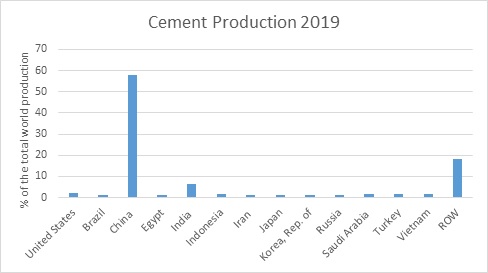
The industry continues
to be dominated by China. India is the next largest producer. Forecasts of CFT
purchases by the cement industry are provided in the following reports
N007 Thermal Catalytic World Air Pollution Markets
N008
Scrubber/Adsorber/Biofilter World Markets
N018 Electrostatic Precipitator World Market
N021 World Fabric Filter and Element Market
N027 FGD Market and Strategies
N056 Mercury Air Reduction Market
N031 Industrial IOT and Remote O&M
5AB Air Pollution Management
N026 Water and Wastewater Treatment Chemicals: World Market
N024 Cartridge Filters: World Market
N006 Liquid Filtration and Media World Markets
N005 Sedimentation and Centrifugation World Markets
For more information
contact Bob Mcilvaine at
rmcilvaine@mcilvainecompany.com.; 847-784-0012, ext 122.
Dry Scrubbing: Most
Profitable Markets
The largest market for
dry scrubbing is to capture SO2 from coal fired power plants. Wet
scrubbing is used by 95 percent of the coal plant operators. The reason is the
much lower reagent cost and the opportunity to generate a by-product (gypsum).
Dry scrubbing offers much lower capital cost as well as reduction in water
consumption and pollution. In many cases the dry scrubbing option is eliminated
by default. Limestone for wet scrubbing is widely available at a predictable
cost. Reasonably priced lime for dry scrubbing may only be available if a lime
supplier agrees to build a dedicated kiln just for a plant or several plants in
a region.
The catalytic filter
with dry sorbent injection n (DSI) is now proven in many smaller applications.
The recent introduction of 6 meter long candles makes it a candidate for power
plants as well as the smaller applications. One vessel instead of three is used
to reduce NOx, SO2, other acid gases, and particulate.
Furthermore clean hot gas at 600F is available for energy recovery
System and reagent
suppliers are challenged to determine which industries and countries to pursue.
The goal is always maximizing profit not revenue. So opportunities should be
quantified based on predicted return. Should a lime company ship product from
one continent to another and be content with a low gross profit or should it
build a plant close by and generate high gross margins? Should a system supplier
and lime producer team to provide a total solution based on a yearly semi fixed
contract ($ per ton of pollutant removed during the year)?
McIlvaine is offering a
service to help suppliers quantify the market in terms of the obtainable gross
profit at various price levels resulting in the revenue and gross margin
combination to provide the Most Profitable Market (MPM).
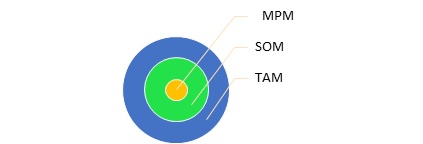
Total Available Market
(TAM) for dry scrubber systems, O&M, and reagent is $30 billion/yr. This
includes the market lost to wet scrubbing. The Serviceable Obtainable Market
(SOM) is the market which can be addressed with the lowest priced product at
even small unit margins. This market is $5 billion per year and eliminates the
wet scrubber portion. The Most Profitable Market (MPM) is the one for which the
supplier can most profitably supply its products and services given its capital
and knowledge resources.
The main types of dry
scrubbing systems are dry sorbent injection (DSI) and systems which use a
dedicated vessel for the reaction. Vessels can be segmented into those which
fluidize and those which recirculate the reagent.
Dry scrubbing is a
market which is being pursued worldwide by air pollution system designers,
reagent suppliers, and suppliers of components such as filters, valves, fans,
conveyors, and instrumentation. There has been recent success with third party
remote monitoring and guidance. The success at NAES plants has been well
documented at Dry Scrubber User Association (DSUA) meetings.
Dry scrubbing is being
used to capture acid gases in a variety of industries around the world. The
largest installations have been in coal fired power generation. For decades the
U.S. was the main market. Now power plants around the world are adopting this
technology. Dry scrubbing is now widely used in waste to energy plants, glass
plants, and in many other industries. So the market has evolved from one country
and one industry to many countries in many industries.
The MPM for system
suppliers is limited to those regions where a lime producer offers a reasonably
priced product. The fact that reagent consumption is a very large percentage of
total cost of ownership dictates a close working relationship between system and
lime suppliers.
The McIlvaine MPM
forecast is being customized for any lime, system or component supplier. The MPM
is derived from the SOM which is provided in
N027 FGD Market and Strategies. McIlvaine will assist in
determining what portion of SOM at what pricing and packaging strategy
constitutes the MPM. Part of the analysis will be to determine the cost of
ownership of all the options. This in turn will be based on decades of evidence
gathered in
44I Coal Fired Power Plant Decisions. For suppliers of fibers, media and
bags the additional insights in
N021 World Fabric Filter and Element Market will be utilized. In
addition McIlvaine is working with others such as International Filtration News
to provide ongoing total cost of ownership analyses. The Dry Scrubber Users
Association is a continuing source of TCO evidence.
The MPM forecast of
purchases by each owner is also available. A small number of power plants
operate most of the dry systems. Forecasts for each owner and for each plant
within a system are available based on data extracted from
42EI Utility Tracking System for coal fired power plants around the world
and
N032 Industrial Plants and Projects for industrial plants
For more information
contact Bob McIlvaine at
rmcilvaine@mcilvainecompany.com; 847-226-2391.
Gas Turbines are a
Most Profitable Market for CFT Suppliers
Suppliers of combust, flow, and treat products and services will benefit from a growing world market for gas turbine generated power. There are many opportunities which fall in the Most Profitable Market category.
·
The market is growing at
a rate above GDP
·
There are continuing
needs for improvement of CFT products
·
Purchasers are oriented
to purchasing products with the lowest total cost of ownership
·
Access to purchasers is
enhanced by the following factors
o
Purchasers are mostly
large companies buying components for multiple plants
o
Purchasers are home
based in markets well served by international CFT suppliers
o
Suppliers have the
opportunity to reach these customers in a manner to validate the lowest total
cost of ownership of their products (LTCOV)
All of these factors
create an opportunity to generate substantial sales with high profit margins.
This opportunity is quantified for each CFT product in the McIlvaine CFT Most
Profitable Market Program
Click Here.
The inventory of
existing gas turbine plants is growing at 4 percent per year and in the next few
years, the base will grow to two million MWs. There are 30,000 individual
units which routinely require service, replacement or repair of CFT components.
The rapid cycling occurring because gas turbines provide backup power for wind
and solar has resulted in serious problems. One of them is Flow Accelerated
Corrosion (FAC). Suppliers of valves, pumps, and other CFT components have the
opportunity to provide upgraded products to deal specifically with this
condition.
Because higher
performance turbines are being purchased there is a need to remove the very
small particles in the turbine intake air. High efficiency glass media is
relatively fragile and more expensive than the typical polymer based media
commonly used. There is a big opportunity to combine efficiency and longer life
to generate high margins.
Fleets of turbines are
being operated remotely. Some of the operators are large power companies and
others are third party service companies. Those CFT suppliers whose products can
be remotely managed to provide lower total cost of ownership can boost margins.
This opportunity expands to the extent that the CFT product supplier can also
supply local process management programs with edge computing. This optimizes the
product operation and reduces the task for the cloud based plant process
management system.
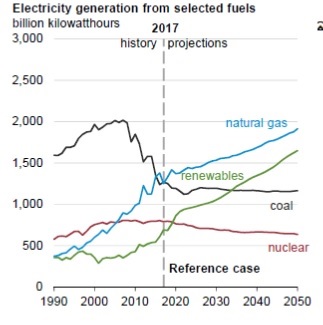
The U.S. will continue
to be the largest market. This increases the profit opportunity for those CFT
suppliers with a strong U.S. presence. Unlike coal fired generation, the U.S.
gas turbine market will remain the world’s largest in the near future. The U.S.
is replacing coal with natural gas whereas Europe is moving more aggressively
toward wind and solar and Asia is continuing to rely on coal. Natural gas power
generation in the U.S. already exceeds coal fired power and will grow at an
average of 1.5 percent per year over the next 30 years.
U.S. Energy Production -
quadrillion BTU
The CFT market is
boosted by the conversions of simple cycle plants to combined cycle. Many plants
which originally were peaking are now being converted to combined cycle
operation and are being used at least for intermittent power to offset
fluctuations in wind and solar. CFT companies have attractive markets in raw
water intake, ultrapure water, and wastewater treatment. Plants in areas with
tough wastewater discharge limits or water scarcity are opting for zero liquid
discharge. This substantially increases the CFT investment. ZLD technology is
developing rapidly. This provides the opportunity to offer products with much
lower total cost of ownership.
The use of IIoT and
Remote O&M will accelerate faster than in other CFT markets. The largest coal
fired boiler is four times larger than the largest gas turbine. Owners are
challenged with operating multiple units. Furthermore gas turbines are complex
enough that OEM guidance is welcomed. MHPS, GE, and other turbine suppliers have
remote monitoring centers. These centers are primarily focused on turbine issues
but are expanding to cover the balance of the plant. Third party operators such
as NAES are contracting to operate a number of plants. The more plants which are
remotely monitored the more cost effective the results. GE cites its experience
with many thousands of turbines as a major resource.
Many plants have cloud
based process management systems. CFT suppliers have the opportunity to supply
packages with edge based software and analytics which is tied into the process
management system.
There is the opportunity
for CFT suppliers to provide extensive O&M services. Air filters, catalyst,
treatment chemicals, valves, pumps, measurement devices and other CFT products
and services can be sold in tandem with remote monitoring to provide a total
solutions approach.
There will be fewer but
larger customers. Consolidation is taking place in many ways. The large
operators continue to expand. Third parties are expanding their activities with
the smaller operators. This provides CFT suppliers with the opportunity for
direct sales contact.
The gas turbine markets
as well as detailed project and plant information is continually updated in 59EI
Gas Turbine and Reciprocating Engine Supplier Program.
For more details on the
program McIlvaine CFT Most Profitable Market Program
Click Here.
The potential for
automation and remote monitoring is analyzed in N031
Industrial IoT and Remote O&M.
DOE Announces Up to
87.3 Million Dollars in Federal Funding for Advanced Coal Technologies and
Research
The U.S. Dept. of Energy (DOE) announced up to $87.3 million in federal funding
for cost-shared research and development (R&D) projects for advanced coal
technologies and research. DOE Assistant Secretary for Fossil Energy Steven
Winberg announced this R&D funding at the Annual Project Review Meeting for
Crosscutting, Rare Earth Elements, Gasification, and Transformative Power
Generation at the National Energy Technology Laboratory.
“Coal-fueled power plants are a significant source of electrical power
generation in the United States. The goal with these projects is to ensure that
the United States can have a fleet of coal-fired power plants that provides
stable power generation with operational flexibility, high efficiency, low
emissions, and lower costs for consumers,” said Assistant Secretary for Fossil
Energy Steven Winberg. “By investing in this R&D, we will enable the United
States to continue maximizing its domestic energy resources while protecting our
supply of reliable and affordable electricity.”
In 2017, coal was the second-largest energy source for electricity generation in
the United States.
The R&D projects for coal-fueled power plants and technologies will fall under
five separate funding opportunity announcements (FOAs):
(1)
Advancing Steam Turbine Performance for Coal Boilers: This FOA seeks to improve
the performance of steam-based power cycles, resulting in a lower cost of
electricity with reduced emissions per megawatt-hour for coal-fueled boilers.
This FOA also includes an area of interest for conceptual engineering design for
steam turbines in the 50–350 MW range in support of DOE’s Coal FIRST initiative.
DOE’s Office of Fossil Energy’s (FE) Advanced Turbines Program will support
these projects. DOE Funding: Up to $22 million.
(2)
Transformational Sensing Systems for Monitoring the Deep Subsurface: This FOA
seeks to reduce uncertainty and enable real-time decision making associated with
subsurface carbon dioxide (CO2) storage. FE’s Carbon Storage Research Program
will support these projects. DOE Funding: Up to $4.8 million.
(3)
Crosscutting Research for Coal-Fueled
Power Plants: This FOA aims to develop innovative technologies that will enhance
the performance and economics of the existing and future coal fleet—thereby
lowering electricity costs for consumers. FE’s Crosscutting Research Program
will support these projects. DOE Funding: Up to $14.5 million.
(4)
Advanced Materials for High-Efficiency, Flexible and Reliable Coal-Fueled Power
Plants: This FOA will reduce the cost and enhance the cyclic durability of
materials used in advanced ultrasupercritical power plants. These advanced
materials are critical to increasing the efficiency and reliability of
coal-fueled power plants. FE’s Advanced Materials Program will support these
projects. DOE Funding: Up to $26
million.
(5)
Process Scale-Up and Optimization/Efficiency Improvements for Rare Earth
Elements (REE) and Critical Materials (CM) Recovery from Coal-Based Resources:
This FOA will support cooperative agreements to advance the development of
technologies for recovery REEs and CMs from domestic coal-based resources
through both novel and conventional extraction, separation, and recovery
processes. FE’s Feasibility of Recovering Rare Earth Elements Program will
support these projects. DOE Funding: Up to $20 million.
DOE’s National Energy Technology Laboratory (NETL) will manage all of the
selected projects.
Sooner Dry Scrubber
Installation Underway
Oklahoma Gas and
Electric (OG&E), a subsidiary of OGE Energy (OGE), is completing a dry scrubber
installation project at the Sooner 1100-MW coal-fired power plant. The cost is
estimated at $500 million for the installation of dry scrubbers on the two units
at Sooner, which is located in Noble County, OK received the order in 2014. The
scope of supply comprises design, engineering, manufacture, supply, and start-up
of two new Turbo CDS (Circulating Dry Scrubbing) systems including fabric
filters and auxiliary equipment. Ductwork and some other components are being
manufactured locally.
Carper Testifies at EPA
Hearing to Defend the Mercury and Air Toxics Standards, MATS Rule
On March 18, Senator Tom
Carper (D-DE), top Democrat on the Environment and Public Works Committee (EPW),
delivered testimony at a public EPA hearing on the agency's recent proposal that
puts the Mercury and Air Toxics Standards in legal jeopardy. Before his
testimony, Senator Carper and Senator Lamar Alexander (R-TN) sent a letter to
EPA with Senators Susan Collins (R-ME), Joe Manchin (D-WV), Thom Tillis (R-NC),
and Sherrod Brown (D-OH) urging the agency to keep the rule in place.
'We now know that the costs of implementing MATS were wildly overestimated, and
the benefits were grossly underestimated. Today, every utility in the U.S. is in
compliance with MATS. It was done faster than predicted, at a third of the
costs. Consumer rates are lower than they were before MATS, and we're already
seeing the health benefits emerge. All of this begs the question of why we are
here today?'
Senator Carper testified.
'If we'll be honest about it, most people in this room today know that the
proposal before us will likely lead to the undoing of the Mercury and Air Toxics
Standards. By gutting the legal foundation for MATS, EPA is opening the door to
future lawsuits to vacate the rule entirely. Despite what EPA claims, the
proposal before us now is not about addressing co-benefits of the MATS rule.
Rather, it is about underestimating health benefits and overestimating costs as
a tactic to undermine a rule that is both protecting public health and providing
business certainty. That is shameful,'
Senator Carper
continued.
BIOMASS
Valmet and Uni Viridas Renew Their Cooperation by Signing a Ten-year Operation and Maintenance Agreement for the Biomass Power Plant In Croatia
Valmet and Uni Viridas
have signed a ten-year operation and maintenance agreement for the biomass power
plant in Babina Greda, Croatia. The order is included in Valmet's first quarter
of 2019 orders received. The value of the order will not be disclosed.
The cooperation of the
companies started in 2011, and in 2015 Valmet began to operate and maintain the
biomass power plant on behalf of the customer.
"It was a milestone for
Valmet to begin to operate its first constructed power plant for the customer in
2015. In principle, the customer delivers the fuel and sells heat and
electricity. Valmet takes care of everything else 365 days a year. The
cooperation with Uni Viridas has been excellent and continuing it is a win-win
solution," says Markus
Bolhar-Nordenkampf, Director, Energy Sales and Services, CEN,
Valmet.
During the past few
years, Valmet has been able to fulfill the expectations of the customer, and the
plant's availability has exceeded agreed targets. For example, there have been
minimal unplanned outages and low flue gas emissions, and efficient boiler
operations at low fuel and water consumption have been demonstrated. In
addition, there haven't been any LTIF (Lost Time Injury Frequency) or reports
from environmental incidents.
"After Valmet's
excellent performance for the last three years, it was only logical to continue
this cooperation for the next ten years," says
Alkin Yaman, Strategy & Business
Development Manager of Unit Group in Istanbul.
Valmet and Uni Viridas
will continue their cooperation and maximize the plant's performance until 2029.
The biomass power plant,
delivered by Valmet, is a fluidized bed boiler - BiowerPower 8 - a plant with an
electrical output of up to 10 MWel and a heat output of up to 16 MWth. The fuel
utilized is forest wood and wood chips.
CEMENT
For its new 7700t- tpd production line in Mangwal, Pakistan, Flying Cement Co.
has placed an important order with FLSmidth.
Headlining the range of equipment from FLSmidth is the OK™ 71-6 Cement Mill, which will be designed to grind OPC cement at a capacity of 415tph. Commissioning is expected in 2020, and the mill will be supplied together with an FLSmidth ILC Preheater System, 2-Base Kiln, Cross-Bar® Cooler, FabriClean® Filters for the kiln and Cooler, a DuoClean™DC2 Filter for the cement mill, ROKSH 119 Separator, MAAG® WPV-5000 Gear and a Heat Exchanger.
FLSmidth to Deliver New
Cement Production in Pakistan
Xuan Thanh Cement has awarded FLSmidth a contract to deliver equipment for a
brownfield cement production line in Ha Nam province in Vietnam. The contract
has a value of around DKK 550 million.
FLSmidth will design and engineer the new clinker production line and deliver
energy-efficient equipment for the entire production from crushing to clinker
silo. The order is due to be fully delivered by the end of 2020, and once
operational the production line will have a capacity of 12,500 tonnes per day.
In 2015, Xuan Thanh Cement placed a similar order for a production line that has
been operating successfully since 2017.
“We are very pleased to continue our engagement with Xuan Thanh Cement. It is
rewarding to work with a customer that combines a strong focus on reliable and
efficient production with the ambition to minimize its environmental impact. Our
cooperation shows that when you focus on total cost of ownership, you can
get energy-efficient equipment that lowers emissions without compromising
productivity,” says Jan Kjaersgaard, President, Cement, FLSmidth.
The order becomes effective immediately, engineering work is performed in the
coming months and the main revenue will be recognized during 2020.
FINANCIAL
NEWS
Donaldson Announces
Fiscal 2021 Financial Targets
An in-depth review of
Donaldson’s strategic priorities, including business segment performance,
leadership through innovation, operational excellence and its capital allocation
framework was provided. Additionally, the company is introducing long-range
financial targets, including a framework for profitable growth through fiscal
2021.
“We continue to make
excellent progress on our strategic priorities related to expanding our
industry-leading technologies and solutions, extending our market access and
executing strategic acquisitions,” said Tod Carpenter, Chairman, President and
Chief Executive Officer. “We expect that benefits from strong execution of these
priorities, supported by our technological innovations, deep customer
relationships and global presence, will allow us to continue delivering
profitable growth well into the future.”
Donaldson expects to
achieve the following financial targets by the end of fiscal 2021:
·
Total fiscal 2021 sales
between $3.0 billion and $3.3 billion, reflecting an average annual growth rate
of 3 to 7 percent in fiscal years 2019 through 2021.
·
Operating margin between
15.0 and 15.8 percent, compared with 13.8 [1] percent in 2018.
The company also expects
to maintain its disciplined approach to capital deployment, including
investments in strategic growth priorities and returning cash to shareholders
through dividends and share repurchase.
Babcock and
Wilcox
Announces New Financing Agreement
Babcock & Wilcox
Enterprises, Inc. announced today it has taken strategic action to significantly
strengthen its financial position and chart a path to profitability in 2019. The
Company has amended its credit agreement with its current lenders, whereby B.
Riley FBR, Inc. has joined the facility and has arranged an additional $150
million in secured financing via a last out term loan and has agreed to provide
an uncommitted incremental credit facility of up to another $15 million. This
follows an additional $10.0 million in commitments from affiliates of B. Riley
FBR under a last out term loan announced on March 19, 2019.
Proceeds from the new
financing have allowed B&W to settle and significantly limit future liabilities
on its two remaining Vølund European loss projects and terminate its obligations
on an additional European waste-to-energy EPC contract which has not yet reached
the project phase. The new financing also provides the additional liquidity the
company needs to release the value of its core business and strong market
position to pivot towards profitability and positive cash flows.
“With this financing,
combined with the reduction of liabilities and risks from the Vølund loss
contracts being vastly reduced through these settlements and recent plant
turnovers, we believe the company is on a path to profitability in 2019,” said
Kenneth Young, Chief Executive Officer, B&W. “We now can focus on unlocking the
real value and strong position of our power business, along with value from the
core technologies of Vølund and SPIG and improving the profitability of our
company.”
Porvair Introduces New
Sintered Fibre Mesh Filter Elements
Porvair Filtration Group
has announced the addition of the Sinterflo® FMC, a fibre mesh
composite for filter elements, to its range of Sinterflo® products.
The Sinterflo®
FMC is specifically designed for the removal of particulates from challenging
gaseous environments. The new media boasts many benefits, including; resistance
to high temperatures and corrosive environments, design and engineering
versatility and minimal maintenance costs. Its fine pore surface layer enhances
surface filtration. Other features include:
·
a highly-permeable
support structure, ensuring reverse jet cleaning energy is delivered to the
filter’s outer surface thus enhancing particulate cake removal, keeping
operating pressure loss to a minimum
·
multilayer internal
support meshes providing mechanical strength removing the need for additional
support structure in low pressure applications
·
reliable emission
control
The self-supporting
Sinterflo® FMC differs from the rest of the
Sinterflo® range due to its multilayer internal mesh support
structure and fine fibre surface layer. The Sinterflo® FMC filter
elements are ideal for continuous on stream reverse jet cleaning applications
where optimum product recovery is required. With its asymmetrical pore
structure, Sinterflo® FMC media is designed to facilitate surface
filtration capturing particulate on the outer flow in surface.
Ian Boxall, Technical
Director, comments, “We are proud to announce the launch of the new Sinterflo®
FMC, which boasts many features, including a sinterbonded, asymmetric structure,
reliable removal efficiency, emission control and excellent regeneration
characteristics
Sinterflo®
FMC complements Porvair’s existing Sinterflo®ange, and allows us to
provide filtration solutions to a wider range of applications.”
Ultra Industries’
Vertical Cartridge Collector Designed to Handle a variety of Air Pollution
Problems
Ultra Industries Inc.
offers the UVC Ultra-Flo vertical cartridge dust collector designed to handle a
variety of quality problems. The compact size allows for installation in tight
areas, while the modular design allows for multiple arrangements to handle
air-flows from 500 to 25,000 CFM. The vertical orientation of the cartridges
requires less cleaning effort because dust falls directly into a collection
hopper without depositing back onto itself, which can occur with horizontal
cartridges, The UVC is covered by a comprehensive warranty that includes a
complete part and labor for the first year. The housing is covered by a
five-year warranty with major structural components covered for 10 years.
Van Tongerern America’s
Dust Collector Provides Final Cleanup Step for Screening and Classifying
Applications
Van Tongeren America
unveiled a dust collection system proven to remove more than 99 percent of
particulates from an airstream to meet all applicable environmental emissions
standards.
Featuring a proprietary
design that controls the airflow direction through the baghouse, the dust
collection system sets the gas entry inlet near the top of the pulse-jet
collector and directs a portion of the particulates into the hopper below before
contact with the filter bags. Dust load on the bags is reduced, their service
life extended and downtime for maintenance minimized while a smaller unit on a
more compact footprint may be specified than with traditional baghouse systems.
Developed to provide the
final cleanup step in dry particulate screening and classifying systems, the
versatile dust collector is ideal for capturing fine particles from processing
aggregates, manufactured sand, cement, lime, salt, fertilizer, and a variety of
other materials and a variety of other materials at a wide range of
temperatures.
PSE is the New Name for
JCEM USA, LLC
JCEM USA LLC, the
exclusive U.S. distributor for JCEM blade pleating equipment for the past 20
years will officially begin doing business as Pleating Systems and Equipment
(PSE) effective April 1, 2019.
This rebranding, in
addition to the removal of JCEM products from their line, will allow them to
offer their customers a larger variety of filter manufacturing equipment
including top-of-the-line CNC servo-driven blade pleaters, rotary and
mini-pleating lines auto banding machines and more,
Back to Fabric Filter Newsletter No. 522 Table of Contents