FABRIC
FILTER NEWSLETTER
March,
2019
No. 521
PRINTER FRIENDLY COPY
MARKETS
Predicting
Profitability of Air Pollution Control Companies
Why is it that some
of the largest U.S.- and European-based air pollution control companies have
failed while some of the smaller ones have thrived? We asked one smaller APC
company why it is successful and were told that it is the ability to combine
a range of services and technologies to meet the customer needs. Here are
their secrets to success:
·
Broad Industry
Coverage: The company recognizes that the customer needs differ by industry
from year to year. So when coal fired boiler pollution control needs are
down the gasifier, kiln, dryer or furnace market may be up. The company has
been quite successful in the frac sand manufacturing market and has a
torrified biomass production plant.
·
Continuing
Innovation: The company has patented a new dry recirculating acid gas
scrubber and has efficient systems for mercury reduction using brominated
activated carbon injection. It has recognized the potential for direct
sorbent injection based on pre testing of injection locations and is
supplying cost effective solutions. The company is known for its innovations
in the design of fabric filters. A new patented dryer has demonstrated
improvements over available designs.
·
Quick and Reliable
System Design: A large engineering staff provides the range of mechanical,
electrical, and structural design needs. It also supplies balanced
duct design, hoods and chutes as needed.
·
Design and Supply of
Auxiliary Systems: The company is providing both vacuum and pressure
pneumatic conveying at the production plants as well as in bulk storage
facilities. It has an in-house automated controls and power design group.
·
Fast and Cost
Effective Construction: The company has its own construction crews and a
proven record.
·
Lifecycle Support:
The company has a large repair parts inventory and extensive service
capabilities. It offers the full arrange of services: advise, design,
supply, construct, guide, maintain. This can include training and even
operational support.
In the last decade
this company has grown sales by more than 10 percent per year. Some of the
public companies in the same business in Europe and the U.S. have shown
large sales decreases. Part of this failure is just the reliance on the
coal-fired boiler market. Part of it may also be failure to fully integrate
the life cycle support activities. The potential for remote O&M was not
realized. There was no aggressive aftermarket support staff. By contrast
this high performing company has a staff of capable sales engineers to make
sure customers know about and take advantage of the best repair part
options.
This leads to
questions about another path. Some air pollution related companies have
opted only to sell components and eliminate the risks associated with system
sales. However with remote monitoring and the potential for third parties to
operate air pollution control systems the component companies may find their
margins and revenues shrinking as the third party operators look for ways to
reduce cost.
The various paths to
profitability in the air pollution control industry are analyzed in
5AB Air Pollution Management.
Forecasting of
Most Profitable Markets for CFT Products and Services
A strong case can be
made that market forecasting should be the foundation of a business program
and not a peripheral tool. In order to become the foundation of the business
model it is necessary to generate the most reliable Most Profitable Market
forecast (MPM). This forecast needs to include projected unit sales, price,
unit margins and gross profit. How can anyone argue against Utopia? These
forecasts will determine where R&D, sales, and marketing efforts need to be
made and at what investment. The salient argument against this approach is
that it is impossible or impossibly expensive.
While perfection may
not be possible a very high value MPM forecast can be achieved because of:
·
the huge amount of
digital information available
·
the rapid
development of process management software and data analytics
· McIlvaine can help organize all of this data for you for any CFT product or service
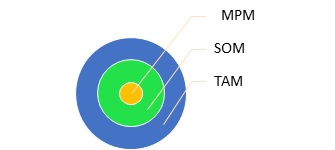
The Total Available
Market includes all sales of the product whether the supplier has the
specific design needed or the geographical infrastructure to serve the
market.
The Serviceable
Obtainable Market is the market which can be served with the lowest priced
product. The MPM market is one for which the supplier can most profitably
supply its products and services given its capital and knowledge resources.
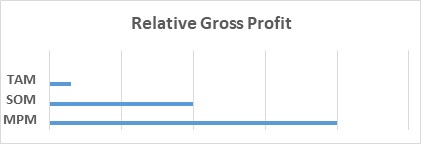
Every company should
strive to maximize the sales of higher performance products and services.
Its R&D should be oriented to increasing the number of products with high
margins due to their lowest total cost of ownership ( LTCO). It should also
be striving to increase the amount by which it does have the LTCO over
competitive products. This will result in higher gross profit. The opposite
side of this coin is that the competition will be striving to do the same.
So the LTCO is always a function of the differential to all of the
competitors.
MPM Program
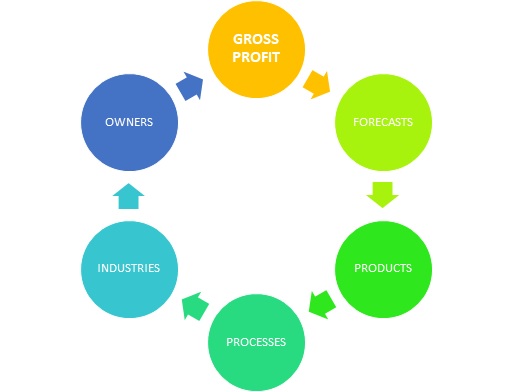
MPM forecasting
needs to be pursued robustly and continuously. It starts with top management
setting gross profit goals
Market forecasts
should be prepared in such detail that they shape the specific initiatives
relative to products, processes, industries and even individual large
owners. Most combust, flow and treat products and services are purchased by
less than 20,000 companies around the world. More than half the coal fired
power plant, refinery, oil and gas, mining, and steel purchases are made by
a very small number of companies.
The forecast should determine the gross profit which is achievable with the TCO of present products. This should be prepared for all the major purchasers.
|
Company |
Product |
Function |
Units |
Margin |
Gross Profit |
|
BASF |
Gate Valve |
Isolation |
|
|
|
|
BASF |
Gate Valve |
Control |
|
|
|
|
BASF |
Globe Valve |
Isolation |
|
|
|
|
BASF |
Globe Valve |
Control |
|
|
|
These forecasts
should be prepared for each product for a company such as BASF and then for
the individual plants. R&D and engineering design decisions should be made
on the basis of potential gross margin and profit and not just on the total
market. If the gross profit forecast is reduced because of a better
competitors design, then the magnitude of the problem should be quantified.
Decisions can then be made as to whether the investment in a new design is
warranted. The knowledge of the LTCO for each process in chemical plants
such as operated by BASF also needs to be taken into account. BASF is in a
number of industries. It makes chlorine increasingly with the membrane
processes but is phasing out its mercury process based chlor alkali
facilities. Valve requirements are different for each process.
Services available from McIlvaine.
The starting point
is the Total Available Market. McIlvaine already has forecasts for TAM for
many thousands of CFT products and services in many industries and in each
individual country. The background information needed to determine unit
margins and gross profit has been systematically gathered by McIlvaine over
the last 45 years. Some of this data appears in the many market reports and
databases. Other information has not been published but is available to
McIlvaine consultants.
One course of action
is to purchase the report or reports with TAM and then add the MPM on a
continuing basis with McIlvaine support.
Information on the
markets is shown at
http://home.mcilvainecompany.com/index.php/markets
Information on the
databases is shown at
http://home.mcilvainecompany.com/index.php/databases.
Information on other
relevant services is shown at
http://home.mcilvainecompany.com/index.php/other-services
For answers to your
questions contact Bob McIlvaine at
rmcilvaine@mcilvainecompany.com; cell 847-226-2391.
COAL-FIRED BOILERS
EPA Enforcement
Shift Will Allow Coal Plants to Pollute More, Former Air Official Say
The Trump
administration's shift away from enforcing air quality standards for major
stationary sources will allow coal-fired power plants and other facilities
to emit more harmful pollution, a former Environmental Protection Agency
enforcement official told Congress this week.
This month, the EPA
decided it will no longer prioritize enforcing its New Source Review rules
on coal-fired power plants, factories and refineries, saying those sources
had significantly reduced pollution. That could allow plants to make
upgrades without emissions oversight, said Bruce Buckheit, former director
of the Air Enforcement Division at EPA.
Current EPA
enforcement chief, Susan Bodine said the agency is "looking at other areas"
to prioritize enforcement, like mobile sources. The agency also announced it
would keep standards for sulfur dioxide at levels set by the Obama
administration, rather than strengthening them as public health advocates
wanted.
Testimony at the
House Energy and Commerce Committee recently highlighted fears among clean
air advocates and some former EPA employees that the agency is giving
polluters — including coal plants — a pass on emissions.
During the hearing,
Democrats pressed Bodine, the assistant administrator for Enforcement and
Compliance Assistance, about recently released numbers showing that
enforcement actions have fallen to their lowest level in decades.
"A strong
enforcement program does not mean that we have to collect a particular
dollar amount of penalties or take a particular number of formal actions,"
Bodine responded, saying that some enforcement actions taken by states after
EPA pressure are not included in the numbers.
On New Source
Review, Bodine reiterated EPA's justification for de-prioritizing
enforcement, saying other sectors could yield more meaningful emissions
reductions.
Critics like
Buckheit, however, say that coal-fired power plants and other generators
continue to upgrade their facilities, potentially increasing their
pollution. Under NSR, facilities must go through a permitting process if
they make meaningful expansions to their plants that could boost emissions.
"We know they're
doing lots of projects," he told reporters after the hearing. "We also know
there are no permits for those projects."
While Bodine touted
emissions reductions from coal-fired power plants, EPA's own Air Enforcement
webpage notes that "investigations of this sector have identified a high
rate of noncompliance with [New Source Review] when old plants are renovated
or upgraded.
Buckheit said that
reflected his experience working for EPA during the Clinton administration,
when his team identified a 70
percent noncompliance rate among U.S. coal-fired power plants, according to
his prepared testimony.
"U.S. coal-fired
power plants are very old," he said, "and to extend their useful life out
requires big capital projects that when we were doing this in the old days
we found triggered the NSR rules, so we found they had to put on controls."
Buckheit said he is
concerned the decision to de-prioritize NSR will mean that EPA staffers are
directed to abandon NSR enforcement altogether, as he said happened during
the second Bush administration.
Wyoming State
Government Makes Coal Closures Harder
Wyoming has passed
legislation requiring utilities to make a “good faith” effort to sell old
coal plants rather than retiring them and compel any buyers, if found, to
buy back power from the plants even if it is more expensive than alternative
sources. The bill is particularly aimed at pre-empting the preference for
Rocky Mountain Power, a subsidiary of PacificCorp, to retire the two
remaining coal units at 448-MW Naughton plant, which could save customers
US$175 million. The Powder River Basin Resource Council flagged its concern
that the bill could force Wyoming’s remaining plants to be sold to smaller,
less financially secure companies that could eventually collapse and leave
rehabilitation costs to be carried by the government
Turkey Scraps
Push to Delay Pollution Standards
A push to defer the
introduction of new air pollution emission limits has been dropped after all
political parties in Turkey’s parliament opposed the move. The campaign
opposing the proposed changes, which would have affected at least 10
proposed coal-fired power plants, attracted 65,000 signatures on a petition
to the parliament. Legislation passed in 2013 allowed power plants until the
end of 2019 to install pollution control equipment to meet air quality
standards.
Action Urged on
Western Balkans Coal Pollution
While the Energy
Community Treaty between the EU and its neighbors set a December 2018
deadline for upgrading pollution controls on the plants, work has mostly
been deferred. A further 2700 MW of new coal-fired power plants, mostly
backed by Chinese banks, are proposed despite not meeting EU pollution
standards.
Black Russian Snow
Highlights Coal Pollution
Videos posted by
residents of the coal mining Kuzbass region to social media have revealed
streets lined with coal-covered snow. “It’s harder to find white snow than
black snow during the winter,” said Vladimir Slivyak from Ecodefense. About
half of Russia’s total coal production comes from the Kuzbass coal basin.
After the imposition of economic sanctions after the invasion of Crimea, the
Russian Government has pursued increasing coal exports especially into the
European and Asian markets. In 2018, 191 million tons of the 432 million
tons produced was exported.
Mormugao Port, Goa,
India Pollution Protests
The Goa State
Pollution Control Board (GCSB) has requested that all coal handling
operations by a subsidiary of the Jindal Group be suspended due to air
pollution affecting the suburbs around Mormugao port in Goa. Videos of coal
dust being blown into residential areas have been widely shared on social
media prompting a local NGO to file complaints with the police against the
Mormugao Port Trust and subsidiaries of Adani and the Jindal Group. In
January 2018, the GCSB temporarily suspended coal import operations after it
was revealed that the port had handled well in excess of its permitted
volume. In July 2018, the terminals were allowed to resume operation though
at a far lower level.
METALS
Aceros Arequipa
Orders Steel Mill and Continuous Billet Caster from SMS Group
Corporación Aceros
Arequipa S.A. (CAASA), based in Arequipa, Peru, has awarded SMS group an
order covering the supply of mechatronic equipment for a new steel mill and
a billet caster with six strands for its Pisco site. The plant is designed
for an annual capacity of 1,200,000 tons and will produce billets with
sections of 130, 160 and 180 millimeters. Commissioning is scheduled for
early 2020
In terms of the
steel mill, SMS group will supply a 120-ton AC electric arc furnace equipped
with innovative technology to secure high productivity levels. A CONDOOR
automated slag door will reduce downtimes and thus make the process more
efficient. The CONSO injection system, in combination with the AEREG
electrode controller, will permit over 180 tons of steel to be produced
every hour in a steady and continuous process. SMS group’s scope of supply
also includes a ladle furnace meeting all requirements with regard to the
respective steel composition.
The steel mill will
be equipped with a gas cleaning plant capable of processing over 2,200,000
cubic meters of process gas per hour, with the frustum exhaust hood from SMS
group permitting the gases produced during furnace charging and tapping to
be captured and extracted more effectively. The gas cleaning plant will
comply with the strictest environmental regulations.
The new plant will
allow Aceros Arequipa to expand its presence on the local market and in
South America and to offer higher-quality products.
Tenova LOI
Thermprocess Will Supply a Large Aluminum Recycling Furnace to an Italian
Recycling and Melting Enterprise
Tenova LOI
Thermprocess, supplier for custom-made heat treatment lines and furnaces and
specialist for recycling plants for contaminated aluminum scrap, has
received an important order from Fonderie Pandolfo, Italy, for the delivery
and installation of a Twin-Chamber
Melting Furnace TCF®.
Fonderie Pandolfo is
the recycling and melting enterprise within the Panalco Holding, specialized
in processing of aluminium, mainly for extrusions. The casted billets are
mainly extruded in the extrusion shops of the main European extruders.
The TCF®,
with a capacity of 65,000 tons/year, is designed for aluminum scrap
recycling. In order to cover a broad range of scrap and contamination
degree, the TCF® combines pre-treatment and melting in one
furnace.
The beneficial TCF®-process
relies on the efficient melting by limiting dross formation due to
pre-treatment, while the evolving Volatile Organic Contents (VOCs) are
combusted completely in the furnace to decrease the overall energy
consumption and fulfill the most restrictive environmental regulations.
By combining
regenerative air heating (CCR) and optimized thermal treatment of the
organic scrap components, this proven furnace technology reaches an
unmatched grade of energy and metal efficiency. A sophisticated automation
technology, applied by Tenova LOI Thermprocess with the aim to streamline a
fully automatic charging machine, increases efficiency further.
The scope of supply
contains the turnkey-installation, including a state-of-the-art flue gas
treatment plant.
GLASS FURNACES
Ecopure CCF Provides
Partial-Flow Exhaust Air Purification for Cost-efficient, Complete
Compliance with Clean Gas Values
Gerresheimer has
commissioned the world’s first partial-flow exhaust air purification system.
This will ensure that the glass manufacturer’s existing system complies with
the much more stringent clean gas values that apply after a glass tank
replacement – and all for half the investment cost of conventional methods.
The cost-efficient solution is based on the new Ecopure® CCF
developed by Dürr.
The Gerresheimer
Group, one of the leading international manufacturers of glass and plastic
primary packagings for the pharmaceutical and cosmetics industries, uses two
melting tanks at its site in Essen. The planned modernization of one of the
furnace and the higher production capacity associated with this means that
the existing exhaust air purification system may no longer be able to
achieve the clean gas values for dust and nitrogen oxide (NOx).
In order to efficiently and cost-effectively prepare the existing system for
the future increase in output, Luft- und Thermotechnik Bayreuth (LTB), a
subsidiary of Dürr, developed an innovative concept with this special
Ecopure® CCF.
The high--melting
temperatures required during glass production result in large quantities of
pollutants. Gerresheimer merges the contaminated exhaust air from the two
glass furnaces into one exhaust air purification system. In the future, half
of the exhaust air will be treated in an
Ecopure® CCF.
This technology combines the three individual processes of exhaust air
purification, enabling one system to precipitate dust, absorb sulfur, and
reduce nitrogen oxides from the exhaust air. This is done using catalytic
candle filters, whose ceramic fibers can withstand temperatures of up to
900°C. The exhaust air, treated in the
Ecopure® CCF, is
then returned to the existing system, where it mixes with the exhaust air
purified there. The Ecopure®
CCF ensures that the exhaust air as a whole complies with all required clean
gas values. The investment costs for partial-flow treatment are therefore
half of typical alternatives. This would have involved replacing the
existing system completely with a new one or upgrading the existing system
with a downstream system
CEMENT
CTP Team Winds
Malaysian Air Pollution Control Contract
CTP Team has been
awarded a turnkey project for air pollution control in Malaysia. The project
consists of the conversion of an existing Pl1 raw mill electrostatic
precipitator (ESP) to a fabric filter and the upgrade of an existing exhaust
fan. The company has signed the turnkey project with YTL Cement for the
Perak-Hanjoong Simen cement plant in Pedang Rengas
The project consists
of a full turnkey solution for the conversion of the existing ESP into a
more efficient bag filter. The existing ESP into a more efficient of filter.
The existing ESP in a 740,000 m3/hour unit, installed downstream
of the kiln and draw mills on line one. The conversion will fit within the
current footprint, with the minimum impact of steel structures, ducting and
the dust transport system.
Within the new
filter, emissions limits will be reduced to below 10 mg/m3
by June 2019. The target is to
meet the government requirement for the control of dust emissions in a short
period of time, in order to drive the cement plant to a safe and competitive
position.
The aim is to reduce
dust emissions well below the limits imposed by the local regulation. The
unit will be equipped with CTP Team’s advanced cleaning system with low
pressure air: SWAP technology.
the system reduces pressure with minimum consumption of compressed air and
further benefit to OPEX for the operator
COMPANY NEWS
Donaldson Achieves
Record Second Quarter Sales and EPS
Donaldson Company,
Inc. reported record 2nd quarter net earnings of $60.1 million,
compared with a loss of $52.9 million in 2018. The current- and prior-year
periods included tax expense of $0.4 million and $109.7 million,
respectively, related to the Federal Tax Cuts and Jobs Act (TCJA). Excluding
these impacts, 2nd quarter 2019 adjusted EPS3
increased 9.3 percent to $0.47 from $0.43 in 2018.
The 2nd
quarter 2019 sales increased 5.9 percent to $703.7 million from
$664.7 million in 2nd quarter 2018. Included within the
year-over-year change are the following items:
Currency translation
negatively impacted sales by approximately 2.7 percentage points.
·
The acquisition of
BOFA International LTD (BOFA), which was completed during first quarter
2019, added approximately 1.4 percentage points,
·
Price increases
added approximately 1.3 percentage points, and
·
Adoption of the
revenue recognition accounting standard added approximately 0.3 percentage
points.
The 2nd
quarter 2019 sales of Engine Products (Engine) increased 6.0 percent from
last year, or 8.6 percent in constant currency. The revenue recognition
accounting change added approximately 0.5 percent to Engine’s growth rate.
Engine results reflect broad geographic strength in Aftermarket, combined
with strong On-Road growth in the U.S./CA and APAC regions. Sales of
Aerospace and Defense benefitted from ground defense orders. Off-Road sales
performance varied by geography, with strong year-over-year growth in EMEA
offset by declines in the U.S./CA and LATAM regions.
The 2nd
quarter 2019 sales of Industrial Products (Industrial) increased 5.6 percent
from last year, or 8.4 percent in constant currency. Sales of Industrial
Filtration Solutions (IFS) increased 13.5 percent, reflecting growth in all
major regions and including a benefit of approximately 6.5 percent from
BOFA. Sales of Gas Turbine Systems (GTS) declined, due in large part to
declining volume of large turbine projects, while Special Applications (SA)
sales were down, due primarily to declining sales of Disk Drive filters.
The 2nd
quarter gross margin of 32.0 percent was below the prior year by 0.9
percentage points, or 0.7 percentage points when adjusting for the impact
from the revenue recognition accounting change. The 2nd quarter
2019 gross margin was negatively impacted by higher raw materials and supply
chain costs, combined with an unfavorable mix of sales, partially offset by
price increases. Operating expense as a percent of sales improved 1.0
percentage points to 19.9 percent from 20.9 percent in 2018, reflecting
lower incentive compensation expense and leverage on increasing sales,
partially offset by higher salary expense.
During 2nd
quarter 2019, Donaldson repurchased 450 thousand shares, or 0.3 percent, of
its common stock at an average price of $46.87 for a total investment of
$21.1 million. Donaldson paid dividends during the 2nd quarter of
$24.3 million. Year to date, the company paid $102.0 million to repurchase
shares and $48.7 million of dividends.
Donaldson now
expects full-year 2019 EPS between $2.27 and $2.41, compared with prior
guidance of $2.31 to $2.45. The company is now projecting fiscal 2019 sales
to increase between 5 and 9 percent, including a currency headwind of
approximately 3 percent and sales contribution from BOFA of approximately 1
percent. The revised 2019 sales forecast is 2 percentage points below prior
guidance, with incremental currency headwinds and business performance each
accounting for approximately half of the change.
CECO Reports
Significant Improvement in Fourth Quarter Financial Performance
CECO Environmental Corp.
reported its
financial results for the 4th quarter and full year of 2018.
Revenue in the 4th
quarter of 2018 was $93.9 million, up 27.8
percent from $73.5 million in the prior-year period, and up 6.3
percent from $88.3 million in the 3rd quarter of 2018.
Revenue in the 4th quarter of 2017 included $8.5 million
attributable to our divested businesses, Keystone, Strobic and Zhongli.
Operating Income was
$5.7 million for the 4th quarter of 2018 (6.1
percent margin), compared with an $(8.2) million loss in the
prior-year period. Non-GAAP operating income was $8.4 million for the fourth
quarter of 2018 (9.0 percent
margin), compared with $3.5 million in the prior-year period (4.8
percent margin).
Net income was $0.9
million for the 4th quarter of 2018, compared with a $(11.6)
million net loss in the prior-year period. Net income on a non-GAAP basis
was $3.0 million for the 4th quarter of 2018, compared with a
$(1.7) million net loss in the prior-year period.
Revenue was $337.3
million for the twelve months in 2018, down 2.2
percent from $345.1 million in the prior-year period. Revenue in 2017
included $34.6 million attributable to our divested businesses, Keystone,
Strobic, and Zhongli compared with $9.3 million for the year of 2018
Operating income was
$10.0 million in 2018 (3.0
percent margin), compared with $8.0 million in the prior-year period (2.3
percent margin). Operating income on a non-GAAP basis was $24.1
million in 2018 (7.1 percent
margin), compared with $28.3 million in the prior-year period (8.2
percent margin).
Net loss was $(7.1)
million for 2018, compared with a net loss of $(3.0) million in the
prior-year period. Net income on a non-GAAP basis was $10.2 million for the
year of 2018, compared with $9.5 million in the prior-year period.
CECO's Chief
Executive Officer Dennis Sadlowski commented, "I am very pleased with our
financial results for the 4th quarter and want to thank the
entire CECO team for delivering big improvements in our performance. We
achieved 44 percent
year-over-year organic revenue growth, over 100
percent growth in EBITDA, and incredible free cash flow generation of
$17 million. We view cash earnings as integral to generating top-tier
returns for our shareholders and believe this to be a fundamental strength
of CECO's asset light business model."
Mr. Sadlowski added,
"In 2018, we executed on our operating strategy, delivered growth with a 20
percent year-over-year increase in bookings and are well underway to
transforming how we do business with a more customer focused and
solutions-based mindset. Our 4th quarter bookings were below our
expectations as capital markets volatility and U.S. political tensions
created delays in customer decisions. We expect this to be more of a timing
issue as our overall sales pipeline remains very strong and robust. We are
headed into a new year with an impressive backlog of $182 million, which is
up $32 million organically from the prior year. Our end markets are large
and generally healthy going into 2019 which provide us confidence in our
aggressive financial targets for 2021."
Advanced Emissions
Solutions Completes Successful Acquisition of ADA Carbon Solutions
Advanced Emissions
Solutions, Inc. filed its Annual Report on Form 10-K and reported financial
results for the 4th quarter and full year ended December 31,
2018, including information about its equity investment in Tinuum Group, LLC
and Tinuum Services, LLC which ADES owns 42.5
percent and 50 percent,
respectively.
ADES Consolidated Highlights:
·
Completed the
successful acquisition of ADA Carbon Solutions, LLC ("Carbon Solutions") on
December 7, 2018 for the total purchase price of $75 million, complementing
the Company's product suite and building out its newly named Power
Generation & Industrials ("PGI") segment
·
Recognized
consolidated revenue of $10.6 million during the 4th quarter and
$23.9 million for full year 2018, both of which included 25 days of
contribution from Carbon Solutions
·
General and
administrative operating costs (i.e., non-cost of revenue expenses) were
$9.7 million for the 4th quarter and $24.1 million for full year
2018
·
Entered into $70.0
million face value term loan, which contributed $0.5 million of interest
expense during the fourth quarter
·
Consolidated net
income was $7.0 million for the 4th quarter and $35.5 million for
full year 2018; pretax income was $12.3 million for the fourth quarter and
$45.9 million for full year 2018
·
Ended 2018 with a
cash balance, inclusive of restricted cash, of $23.8 million, a decrease of
$8.1 million since September 30, 2018, driven by cash expenses incurred as a
result of the acquisition of Carbon Solutions
·
Announced share
repurchase program for up to an additional $20.0 million of the company's
common stock in the open market
·
Returned $45.5
million to share holders in 2018 through capital allocation initiatives
L. Heath Sampson,
President and CEO of ADES commented, he acquisition of Carbon Solutions met
each and every one of our explicit acquisition criteria. This acquisition
immediately makes us the lowest-cost producer of Powder Activated Carbon and
market leader within the North American mercury control space, complementing
our existing technologies and offering attractive operating synergies. It
also opens the door to adjacent, growing markets that are ripe for
evaluation and pursuit such as municipal water, the broader commercial and
consumer water markets.”
PRODUCT NEWS
Catalytic Ceramic
Filters are Now Being used for Large Applications
GEA now offers a ceramic catalytic 6 meter long element. To date, the 3
meter element has been the longest available choice. The big advantage of
combining DSI with catalytic filtration is that only one vessel is needed
for particulate, acid gas and NOx reduction. These systems have
been extensively used in the glass industry and other applications with
modest gas flows. Now with
twice the capacity per element there is the opportunity to pursue larger
applications
One of the big potential advantages of catalytic filtration and DSI is to
produce a clean gas at temperatures above 600°F. Dürr is one company
pursuing the use of efficient heat exchangers and energy recovery
Camfil APC’s New
Quad Pulse Package 2 Dust Collector for Chemical Processing Facilities
Increases Filtration Capacity with Two Main Cartridges
Chemical processing
facilities that produce high concentrations of fine, hazardous, combustible,
and nuisance dust need an industrial dust collector that is cost effective
to operate and easy to maintain on the plant floor. The Quad Pulse Package 2
(QPP2) dust collector from Camfil Air Pollution Control (APC) has two main
filter cartridges designed for 590-1765 cu ft/min air volumes to increase
filtration capacity.
The QPP2 also
features a cleanable filter system that allows manufacturers to run
continuous production processes and avoid frequent, expensive filter
replacements.
The QPP2 is ideal
for chemical processing applications including weighing, batching, blending,
mixing, drying, calcining, screening, packaging, sack tipping, conveying,
sieving, salting, coating, and paint pigment processing.
The QPP2 cleans
filters in four segments, one at a time, so that they are continually
cleaned without interrupting airflow. The primary filters provide excellent
filtration efficiency and remove the majority of collected dust. This design
prolongs the service life of the second-stage HEPA filter, which provides
99.995 percent filtration efficiency to capture the finest, most hazardous
dust particles. The HEPA filter is also a tested flame and contamination
barrier.
The QPP2 provides
explosion protection in accordance with NFPA and ATEX standards. The
pressure shock resistant housing maintains its integrity with no damage
during an explosion event. The QPP2 can safely contain an explosion event
without the need for additional safety devices, and it can be safely
installed indoors close to the processing area.
The QPP2 uses a
bag-in/bag-out (BIBO) system to protect workers and prevent
cross-contamination. The BIBO system provides full dust containment to
ensure safe change-out at the primary filter, HEPA filter and dust discharge
stages. Because the compact QPP2 can be installed indoors, it reduces the
need for long duct runs and enables easy access to the unit.
Schenck Offers New
Vertical Cartridge Filter for Industrial Dust Collection
The new Vertical
Cartridge Filter from Schenck Process Holding GmbH, removes industrial dust
while incorporating a unique design for handling medium-to-high air volumes.
The dust collector comes equipped with many time- and cost-saving features.
An easy-to-use cartridge clamp system simplifies replacement of the filter
media, thereby minimizing maintenance time and lowering overall cost of
operation. The filter is also equipped with a smart timer, which includes an
onboard sensor that reads the
pressure drop across the filtering elements for on-demand cleaning. This
results in reduced compressed-air consumption and longer cartridge life. A
standard radial inlet allows for excellent material separation during
moderate air-volume applications, while the optional high-entry inlet with a
pre-separation chamber is designed for optimal performance in high-volume
systems. The chamber separates the largest powder particles, safeguarding
the media from excess loads of pollutants and guaranteeing longer media
life.
Back to Fabric Filter Newsletter No. 521 Table of Contents