CONTENTS OVERVIEW
Since 1974 McIlvaine has been analyzing scrubber markets and technology. By the early 1980s suppliers were hiring McIlvaine for market research. This resulted in this multi-client market report ” which has been published every three to four years since the 1980s. Now McIlvaine has converted this report from periodic, with hundreds of forecasts, to continuous with 40,000 forecasts.
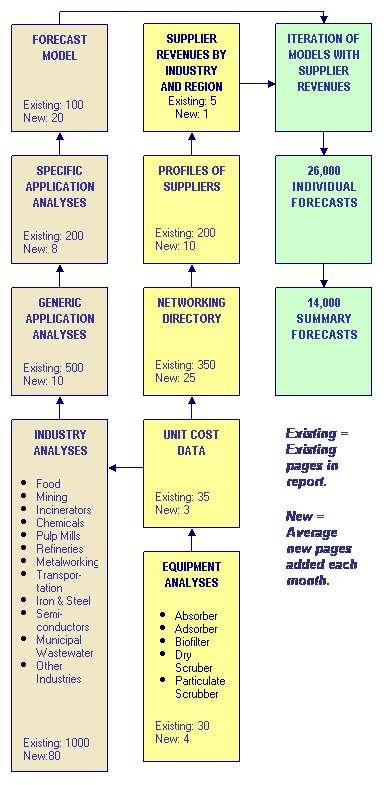
The power of the system is displayed in the accompanying chart. The analysis sequence consists of two paths. The first path results in forecasts of revenues based on industry models and the second path results in aggregation of the revenues of the suppliers. For the present year the aggregation of the supplier revenues has to equal the forecast model. If it doesn’t then the model has to be changed. The corrected model is then used to forecast future years. Whereas suppliers are very knowledgeable about their own sales in the present and in the past and have decent knowledge about competitors present and historic sales, they do not have this knowledge about the future.
Suppliers, of course, have invaluable insights about the future. But without the comprehensive models relative to each industry the forecasts of future sales are not going to be overly reliable. To project municipal odor control scrubber purchases it is invaluable to project secondary treatment additions in mgd and then determine a penetration rate for scrubbers.
As you can see from the chart, there is also a category entitled “Generic Application Analyses.” In this segment for each industry we attempt to determine the air pollution control requirements for the processes. For example, in the rendering industry, what are the process requirements? What quantities of air are involved? These are the questions answered in the “Generic Application” section. This contrasts to a specific application analysis.
Based on the “Generic Application Analyses”, the “Specific Application Analyses” and the industry production rates contained in the “Industry Analyses” sections, models are determined which provide present and future revenues for each of the equipment types in each industry in each country. However, these models need validation. This is where the analyses path comes into play. A networking directory identifies the universe of suppliers of each equipment type in each region of the world. Profiles of the larger companies become the basis of individual company revenue determinations. The aggregate of these individual revenues for the past year is compared to the models in the upper path. An iteration of these two approaches results in a validated model.
This validated model is then used to project future revenues. The result is xxx specific revenue forecasts (9 industries x 6 equipment types x 80 countries x 6 years). These forecasts are aggregated by country and region and equipment type resulting in another 7,000 forecasts. However, the forecasts are displayed as a result of queries. There are nine different query options. Therefore, the 26,000 forecasts can be displayed 9 different ways resulting in more than 100,000 different page displays of forecasts.
The system is built on the industry analyses. Forecasts for the power industry, for example, are changing continually. We estimate that there will be at least 100 page changes a month in the industry analyses. By contrast the comparisons and analyses of the basic equipment will only change occasionally (3 pages/month average); other sections will change at varying rates.
This brings us to the issue of printed versus online access to the data. Because the reports are thousands of pages in length and are being updated constantly, a printed copy would be both unwieldy and quickly obsolete. Our solution is to make the online reports easy to print. We are using techniques such as “bookmarking.” This allows you to click on a specific section but to print out a whole chapter.
SCRUBBERS/ADSORBERS/BIOFILTERS CONTENTS OVERVIEW CHART
