•Direct measurement and real-time control of pre-boiler corrosion at paper mill
Steam plays a critical role in paper manufacturing to dry paper sheets. Any loss in steam availability can have a very serious impact on the production rate and profitable operation of a paper mill. It's easy to understand then why maintaining 100% boiler system availability is so important.
One of the main threats to reliable boiler operation is oxygen corrosion. Even small amounts of dissolved oxygen (DO), as low as 10 ppb, can be very aggressive to a boiler feedwater system. Oxygen corrosion dissolves the metal surfaces, often causing localized pitting. This localized pitting attack can be especially aggressive and quickly penetrate through the metal pipe wall resulting in feedwater system leaks and failures. Just as important, corrosion sends dissolved iron into the boiler that can deposit onto boiler tubes, causing overheating and tube failure.
Since oxygen is so highly corrosive, it must be reduced to the lowest possible concentration. A typical strategy is to remove corrosive oxygen using mechanical deaeration of boiler feedwater and chemical treatment with an oxygen scavenger or passivator. The oxygen scavenger or passivator dosage is controlled by maintaining a prescribed residual level based on periodic testing and manual adjustment. Another common practice is to slave the product feed to feedwater flow, which would increase or decrease dosage according to boiler system water demand. Occasionally a facility may also use on-line DO monitoring, or a cumbersome oxygen wet test. Some may even measure iron in the feedwater to get a feel for program effectiveness and corrosion protection. These conventional control methods, though, are all indirect measurements and don't provide a direct indication of corrosion control.
Performance
One multinational manufacturer of writing paper agreed to evaluate Nalco's 3D TRASAR Automation for Boilers, which uses a new Corrosion Stress Monitor for preboiler corrosion control. The corrosion process occurs via oxidation-reduction reactions characterized by a potential (V). NCSM technology measures the net potential of all the oxidation-reduction reactions occurring simultaneously in the bulk feedwater which predicts the tendency of corrosion to occur. Nalco's 3D TRASAR boiler technology with the NCSM minimizes boiler feedwater corrosion by measuring the oxidation-reduction potential (ORP) of the feedwater at the actual boiler operating temperatures and pressures, and responds by changing oxygen scavenger or passivator feed to maintain a constant, reduced ORP setpoint.
The feedwater isn't cooled or otherwise conditioned, eliminating potential errors due to sampling technique or the changes in water chemistry from cooling the sample. Robust hardware and probes are designed to withstand temperatures up to 500°F and operating pressure up to 1500 psi, making them capable of withstanding industrial boiler feedwater conditions.
This technology allowed real time direct measurement and response to system stresses caused by mechanical, operational and chemical (MOC) variations, such as system start-ups and shutdowns, deaerator performance changes and changes in feedwater quality. It also can be used to diagnose potential problems that could eventually result in a system shutdown.
Results
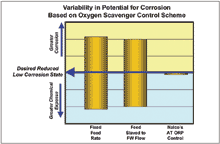
The NCSM signal was measured for three different control schemes. Figure 1 shows the variation in NCSM readings, i.e., corrosion potential, for each of those schemes. A setpoint of -325 mV was determined to be the ideal reduced, non-corrosive state for this system. Deviation upward to a less negative reading would indicate a more corrosive state and could threaten to allow damaging corrosion to occur. A reading lower than -325 mV would waste chemical from overfeed and add unnecessary solids to the boiler in addition to the extra expense.
Conclusion
Before development of NCSM technology, the steam plant managers at this paper mill had limited options to manage feedwater system corrosion. Neither fixing the oxygen scavenger dosage to a constant pump rate or even using a more advanced strategy of slaving chemical feed to feedwater flow, provided the corrosion protection or cost control desired. The 3D TRASAR Automation for Boilers using Nalco Corrosion Stress Monitor technology was the only strategy that could provide the 24/7 corrosion control needed.
This mill produces 440 tons of writing paper per day. Therefore, a typical interruption in operation would cost the plant $430,000 per day in lost revenue alone. In addition, the plant would have to incur any associated maintenance costs. The Nalco solution gives the steam plant manager a tool to minimize these costly shutdowns and finally achieve the operating objectives established by the mill to both minimize system corrosion and optimize operating costs.
Based in Naperville, IL, Nalco Company also has regional offices in The Netherlands, Singapore and Brazil. Its Energy Services Division is in Sugar Land, TX. Contact: 630-305-1000 or www.nalco.com
Figure 1. Nalco's 3D TRASAR Automation for Boilers with the Nalco Corrosion Stress Monitor responded real time to system stresses, dosing the correct amount of oxygen scavenger to maintain an ideal non-corrosive state.
Control Strategies
• Fixed Feed ? The first control scheme feeds the chemical oxygen scavenger at a fixed pump speed. The Nalco Corrosion Stress Monitor (NCSM) signal varied widely, up to 110 mV using this strategy, confirming a constant oxygen scavenger feed rate to a variable system would produce periods of overfeed and underfeed. This is the practical reality all mills face in balancing the cost of treatment versus the desired performance.
• Slaved Feed ? The next control scheme was slaving the chemical scavenger feed rate to feedwater flow. The oxygen scavenger feed was increased as feedwater demand rose, and similarly scavenger decreased as feedwater demand fell. This improved control only slightly. The NCSM reading still varied as much as 100 mV, suggesting feedwater flow variation isn't the only factor causing corrosion variability. This scenario, as with the fixed dosage rate, also results in overfeed and underfeed conditions that compromise operating cost and reduce asset life.
• At Temperature ORP ? Lastly, the NCSM signal was used as the control strategy. A setpoint value of -325 mV was determined as an NCSM value where the corrosion of the mild steel piping used in this particular boiler economizer was minimized. The graphic shows that the control system and chemical feed pump being used were capable of dosing the additive to maintain a steady, noncorrosive ORP state. The ability to maintain an NCSM setpoint accomplishes the objective of neither over- or underfeeding oxygen scavenger. The correct amount of oxygen scavenger was dosed real time in response to system stresses, minimizing corrosion and protecting the boiler assets.