Berkshire Hathaway
Alert #7
Overview
Can Hunter and Huntington avoid full scale SCR
BHE can leverage IoT and remote monitoring with
the BHE and Supplier Connect
BHE Revenues were $5.2 billion in third quarter
NV Energy plan to buy Arizona gas-fired power
plant is rejected
Renewables
Grande Prairie Wind project (GPW), Kallanish
Energy moving forward
Net metering proposal for Utah solar customers
is suspended
BHE to buy Alamo 6 solar farm
BHE Renewables is a leading operator of megawatt
scale PV: plants
Energy gateway for Rock Mountain Power is
approved
NV Energy plan to buy Arizona gas-fired power
plant is rejected
Las Vegas will now be powered entirely by
renewable energy
Iowa moving toward a mostly renewable energy
supply
Vestas obtains new wind turbine order from
MidAmerican
Transmission
MidAmerican Energy Co. has completed
construction of a transmission line in northwest
Iowa
Overview
Can Hunter and Huntington avoid full scale SCR
In September 2016 PacifiCorp and the State of
Utah both filed suits against the Environmental
Protection
Agency (EPA). They want to reverse a ruling
which requires NOx reductions at the
Hunter and Huntington
plants to levels below what had been originally
submitted in the State Plan. The question is
whether the new administration will decide to
retract the adverse ruling. The new EPA
Administrator will be Paul Pruitt who
unsuccessfully sued the federal agency several
times to block its efforts to address emissions
from Oklahoma’s aging coal plants.
At the Hunter and Huntington plants it appears
that a combination of novel technologies will
result in emission levels close to the mandated
.07 lbs/MMBtu. This combination will save nearly
$200 million in capital costs. Since the
PacifiCorp solution will be nearly as good as
the full scale SCR there would seem to be
grounds for settling the law suit with an
agreement to install the novel
technologies. There are nine hours of recorded
webinars discussing the combination of
options. These are linked through the McIlvaine
44I Coal Fired Power Plant Decisions website
which is free of charge to all BHE employees.
BHE can leverage IoT and remote monitoring with
the BHE and Supplier Connect
The BHE Supplier Connect program to which you
have access has identified many of the
components and gathered data about each of the
hundreds of power plants owned by BHE.
The innovations in software, smart instruments
and remote monitoring can be leveraged to
greatly improve power plant performance.
However the specific knowledge incorporated in
the Supplier Connect system is needed to make
these improvements possible.
Let’s take lubrication as an example. McIlvaine
has identified much of the rotating equipment at
each plant. This includes turbines, fans,
pulverizers, pumps etc. it has gathered
information on lubrication problems and
solutions at many of the plants.
McIlvaine has initiated a LinkedIn discussion
group Power Plant Lubrication
https://www.linkedin.com/groups/12021297
Richard Winslow is a niche expert on power plant
Lubrication. We first learned about Richard’s
lubrication expertise in an article he wrote
when he was with PacifCorp. There was a
pulverizer wear problem at the Naughton plant of
PacifiCorp. An advanced filtration technology
for the coal pulverizer was determined to be
readily available for heavy gear oil that would
meet solve the maintenance problems. An off-line
kidney loop filtration package using a
high-efficiency, high-dirt-holding capacity,
synthetic filter media was solved the problem.
Richard moved on from PacifiCorp and most
recently has been in Alaska with ConocoPhillips.
He has agreed to a niche expert role in our
LinkedIn discussions and decision system. In
addition to his Naughton paper we have also
included his paper on minimizing bacterial
contamination. His resume’ is included in the
intelligence system.
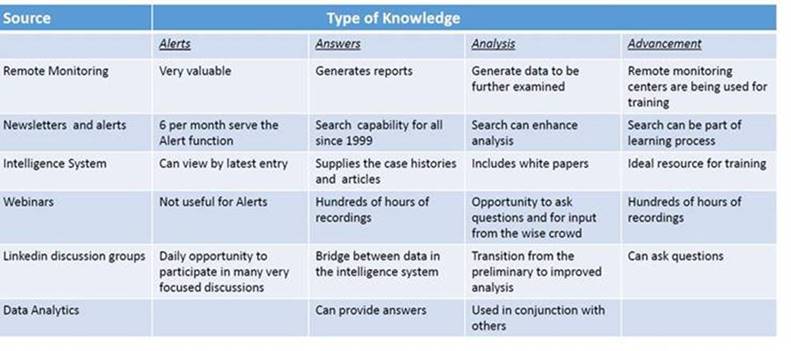
This background information can be combined with
remote monitoring of all the rotating equipment
in the plants and better decisions made
regarding maintenance and operation. All
of this comes together to provide the four
knowledge needs: Alerts, Answers, Analysis, and
Advancement.
NV Energy plan to buy Arizona gas-fired power
plant is rejected
In a split decision, the state Public Utilities
Commission last week rejected a plan by NV
Energy to buy a natural gas-fired power plant in
Arizona for $75 million. Commissioner Paul
Thomsen, who wrote the majority decision, noted
that Nevada is the second-fastest growing state
in the union, but the demand for energy is
decreasing. “There will be decreased load in
Northern and Southern Nevada,” he said.
The company said 70 percent of the energy from
the plant would have been used in Southern
Nevada and the rest in Northern Nevada. In his
written dissent, Commission Chairman Joseph
Reynolds said the purchase would be “a good
value” and help meet the state’s future energy
needs.
Renewables
Grande Prairie Wind project (GPW), Kallanish
Energy moving forward
GPW is a 400-megawatt (MW) wind farm in Holt
County, Nebraska – the largest wind energy
project in the state’s history – owned by BHE
Renewables, a Berkshire Hathaway Energy
subsidiary. The project will increase Nebraska’s
wind energy capacity by nearly 50 percent, and
represents the first project in the state for
BHE, BHE announced in April 2015 the plan to
start construction of GPW. The project has a
long term power purchase agreement with the
Omaha Public Power District.
BHE Revenues were $5.2 billion in third quarter
Berkshire Hathaway manages its energy business
through BHE (Berkshire Hathaway Energy). It has
an 89.9 percent stake. Berkshire owns utilities,
downstream companies, and transmission
companies. The company operates utilities
through MidAmerican Energy, PacifiCorp, and NV
Energy, which was acquired in 2013. The company
is expected to see year-over-year growth for BHE
in 4Q 2016. In 3Q 2016, BHE posted revenues of
$5.2 billion—compared to $5.1 billion during the
same quarter last year. The growth was due to
higher revenues from MidAmerican and real estate
brokerage. It was partially offset by a weak
performance from NV Energy and Northern
Powergrid.

In 3Q 2016, BHE’s earnings before taxes
increased to $1,246 million—compared to $1,153
million during the same quarter last year. The
operating earnings rose for MidAmerican, NV
Energy, and PacifiCorp due to customer load and
higher electric rates. The earnings were
partially impacted by lower natural gas
revenues.
Berkshire, under BHE, also operates the
second-largest residential real estate brokerage
company in the U.S. Internationally, BHE
operates two regulated electricity distribution
businesses in the United Kingdom. The company
faces competition from utility operators and
alternative managers such as Blackstone Group
(BX), KKR (KKR), and other managers that form
part of the Utilities Select Sector SPDR ETF
(XLU).
Net metering proposal for Utah solar customers
is suspended
The Utah Public Service Commission suspended
Rocky Mountain Power's net metering proposal at
the utility's request in order to "seek mutually
acceptable solutions" from other stakeholders,
such as solar advocates, media outlets report.
The net metering proposal would have applied the
new rates for customers seeking interconnection
after December 9 of this year, but since none of
the parties could come to an agreement over the
deadline, RMP chose to have the decision
delayed. Despite the respite, RMP doesn't plan
to shelve its push to find a "rate that's fair
to Utah solar customers" and non-solar
customers, a spokesman told radio outlet KPCW.
Proceedings are still scheduled for the
utility's net metering program.
Under the proposal, Utah solar customers would
have participated in a 3-tier rate design
consisting of a demand charge, a $15 fixed
customer charge and a $0.03/kWh charge for the
amount of energy used.
BHE to buy Alamo 6 solar farm
San Antonio-based solar developer OCI Solar
Power is seeking state approval to sell its
Alamo 6 solar farm to a subsidiary to BHE. Alamo
6 Solar Holdings is a wholly-owned subsidiary of
BHE Solar LLC, which is owned by BHE Renewables
LLC, which is in turn owned by Berkshire
Hathaway Energy CoA sale price has not been
disclosed but OCI Solar Power officials
confirmed that the company signed a purchase
agreement to sell the West Texas solar farm.
Located in Pecos County, Alamo 6 remains under
construction but once complete it will supply
110.2 megawatts of electricity to San Antonio's
municipally-owned utility company CPS Energy.
BHE Renewables is a leading operator of megawatt
scale PV plants
The top 100 owners of megawatt-scale PV plants
globally - outside of China - accounted for more
than 33 gigawatts of net installed capacity as
of Q3 2016, Of the top players, 54 are
independent power producers (IPPs), with a total
of more than 19.6 gigawatts of net capacity.
Financial investors and funds are the
second-largest category, with 35 of the top 100
positions and 9.2 gigawatts of capacity.
YieldCos and developers collectively represent
just 11 of the top 100 owners with total net
capacities of 2.8 gigawatts and 1.3 gigawatts,
respectively. A new report by GTM Research
identifies the top five owners of utility PV
assets as: American IPPs BHE Renewables, NextEra
Energy Resources and ConEdison Development;
German IPP Enerparc; and British investor
Octopus Investments. American firms are buoyed
by a fast-growth U.S. market featuring large
plant and portfolio sizes, while European firms
operate in lower-growth environments and tend to
manage portfolios of plants built over longer
time periods.
Energy gateway for Rocky Mountain Power is
approved
The U.S. Bureau of Land Management announced in
the Dec. 16 Federal Register the
availability of the Record of Decision for the
Energy Gateway South Transmission Project and
approved land use plan amendments of the
Rawlins, Little Snake, Pony Express, Price and
Vernal Resource Management Plans.
The ROD constitutes the BLM’s final decision
granting a right of way to PacifiCorp (Rocky
Mountain Power, to construct and operate an
extra-high voltage alternating-current
transmission system. The decisions are effective
immediately.
When completed, the project will transmit about
1,500 MW of electricity generated from renewable
sources at planned facilities in Wyoming, as
well as from existing thermal sources. The
project will begin in south central Wyoming near
Medicine Bow, at the permitted Aeolus
Substation, and traverses from northeast to
southwest across northwestern Colorado to the
existing Clover Substation near Mona, Utah, a
distance of about 416 miles.
The facilities will include:
-
Construction of a
single-circuit, alternating
current 500-kV overhead
transmission line (including
associated structures, shield
wires, conductors, and
insulators) between the Aeolus
Substation and Clover Substation
-
Construction of two series
compensation stations, at points
between the Aeolus and Clover
substations, to improve the
transport capacity and
efficiency of the transmission
line
-
Construction of communication
regeneration stations associated
with the transmission line
(about every 55 miles)
-
Rebuilding of two existing
345-kV transmission lines
between the Clover and Mona
Substations (in the existing
rights-of-way)
-
Rerouting of the Mona to
Huntington 345-kV transmission
line through the Clover
Substation
-
Relocation of an approximate
2-mile portion of an existing
line (Bears Ears to Bonanza
345-kV transmission line) to
eliminate multiple line
crossings in a short distance
and avoid the BLM Raven Ridge
Area of Critical Environmental
Concern
Las Vegas will now be powered entirely by
renewable energy
After a large solar array, Boulder Solar 1, came
online on Dec. 12, the city was able to buy
enough carbon-free electricity to power its 140
buildings, streetlights and other facilities.
The power flows from a mix of solar panels and
hydroelectric turbines including the Hoover Dam.
The renewables, plus energy efficiency savings,
are estimated to save the city roughly $5
million per year.
The Vegas city council, after threatening to
leave the grid entirely in 2015, struck a deal
with NV Energy that would help the city get to
100 percent renewable. Casinos—including Wynn
Las Vegas, MGM Resorts International and Las
Vegas Sands Corp.—are now doing the same by
installing acres of solar panels on their roofs.
Vestas obtains new wind turbine order from
MidAmerican
MidAmerican Energy Co has awarded another firm
contract to Denmark’s Vestas Wind Systems A/S
(CPH:VWS) concerning its up-to-2-GW Wind XI
power complex in Iowa, this time for 153 MW of
turbines.
Vestas announced today it will deliver 153 MW of
its V110-2.0 MW turbines under the latest firm
and unconditional order from BHE. The company
will manufacture the machines at its Colorado
factories and will deliver them next year.
The order also includes a five-year Active
Output Management 5000 (AOM5000) service
agreement.
In June, Vestas said it had signed a pact to
supply and commission the 1,000 x 2-MW turbines
that will make up the whole USD-3.6-billion
(€3.45bn) Wind XI complex. Three months later it
announced a firm and unconditional order for 214
MW of production tax credit (PTC)-qualifying
wind turbines that would be installed at the
Wind XI site.
Iowa moving toward a mostly renewable energy
supply
Iowa's new energy strategy envisions electric
car-charging stations across the state,
anaerobic digesters that turn animal waste to
energy, and top state and federal researchers
finding ways to store wind and solar energy.
Lt. Gov. Kim Reynolds released the broad energy
report last week that looks at Iowa's energy
needs over the next decade. It provided 45
recommendations ranging from modernizing the
state's electric power grid to improving state
tax credits for solar energy. Reynolds and Debi
Durham, Iowa's economic development leader, said
energy is key to economic development and job
creation across the state, especially in rural
areas.
Iowa gets about 30 percent of its electricity
from wind generation and is the leading producer
of ethanol and biodiesel. The leading source of
electricity in Iowa comes from coal. The report
said Iowans have invested $85 million in solar
projects in 92 counties since 2012. They
received about $11 million in state tax
incentives.
One of the complaints about wind energy, is that
it can't be stored and tapped when demand is at
its highest. With research at Iowa State
University and the Ames National Laboratory, a
federal energy facility, Iowa is "positioned to
become a leader in storage technology research
and development," the report said. While touting
renewable energy opportunities, the strategy
said Iowa needs "a diverse energy portfolio"
that includes natural gas and coal. It noted
strong opportunities, particularly in
hydroelectric energy.
Iowa ranks 10th nationally for hydroelectric
potential, but the state gets less than 2
percent of its electricity from water.
MidAmerican Energy and the Iowa Association of
Electric Cooperatives said they're studying the
report. Chuck Soderberg, the association's
executive vice president, said the group wants
to "assess the impact that implementing the
final objectives might have on Iowa’s rural
electric cooperatives and their member-owners."
Transmission
MidAmerican Energy Co. has completed
construction of a transmission line in northwest
Iowa
The high-voltage transmission line spans
portions of Clay, Humboldt, Kossuth, O’Brien,
Palo Alto and Webster counties. “By updating the
energy grid, we can better serve our customers,”
said Steve Ambrose, project manager,
high-voltage transmission, for MidAmerican
Energy.
“Over the years the population and energy needs
have grown and so have our needs for
reliability. Bigger houses, more technology and
more appliances have led to increases in energy
use. By building new transmission lines, we can
meet these demands and provide more reliable
service to customers. A smarter energy grid will
also carry and deliver more wind energy through
Iowa and, ultimately, to our customers,” he
said.
The transmission line runs 120 miles and carries
345 kilovolts of electricity. The transmission
line project was part of the Transmission
Expansion Plan approved in 2011 by the
Midcontinent Independent Transmission System
Operator Inc.
In addition to the most recent transmission line
project, MidAmerican Energy is working on a
27-mile line through Appanoose, Davis and
Wapello counties, and a 33-mile transmission
line that will cross through Henry, Knox, Mercer
and Rock Island counties. Those projects are
scheduled to be completed by mid-2017 or
mid-2018.