Berkshire Hathaway Energy
Alert # 1
Table of Contents
Custom Website for Berkshire Hathaway Power
Generation Plants
PacifiCorp NOx Project is just One
Step along the Way to the New Decision Making
Approach
Huntington Power Plant of PacifiCorp has been
sued for Water Contamination
Coalstrip Owners including PacifiCorp agree to
stop discharging Scrubber Wastewater
Wyodak replaces ACC and selects Pall Filters
PacifiCorp plans unveiled in 2014 Analysis
Energy-saving Projects at Washington Plants
Chemicals used PacifiCorp Wyoming plants are
identified
PacifiCorp Activities to Receive Special
Coverage in GTRE Decisions
GE Provided Op Flex Optimization Software at
PacifiCorp Currant Creek for $7.8 million. What
was the payback?
Currant Creek Plant is CHP with Successful
Tomato Growing Operation
Energy Saving Projects at Washington Plants
Approved gas turbine component supplier list for
PacifiCorp
Custom Website for Berkshire Hathaway power
generation plants.
The power industry has been challenged to
progress at the “hurry up” pace endemic to
Silicon Valley. One of the cited routes is the
utilization of the interconnectivity among
machines. However, this progress requires better
interconnectivity of people. McIlvaine has
introduced a free internet decision system for
power plants based around separate websites for
gas turbines/reciprocating engines and coal
fired power.
The value of this system to a power plant has
been demonstrated at PacifiCorp where use of the
system along with a series of five webinars has
shown the way to lower cost NOx
control for four coal fired units. The decisive
classification tools in the system were
important but the insights from the “wise crowd”
have been equally important. McIlvaine is now
taking the next step in interconnectivity with a
website and decision system for all the
Berkshire Hathaway generation plants.
The website includes links to the decision
systems but also includes an Alert just for BH
people. It includes details on each generating
unit with continuing updates. McIlvaine already
tracks components and consumables such as the NOx
reagents and suppliers for the various gas
turbine units. The coal plant NOx
project will use more reagent than any of the
gas turbine plants. The combination of H202
and urea may be better than just urea.
If this is true for the coal plants is there a
benefit for the gas turbine plants?
Siemens, GE and Emerson are each proposing
optimization systems for the coal NOx
project. The gas turbine plants in the fleet are
newer and the operators have insights on the
latest technology. One upgrade was priced
at $8 million if the improved performance was
achieved but only $300,000 if it was not. The
decision makers for the coal project need to
hear from the gas turbine plant operators on
this.
String wound condensate polishing filters for
one of the coal plants were replaced several
years ago with 20 micron filters. However, at
the time there was speculation that the more
expensive 10 micron filters would have been
worth the extra investment. A total lowest
cost of ownership study on this selection would
be useful to all the coal and combined cycle gas
plants.
The bidders
list for Currant Creek lists Cuno as the only
approved bidder. The Cuno string wound filters
were deemed too inefficient and that is why they
were replaced with Pall 20 micron filters at the
coal plant. But the condensate cooling at
that plant is achieved with air cooled
condensers. This results in more
contamination than when wet cooling is utilized.
Also Cuno has a range of filters. So an approved
bidders list should specify filter efficiency
and take advantage of recent experience. In
any case a condensate filter users group within
the corporation would be desirable.
Valve and pump approved bidders’ lists for the
water and steam applications for one new gas
turbine plant are included in the decision
system. In its valve and pump services McIlvaine
is writing about the many improvements in the
product offerings. This includes designs
but also materials such as hard facings. This
list should be shared among all the plants and
the “wise crowd” invited to provide insights.
There should be a
BH power generation valve users group and
also a users group on pumps.
There are lots of individuals in the crowd who
can provide valuable input on the generation
mix. Warren Buffet has been defending the
policy of not subsidizing photovoltaic solar
owners in Nevada. They are paid 11 cents/kWh for
their electricity when the company can buy from
central solar suppliers for 5 cents/kWh.
At the heart of this dispute is the true cost of
generation when transmission and other costs are
included. This true cost is influenced by the
fluctuations in demand and the contribution of
all the other generation sources in the system.
Mid American
Energy filed changes to its private generation
tariff with the Iowa Utilities Board. It is now
dedicated to 100 percent renewables over time.
Wind energy will be the foundation.
Relative to the solar tariff the company said
“Most private solar customers remain connected
to the power grid for back-up power to use when
the sun isn’t shining. However, they pay less
for using the grid – customers who don’t have
private solar end up paying the difference. We
believe the filing is a step forward in the
process to balance the needs of all customers
and ensure that customers who install private
generation pay their share of the costs for
maintaining the grid. We will continue to move
policies in a direction that encourage private
solar and wind development.”
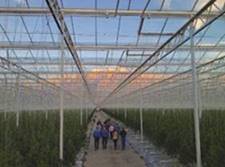
There is a commercial tomato greenhouse at the
Currant Creek plant. It produces 22
million lbs of tomatoes per year. It uses
heat and CO2 from the power generator
but also is recovering a significant amount of
water from the flue gas (derived from hydrogen
in the fuel). The grower operates another
plant in California and is building one in
Canada. These plants each use two 4 MW gas
engines to provide the electricity, heat, light,
and CO2. Their energy
efficiency is greater than 80 percent.
However, the produce grows up to 40 percent
faster because of the CO2. Therefore
you can make a good case that the gas engines
are more than 100 percent efficient and
therefore are better than wind or solar.
This case is even stronger when the grower uses
biogas from the produce waste to fuel the
engines. The recovery of water from the exhaust
at Currant Creek creates another ponder able.
McIlvaine has a common metric to measure the
harm from CO2 vs. the recovery of
water in an arid area. 10 tons of
recovered water is worth 1 ton of CO2.
Therefore further quantification of the water
recovery is important.
Much of the area in which the Berkshire plants
are located is arid and sunny. Many
experts are predicting a huge future for indoor
agriculture with gas engines burning low cost
natural gas or biogas. These engines will
operate 24-7 unlike wind and solar. Data centers
are investing in emergency engines to provide up
to 6 percent of all the energy potentially
consumed in the region. They could invest
in NOx control equipment and switch
to standby service. Should gas engines be a
bigger part of the fleet? Presently the long
range plans for PacifiCorp only include a
fractional percent of energy from this source.
The “wise crowd” of Berkshire people along with
experts from the supplier and consulting
companies will have a unique tool to help make
better combustion, flow control and treatment
decisions throughout the organization. The
long range plan is to provide the custom
websites for all the major utility generators
throughout the world. Since these are offered
free of charge the challenge is not obtaining
the utility buy in but in the funding from the
supplier community who will benefit from the
customer interface and the mechanism to
demonstrate that their products will result in
the lowest total cost of ownership (TCO).
PacifiCorp NOx Project is just One
Step along the Way to the New Decision Making
Approach
Five webinars have been conducted for PacifiCorp
to help them with their decisions on NOx
removal at four units installed at Hunter &
Huntington. It looks as though the
solution will involve:
•
Combustion modifications
•
Optimization
•
SNCR with urea or urea and H2O2
•
In duct SCR
•
Ozone /H2O2 injection
prior to the scrubber
Ian Andrews of PacifiCorp believes that the
series of five webinars have set the stage for a
number of individual discussions with vendors
and for selection of technologies to test at a 5
MW test facility.
The in-duct SCR and the optimization options
have been reviewed with multiple vendors in the
webinars and PacifiCorp is pursuing discussions
with individual vendors. It is very likely that
a test facility will be set up to test the ozone
injection ahead of the scrubber.
A deeper dive into wastewater ramifications of
NOx reagents uncovered concerns about
SO2 removal in a lime-based system. H2O2
is being proposed for PacifiCorp. It could be
added along with urea in the boiler for NOx
reduction. It is being proposed along with ozone
to oxidize NOx ahead of the
scrubber. Both processes may generate unreacted
NO2. This unreacted NO2
apparently can reduce sulfite ions and lower SO2
capture.
Solutions include adding additional chemicals in
the scrubber. Dibasic acid (DBA) is used with
some limestone systems and does raise pH. Adding
dolomite (magnesium lime) is another potential
solution. On the other hand, it would seem that
the NO2 will be converted to N2O5
with ozone injection. The N2O5
may also affect SO2 capture and
therefore dictate some chemical to raise pH.
Marsulex
supplied the scrubber,
Graymont supplies the lime.
AECOM is
the licensee for the ozone injection system
designed by
Linde.
PeroxyChem,
Solvay, and
U.S.
Peroxide offer the H2O2.
Invista offers DBA.
Nalco,
GE
Betz and
Solenis are all involved with chemical
additions in the boiler and for wastewater
treatment. They may have insights. McIlvaine
encourages input from these companies and others
who can contribute to this analysis.
There is a concern regarding a visible plume
which can be created from H2O2
additions. The three peroxide suppliers can
adequately address this question.
There were a number of valuable discussions that
are more applicable to other plants than
to Hunter and Huntington. The air pre-heater is
affected by whichever NOx control
option is selected. The potential for ABS
fouling can be reduced by sorbent injection
ahead of the air heater. If catalytic filters
are selected, there would be major air heater
changes. Catalytic baskets, according to
Arvos
are not an attractive option because of the need
to periodically wash the air heater internals.
The present discharge temperature from the air
heater is 275°F. A
Hamon
baghouse with low pressure high volume cleaning
is installed at each of the four units.
F.L
Smidth has a catalytic filter bag which
can operate at 400°F at high efficiency but at
275°F it would have low efficiency and there
would be concern about ABS plugging. Hamon is
investigating a new catalytic bag design which
would operate efficiently at the 275°F
temperature. However, this is still in R&D
development. Hamon has offered to supply a
pilot unit to determine the efficacy of this
option.
Because PacifiCorp already has downstream
scrubbers, the dry sorbent injection (DSI)
combined with catalytic filtration is not
attractive. However, a catalytic filter with 33
foot long bags operating at 400°F is now
operating successfully at a European cement
plant. This opens the door for several
combinations of technologies.
One option includes a two-stage heat recovery
system (similar to a HRSG). The rotary air pre-
heater reduces the temperature to 450°F. The
fiberglass catalytic filter baghouse with DSI
removes the particulate, mercury and acid gases
while reducing the NOx. A second heat
exchanger extracts the heat from the clean hot
gas and discharges flue gas at 150°F. The
capital cost of this system would be much lower
than the separate SCR, baghouse, and wet
scrubber combination.
Another option for new plants is to use ceramic
elements at 850°F for DSI and catalytic
filtration. A new air heater design, taking
advantage of the clean gas condition, would be
more efficient and would eliminate in-leakage
which is typically 10 percent. Flue gas would be
discharged at 150°F. The ID fans would utilize
less energy due to the lower gas volume. The
problem with this approach is that mercury
removal is not going to be high due to the 850°F
injection temperature. W.L.
Gore is installing their mercury removal
module down stream of scrubbers and could insert
their module in the exhaust duct after the heat
exchange.
The PacifiCorp NOx project
demonstration is being expanded to other
subjects and other companies.
Huntington Power Plant of PacifiCorp has been
sued for Water Contamination
A coalition of environmental groups launched a
lawsuit against PacifiCorp over coal ash
disposal practices at
Rocky
Mountain Power's
Huntington power plant, asserting liquid and
solid wastes are contaminating surface water and
groundwater.
The suit filed in U.S. District Court for Utah
asks that PacifiCorp be forced to prevent
further contamination of Huntington Creek and
surrounding areas by capping the waste,
preventing groundwater from reaching Huntington
Creek and restoring the stream to its natural
state.
Rocky Mountain Power, which is a unit of
PacifiCorp, and the
Sierra Club,
HEAL
Utah and
Public Justice have been in talks for a
couple of months over the disposal methods for
coal ash — a byproduct of coal combustion — but
the groups could not come to any resolution.
Dave Eskelsen, a spokesman for Rocky Mountain
Power, said the lawsuit is baseless and the
Huntington power plant is in compliance with
environmental regulations and all permits.
"Wastewater is stored in a clay-lined
evaporation pond throughout the year and is used
to irrigate the Research Pond from April through
November. Irrigation water is applied at a rate
to minimize surface water runoff and
infiltration into groundwater.
The bedrock at the plant site is Mancos Shale,
which contains large amounts of soluble salts
that leach into ground and surface water.
Precipitation falling on the site dissolves more
soluble minerals from the Mancos Shale the
longer it has been in contact with the
formation. As a result groundwater quality
varies considerably making it difficult or
impossible to distinguish between
naturally-occurring changes in water quality
from changes due to activities and facilities
related to the power plant.
Ground water in the alluvial aquifer under the
Research Farm is of limited extent and generally
poor quality, except in wells adjacent to
Huntington Creek. Monitoring data since the late
1970s shows that land applications of wastewater
has not significantly affected ground water
quality. A new set of ground water monitor wells
was installed in 1997 and has been sampled
semi-annually since then. By design, protection
levels are a fraction of the ground water
quality standard to provide an early warning of
impending ground water contamination and if
necessary, implement corrective actions.
To evaluate whether PacifiCorp’s activities are
affecting water quality in Huntington Creek,
surface water is sampled in Huntington Creek
above and below PacifiCorp’s facilities. Surface
water quality standards must be met at the
downstream monitoring point.
Eskelsen continued, “These groups probably don’t
understand that there has been research
conducted at those farms by
Utah
State University in the utilization of
processed water in this way. The irrigation
process is closely monitored so the application
of water is completely used.”
“We are not in violation of any laws under our
federal and state permits,” he concluded.
Coalstrip Owners including PacifiCorp agree to
stop discharging Scrubber Wastewater
The owners of the Coalstrip power plant in
southeastern Montana signed an agreement in July
to stop pouring coal sludge and other liquid
waste into storage ponds.
The agreement between
Talen
Energy, which represents the six
Coalstrip owners and three environmental groups,
is the latest development for the Coalstrip
Steam Electric Station, the second-largest
coal-fired power plant west of the Mississippi
River that has come under increasing market and
regulatory pressure. Earlier this month, the
plant’s owners agreed to shut down its two older
units by 2022 in a proposed settlement filed in
a separate lawsuit.
The new settlement calls for Coalstrip’s two
newer units to convert to a non-liquid disposal
system for its bottom ash by 2018 and for its
scrubber sludge by 2022. Bottom ash is sluiced
with water and disposed of in the ash ponds
outside the plant, The other types of liquids
that go to the ponds include scrubber sludge.
Under the agreement,
the Coalstrip owners will convert to a
“non-liquid” disposal system for CCR material
generated by Coalstrip Units 3 and 4’s
scrubbers, which is deposited in the effluent
holding ponds for Units 3 and 4 (the “Units 3
and 4 EHP”),
no later than July 1, 2022.
Wyodak replaces ACC and selects Pall Filters
This coal-fired power plant used air cooled
condensers which caused problems with the
condensate. In 2011 PacifiCorp purchased
Pall
20 micron filters for the full flow. The
question posed at the time was whether it would
be worthwhile to use more efficient filters e.g.
10 micron or 6 micron. Five years have now
passed since this presentation at the 2011 ACC
users group. What is the current status and
experience?
This 365 MW
coal-fired power plant in Gillette, Wyoming
operates with a 1,800 psi throttle pressure. The
fuel is Pulverized Powder River Basin Coal.
The
original ACC was GEA and replaced in 2011 with
an
SPX design.
Joy
Niro dry scrubbers and
Hamon
fabric filters are installed.
B&W
provided a low NOx burner upgrade in
2011.The steam turbine was supplied by
GE.
Gary Hoffman – PacifiCorp and Pat Caton – AEC
Power Flow presented information on their
selection of a filter for full flow condensate
filtration at the
3rd Air-Cooled Condenser User Group Meeting
on September 20, 2011
In 2011 after 33
years of service, the air-cooled condenser was
replaced. High turbine back-pressure due to
severe in-leakage provided adequate
justification for replacement. (18,000+ MW/hr.
lost in 2010 due to high ambient temperatures).
Before
Replacement:
-
Air in-leakage
pegs the meter (> 30 scfm)
-
Always running
with both air ejectors in service
-
Condensate pump
discharge dissolved oxygen often > 200 ppb,
almost always > 100 ppb
After
Replacement:
-
Air in-leakage @
9 scfm with one ejector in service
• (Note: steam
duct from LP turbine to the ACC was not
replaced with the ACC. Several expansion joints
on the line supplying the ACC are likely
leaking)
-
Condensate pump
discharge dissolved oxygen most always less than
100 ppb and often less than 40 ppb – still a
major concern!
Experience at
Currant Creek plant (Mona, UT) was negative
relative to string wound filters.
-
178 string-wound
Cuno filters
-
In service for 1
year with no real increase in pressure drop.
This suggests significant bypassing with
string-wound filter.
-
Filters
always in service
-
1,000 ppm
chromium on filtrate analysis
-
Normal air
in-leakage at 30 acfm
So the decision
was to choose a high efficiency filter. Pall
high flow filters were selected.
Vessel design
code: ASME VIII DIV 1 “U” STAMP
– Flow rate:
5,500 gpm
– Operating
pressure: 450 psig
– Filtration:
Beta X(c) = 5,000
– Calculated
clean element pressure drop: 0.608 psig
– Calculated
vessel pressure drop: < 5 psig
– Bypass
automatically opens at a pressure drop of 50
psig
– Installed
downstream of condensate pump and upstream of
5th point feedwater heater
(1st LP heater).
Condensate
filtration package consists of 1 vessel with 19
pleated filter elements, isolation valves,
by-pass piping w/isolation valve, drain valves,
DP transmitter and NEMA 4 control panel. All
components are mounted on a structural steel
frame.
– Vessel inlet
and outlet port isolation valves are butterfly
valves with a manual handwheel / gearbox
operator. These valves are used for positive
isolation of the vessel from the condensate
system when element changeout is required.
– Isolation
valve in the by-pass loop is also a butterfly
valve with a pneumatic actuated, spring return
operator. The operator uses a solenoid valve for
pilot control of the main actuator piston. The
solenoid valve receives an output signal from a
PLC in the control panel, based on an input
signal from the differential pressure
transmitter.
– The by-pass
loop is included to provide uninterrupted flow
when elements need to be changed. By-pass loop
can handle full system flow. No operator
intervention is required to move into the
by-pass mode. At Wyodak, the switchover to
bypass mode happens at 50 psid across the
filter. Local alarming is available to alert
operations of the need to change filters.
The conclusions
were that:
–
Filter
installation has been very effective at removing
suspended iron.
–
Additional
testing is recommended to quantify current iron
transport.
–
Better removal
is available with 10μ or 6μ filter; however, the
cost of element replacement suggests using 20μ
elements
This system has
now been operating for five years. What is the
latest experience? Are the 20 micron rated
filters still considered to be the best economic
choice?
PacifiCorp plans
unveiled in 2014 Analysis
A number of Pacific plants need to install SCR.
The 2014 plan lists specific timetables.
Litigation has changed some of these plans in
the interim and we need to determine the latest
status but this has the information in one place
and is a valuable reference. You will find the
full text in the PPAQD Decisions intelligence
System.
The
Environmental Protection Agency (EPA)
partially approved and partially rejected the
Wyoming Regional Haze state implementation plan
(SIP) and issued a federal implementation plan
(FIP) to cover those areas of SIP disapproval in
January 2014. This action established compliance
requirements and schedules for specific Wyoming
coal units under the Regional Haze program,
including a requirement for installation of
selective catalytic reduction (SCR) at Wyodak by
early March 2019.
In
March 2011, the state of Arizona submitted its
Regional Haze state implementation plan (SIP) to
the Environmental Protection Agency (EPA) for
review. The SIP requires currently installed low
NOx burners (LNB) as best available
retrofit technology (BART) for NOx
emissions at Cholla Unit 4. By final rule dated
December 5, 2012, EPA disapproved portions of
the Arizona Regional Haze SIP and issued a
federal implementation plan (FIP). The FIP
requires, among other things, installation of
selective catalytic reduction (SCR) on Cholla
Unit 4 by January 4, 2018. The FIP also
institutes an averaged NOx emissions
rate of 0.055 lb/MMBtu for Cholla Units 2, 3 and
4. In January and February 2013, PacifiCorp, the
state of Arizona and other Arizona utilities
filed separate appeals of EPA’s FIP with the
U.S. Ninth Circuit Court of Appeals.
Ultimately, EPA’s final determination requires
installation of the following NOx and
PM controls at PacifiCorp facilities:
SCR
equipment and a baghouse at Naughton Unit 3 by
December 31, 2014; SCR equipment at Jim Bridger
Unit 3 by December 31, 2015; SCR equipment at
Jim Bridger Unit 4
by December 31,
2016; SCR equipment at Jim Bridger Unit 1 by
December 31, 2022; SCR equipment at Jim Bridger
Unit 2 by December 31, 2021; SCR within five
years or a commitment to shut down in 2027 at
Dave Johnston Unit 3; and SCR at Wyodak within 5
years. With respect to Naughton Unit 3, EPA
indicated its support for the conversion of the
unit to natural gas and that it would expedite
action relative to consideration of the gas
conversion once the state of Wyoming submitted
the requisite SIP amendment. The EPA action
became final on March 3, 2014.
Mercury:
The Company believes its emission
reduction projects completed to date or
currently permitted or planned for installation,
including the scrubbers, baghouses and
electrostatic precipitators required under other
EPA requirements, are consistent with achieving
the MATS requirements and will support
PacifiCorp’s ability to comply with the final
standards for acid gases and non-mercury
metallic hazardous air pollutants. PacifiCorp
will be required to take additional actions to
reduce mercury emissions through the
installation of controls or use of sorbent
injection at certain of its coal-fueled
generating facilities and otherwise comply with
the standards.
Energy-saving
Projects at Washington Plants
PacifiCorp Energy has seven generation
facilities in their fleet that provide
electricity to the
State of Washington. These units vary from coal‐fired
to natural gas to wind. The State of
Washington has recently passed legislation
requiring PacifiCorp to complete all cost
effective
energy efficiency measures in these generation
facilities.
The purpose of this 2011 report was to outline
the systems investigated and detail the cost
effective measures at three of the seven
locations: Jim Bridger (Unit #1 only), Chehalis
and Goodnoe Hills.
This 2011 report is displayed in full in
the PPAQD intelligence system.
One
of the biggest potential improvements at the
time of the report was adding VFD to pumps and
fans. For example, VFD could be installed at Jim
Bridger for RO feed and condensate pumps. This
system consists of three RO system trains; A, B
and C. Trains A and B utilize
three 60 HP RO feed pumps and train C has two 75
HP pumps. Trains A and B use a discharge
control valve to deliver about 270 gpm of
filtered water to the RO membranes. During
normal
operation two of the three trains are in
operation. When Trains A and B are in operation
only 2
of the three pumps are needed. Train C only
needs one of two pumps to operate.
Proposed: RO feed pumps on Trains A and B should
be upgraded with VFDs and controls to
vary pump speed to deliver the required flow to
the RO membranes. This measure would add the
following equipment:
•
Six 60 HP pump VFDs
•
VFD controls
Condensate Pumps
Baseline:
The condensate pump system consists of three 700
HP 7,200 volt pumps that transport
condensate from the discharge of the main
turbine to the Deaerator (DA) tank.
During normal operation two of the three pumps
are needed to maintain the tank level in the
DA tank. Two parallel discharge control
valves are modulated to the desired DA tank
level,
Proposed: The proposed changes would install new
inverter rated motors with VFDs and
necessary controls to regulate the pump speed.
The pump speed will be varied to maintain the
DA tank level. The existing control valves
should be fully opened during normal operation.
This measure would add the following equipment:
•
Three 700 HP 7,200 volt pump VFDs
•
Three 700 HP 7,200 volt inverter duty motors
•
VFD controls
Forced Draft Fans
Baseline:
This system consists of two 2,250 HP 7,200 volt
centrifugal fans that operate in parallel
to provide secondary and overfire combustion air
to the boiler. Capacity control is
achieved by variable inlet vanes. The fans
maintain a static pressure of approximately 16
in WC in the duct. Both fans are needed
during normal operation.
Proposed: The proposed ECM is to install new
7,200 volt inverter duty motors and VFDs with
controls. The existing inlet vane dampers should
be removed and speed control used to meet the
required flow and pressure based on unit load.
This measure would add the following equipment:
•
Two 2,250 HP invertor duty 7,200 volt motors
•
Two correctly sized VFDs
•
VFD controls
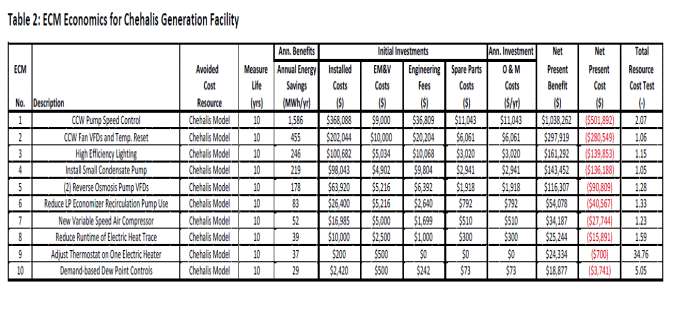
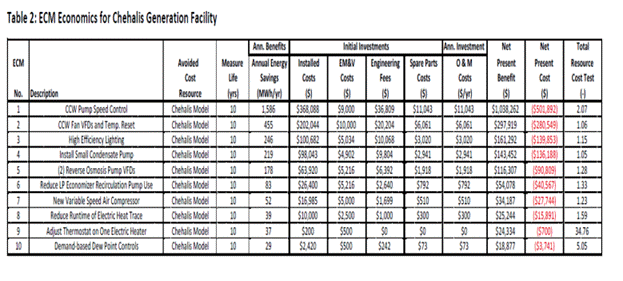
Other pumps and
fans were included. The investments and savings
are shown below.
Also
included is the analysis for the 520 MW gas
turbine combined cycle power plant located in
Chehalis.
Chemicals used at PacifiCorp Wyoming plants are
identified
A tax dispute resulted in this analysis of
chemicals used in the boiler, water treatment,
cooling, scrubbers and wastewater at four
Wyoming plants. At Jim Bridger and Naughton
sodium bicarbonate is used as the scrubbing
reagent.
At Dave Johnston and Wyodak limestone is
the reagent. Since Wyodak uses an air cooled
condenser its chemical usage is less than the
other three plants which use evaporative
cooling.
PacifiCorp Activities to Receive Special
Coverage in GTRE Decisions
McIlvaine
has been conducting a series of five webinars
for PacifiCorp to help them with their decisions
on NOx control at coal-fired power
plants. The webinars are organized around the
information which is gathered for Power Plant
Air Quality Decisions. This effort is
being expanded to cover activities at all the
PacifiCorp power plants. The purpose of adding
information on PacifiCorp gas turbine and gas
engine activities is to demonstrate the value of
GTRE Decisions to any power plant
Person to
person communication optimization is just as
challenging as machine to machine. Suppliers and
consultants as well as individuals within
PacifiCorp can benefit from the communication
regarding activities at all the plants.
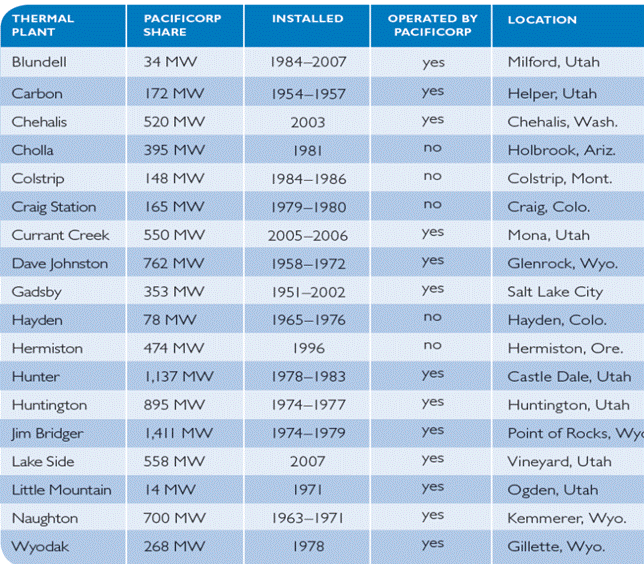
All the newer thermal power plants operated by
the company are fueled with natural gas.
GE Provided Op Flex Optimization Software
at PacifiCorp Currant Creek for $7.8 million.
What was the payback?
An upgrade was supplied several years ago.
We would like to report on the current status
and include options by one and all on the
approach.
The Currant Creek project is a grassroots
525-megawatt natural gas-fired power plant
consisting of a 2 x 1 combined cycle power
block. The plant was constructed in two phases:
Phase 1 consisted of the installation of two GE
7FA combustion turbine generators to operate in
simple cycle mode, and Phase II called for the
installation of two heat recovery steam
generators (HSRGs) and a steam turbine
generator.
The two HRSGs constructed in Phase II were a
10-module tube bundle design. PCL’s work
included installation of the Low Pressure (LP),
Intermediate Pressure (IP), and High Pressure
(HP) steam drums, boiler piping, soot blowers,
platforms, grating, and associated equipment.
PacifiCorp
entered into a sole source contract with General
Electric International to install its Op-Flex
cold day performance package on the Currant
Creek plant. The estimated amount of this
purchase is $7,819,500.
Under the contract General Electric was to
provide three equipment packages designed to
increase the cold weather performance, gas
turbine operational flexibility, increase base
load output, and enhance combustion dynamics
monitoring at the Currant Creek plant. The
“Op-Flex Cold Day Performance” package is
designed to provide increased output and
improved heat rate during cold weather
conditions. The “Op-Flex Turndown” package
provides the ability for plant turndown
(reduction in load) to be reduced from 80% to
70%. This package will result in lower
operating costs, increased low load reliability,
less fuel consumption to stay on line, and
expanded emission compliance. The
“Continuous Dynamics Monitoring” package enables
the first two packages to work.
PacifiCorp said that they had exhausted
competitive alternatives to the engine control
packages offered by General Electric.
These packages can only be provided by General
Electric, the original equipment manufacturer
and owner of the proprietary engine control
system. Payment for the equipment packages
is based on a sliding scale based on
performance. If the unit performance meets
or exceeds the guaranteed performance levels,
payment will be at the level stated above.
If unit performance does not meet the guaranteed
level, the payment is reduced accordingly down
to a minimum level of $319,500.
If you have any contributions to update us on
this, it would be appreciated.
Currant Creek Plant is CHP with Successful
Tomato Growing Operation
The Currant creek plant provides heat and CO2
to a large on site tomato greenhouse. It
involves a large duct providing waste heat and
CO2 as shown in the picture below.
It has been quite successful but one PacifiCorp
source said that in the future the hot water
from the HRSG a smaller duct with just enough
flow to provide the CO2 would be an
even better solution.
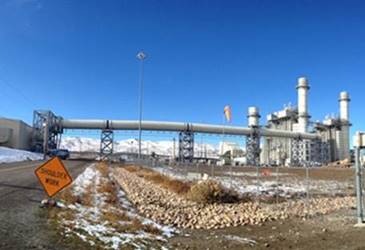
A duct connects Rocky Mountain Power's Currant
Creek Plant with the Houweling’s Tomatoes
greenhouse. The power plant heats the greenhouse
and it provides nutrients and condensed water to
the tomato plants.
The 28-acre Houweling’s Tomatoes greenhouse near
Mona, Utah, is among the first of its kind in
the world to draw its heat and plant-nourishing
carbon dioxide from a neighboring power plant. A
bonus for Houweling’s is the water it condenses
from the flue gas is used to irrigate the tomato
plants.
Brad Richards, manager at Rocky Mountain Power’s
Currant Creek Plant explained, “The manufacturer
of the boiler and stack engineered the
penetration in the stack and determined there
wouldn’t be any issues with our operations or
with our emissions monitoring equipment.”
A plant outage was required to complete
construction of the duct. So Houwelings and
Rocky Mountain Power coordinated the work during
planned maintenance on a weekend in April 2015.
The Houweling’s Tomatoes heat recovery system
inside its boiler building connects to the
10-foot-diameter duct from Currant Creek Plant.
“We’ve been upfront with Houweling’s from the
beginning that our customers are first priority
with everything having to do with safety and
plant operations,” said Ian Andrews, Rocky
Mountain Power resource development director.
“We had to coordinate a phased construction
process to work around the plant’s planned
outage schedule.”
Houweling’s began construction of the
475-foot-long duct from the plant to the
greenhouse in July 2015. The 10-foot-diameter
duct stands 25 to 30 feet above the ground.
“We didn’t expect any effects on plant
performance or reliability, and there haven’t
been any,” Richards reported. “The system is
working well and was designed with very few
changes to our normal operation.”
Using an Argus control system, waste exhaust is
drawn off the side of the stack, diverting it
into Houwelings energy building where thermal
energy is captured and stored for on-demand
heat. Condensation from this process is captured
and used to supplement irrigation water, and the
remaining exhaust CO₂
is released directly into the greenhouse to
promote plant growth. The custom Argus system
controls the equipment that extracts the CO₂
and the heat from the stack gas and sends
signals to and from the power plant, including
general status, alarm points and portions of
dampers, CO₂
demand, boiler status, and temperature and
efficiency readings. The control system also
monitors gas flow and temperature, concentration
of CO and NOx, and controls the condenser fans,
condenser pumps and dampers on this project.
Yurij Duda, Argus Controls General Manager
congratulated Houweling’s on the award:
“Houwelings is a real leader in sustainable
agriculture and is truly committed to innovation
in energy management. Argus was honored to be
selected as their control system partner to help
make this unique project a reality.”
Energy Saving
Projects at Washington Plants
PacifiCorp Energy has seven generation
facilities in their fleet that provide
electricity to the
State of Washington. These units vary from coal‐fired
to natural gas to wind. The State of
Washington has recently passed legislation
requiring PacifiCorp to complete all cost
effective
energy efficiency measures in these generation
facilities.
The purpose of a 2011 report was to outline the
systems investigated and detail the cost
effective measures at three of the seven
locations: Jim Bridger (Unit #1 only), Chehalis
and Goodnoe Hills. This 2011 report is
displayed in full in the PPAQD Intelligence
System.
One of the
biggest potential improvements at the time of
the report was adding VFD to pumps and fans. For
example, VFD could be installed at Jim Bridger
for RO feed and condensate pumps.
This system consists of three RO system trains;
A, B and C. Trains A and B utilize
three 60 HP RO feed pumps and train C has two 75
HP pumps. Trains A and B use a discharge
control valve to deliver about 270 gpm of
filtered water to the RO membranes. During
normal
operation two of the three trains are in
operation. When Trains A and B are in operation
only 2
of the three pumps are needed. Train C only
needs one of two pumps to operate.
Proposed: RO feed pumps on Trains A and B should
be upgraded with VFDs and controls to
vary pump speed to deliver the required flow to
the RO membranes.
This measure would add the following equipment:
·
Six 60 HP pump VFDs
·
VFD controls
Condensate Pumps Baseline: The condensate
pump system consists of three 700 HP 7,200 volt
pumps that transport condensate from the
discharge of the main turbine to the Deaerator
(DA) tank.
During normal operation two of the three pumps
are needed to maintain the tank level in the
DA tank. Two parallel discharge control valves
are modulated to the desired DA tank level.
Proposed: The proposed changes would install new
inverter rated motors with VFDs and
necessary controls to regulate the pump speed.
The pump speed will be varied to maintain the
DA tank level. The existing control valves
should be fully opened during normal operation.
This measure would add the following equipment:
·
Three 700 HP 7,200 volt pump VFDs
·
Three 700 HP 7,200 volt inverter duty motors
·
VFD controls
Forced Draft Fans Baseline: This system
consists of two 2,250 HP 7,200 volt centrifugal
fans that operate in parallel to provide
secondary and overfire combustion air to the
boiler. Capacity control is achieved by
variable inlet vanes. The fans maintain a static
pressure of approximately 16 in WC in the
duct. Both fans are needed during normal
operation.
Proposed: The proposed ECM is to install new
7,200 volt inverter duty motors and VFDs with
controls. The existing inlet vane dampers should
be removed and speed control used to meet the
required flow and pressure based on unit load.
This measure would add the following equipment:
·
Two 2,250 HP invertor duty 7,200 volt motors
·
Two correctly sized VFDs
·
VFD controls
Other pumps and
fans were included. Also included
is the analysis for the 520 MW gas turbine
combined cycle plant located in Chehalis.
Approved gas turbine component supplier list
for PacifiCorp
Preferred vendors based on the
Currant Creek 2 plant are designated. For
example, Cuno is the approved supplier for the
condensate filters. However, in 2011 at Wyodak
the Pall filter was installed to replace the
existing Cuno string wound filters and positive
results such as less iron deposition were
experienced. Has this information been
transferred to those making up bidders’ lists?